
What Are LLM Agents?
An LLM agent is not a smarter chatbot. It is a goal-driven system that uses a language model as its brain, then loops through action and observation until…

Key topics
An LLM agent is not a smarter chatbot. It is a goal-driven system that uses a language model as its brain, then loops through action and observation until the task is done.
Why "Smarter Chatbot" Is the Wrong Mental Model
Ask a plain LLM to research a topic and summarize what it finds, and you will get a confident answer assembled from whatever the model already knows. It will not search the web. It will not check a database. It will not notice that its information is outdated and go looking for something newer. It answers once and stops.
An agent does not stop. Give the same task to an agent, and it can search, read sources, draft a summary, notice gaps, search again, revise, and keep working until the result is good enough.
That difference is not a matter of scale. It is a difference in structure. A chatbot responds to a single prompt in isolation. An agent holds an objective and runs a loop: evaluate the current state, decide what to do next, take an action, observe the result, and repeat until the goal is reached.
Think of it as sense-think-act, repeated. The agent senses where it is, thinks about what step moves it closer to the goal, acts, observes what changed, and decides whether it is done. That looping process is the core mental model. Everything else—memory, tools, planning—exists to make the loop work.
Knowledge check
Check your understanding
Answer this question before you continue.
Watch the Loop in Action
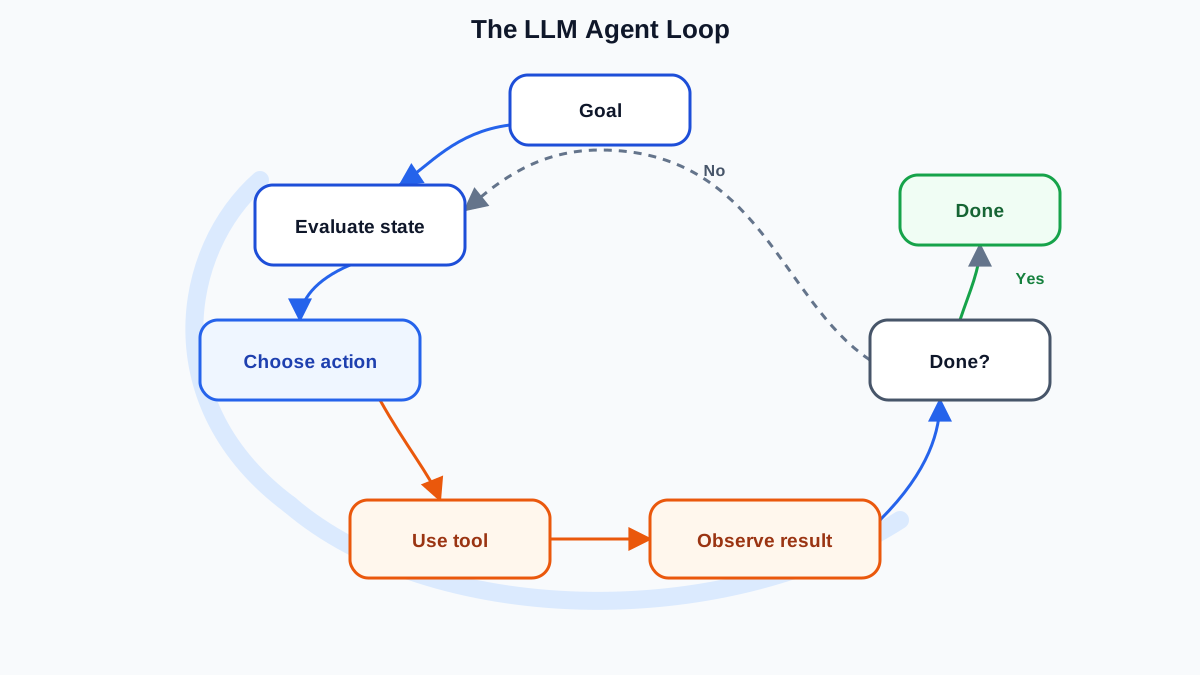
Let's make the loop concrete. Suppose the goal is: "Find out whether the company's revenue grew last quarter, and write a one-paragraph summary."
Here is what an agent might do:
- Decide the first step. The model knows its training data may be outdated, so it chooses to search the web for the company's latest quarterly report.
- Call a tool. The search returns several links, including the official earnings release.
- Observe the result. The agent reads the release and finds the revenue figure.
- Check the goal. It has the number, but it also needs a comparison to the prior quarter. It searches again for last quarter's figure.
- Stop. With both numbers in hand, it writes the summary and ends the loop.
Notice what happened between step 1 and step 4. The agent did not follow a script written in advance. It looked at what the first search returned, realized something was missing, and chose a different next action. That ability to revise its plan based on new information is what separates an agent from a fixed pipeline.
Knowledge check
Check your understanding
Answer this question before you continue.
The Anatomy of an Agent
An agent is built by layering components around a base language model. The LLM alone is not the agent. The surrounding system is what makes it an agent.
Agent core. This is the LLM acting as the coordinator. It interprets the goal, decides which steps to take, and directs the other components. Think of it as the reasoning center that turns a user request into a sequence of actions.
Tools. Tools are how the agent acts on the world. A search API, a calculator, a database connection, a code interpreter—these give the agent capabilities the language model does not have on its own. The LLM can reason about what tool to call, but the tool is what actually fetches data, runs a computation, or changes something.
Planning. Large goals need to be broken into smaller steps. The planning component decomposes a task like "analyze this company's quarterly performance" into sub-tasks: pull the financial data, compare it to last quarter, identify notable changes, and draft the summary.
Memory. The agent needs to remember what it has already done and what it learned along the way. Short-term memory tracks the current task—which steps are complete, what the last tool returned. Longer-term memory can hold information across sessions, like user preferences or past decisions.
Picture the agent core at the center, with arrows connecting it to planning, memory, and tools. The core decides; the other parts execute and report back.
What Is Essential vs. Optional
Here is where beginners often get confused. Planning, memory, and even autonomy sound like mandatory ingredients, but they are really implementation patterns. The essential behavior is the loop: the system can choose an action, observe the result, and choose again.
A fixed workflow with a few tool calls can be agent-like without a separate planning module. "Memory" may simply mean the current task state—what the last search returned—rather than durable storage. And autonomy is a dial, not a switch. Some agents make many decisions on their own; others pause for human approval at key steps.
When you read about agent architectures, treat planning and memory as design choices, not requirements.
Knowledge check
Check your understanding
Answer this question before you continue.
What Agents Can Actually Do (and What They Can't)
Agents shine on tasks that need multiple steps, external information, and iteration. A financial analyst asking about a company's performance might need revenue figures, a comparison to prior years, context from recent news, and a synthesis of all three. That is not a single lookup. It is a workflow with several decisions along the way.
Agents are also useful when there is no single obvious answer. Research tasks, competitive analysis, debugging a problem that requires checking several systems—these benefit from an agent that can gather evidence, evaluate it, and revise its approach.
But agents have real limits, and you should know them before you trust one with anything important.
Agents can hallucinate. The underlying LLM can produce confident nonsense, and the agent will happily build a plan on top of it. Agents can follow bad plans, especially when the goal is vague or the steps are poorly defined. And agents fail when tools return confusing or conflicting results—a search returns nothing useful, an API times out, two sources disagree.
Reliability is the open problem. Agents need guardrails: clear tool boundaries, oversight, and a design that assumes things will go wrong. An agent with too many tools and too few constraints is an agent that can take actions you never intended.
Agent vs. Chatbot vs. RAG: Where the Lines Are
If you have already met retrieval-augmented generation, you have seen one piece of the agent puzzle. RAG adds retrieval so the model can ground its answers in external documents. But a RAG system still answers a question. It does not pursue a multi-step goal.
| Chatbot | RAG | Agent | |
|---|---|---|---|
| Core behavior | Responds to prompts | Retrieves relevant documents, then answers | Chooses actions and iterates toward a goal |
| External data | None (model knowledge only) | Yes, via retrieval | Yes, via tools (retrieval may be one) |
| Multi-step loop | No | No | Yes |
| Decision-making | None | None | Delegated action under tool and approval boundaries |
The practical way to think about it: RAG is a tool an agent might call. When an agent needs to answer a question grounded in your company documents, it can use a retrieval tool as one step in its plan. The retrieval does not make it an agent. The loop does.
Knowledge check
Check your understanding
Answer this question before you continue.
A Simple Way to Think About Building One
You do not need code to understand how an agent is assembled. Start with the goal and work backward.
First, define the goal clearly. "Research this topic" is a start, but "produce a summary with at least three cited sources and a list of open questions" gives the agent something to aim for.
Second, decide which tools the agent genuinely needs. If the task requires current information, it needs search. If it requires math, it needs a calculator. Keep the tool set small and explicit. Every tool you add is another way for the agent to go wrong.
Third, define the loop. What does the agent observe at each step? What actions can it take? When should it stop? A good stopping rule matters as much as a good starting goal. Without one, the agent may keep iterating long after the task is done.
Finally, expect to iterate. Agents fail in visible ways—they call the wrong tool, they misinterpret results, they stop too early. Those failures are not embarrassments. They are the fastest way to learn what the agent needs. Run it, watch where it breaks, and tighten the design.
When an Agent Is Worth It
Here is the decision rule I use: reach for an agent when the path to the goal cannot be fully specified in advance and the system must choose among tools or actions based on what it observes. If the steps and branches are known ahead of time, a fixed workflow is simpler, cheaper, and more reliable. If a single grounded answer will do, a chatbot with RAG is the better choice.
An agent is a system with moving parts, and every moving part can fail. That complexity is worth it only when the task genuinely demands it.
The best way to make this concrete is to try it. Pick a small task that requires current information and several steps—research a topic, compare a few sources, and produce a short brief. Run it through a plain LLM first, then through an agent. But do not compare only the final answers. Watch the process:
- Did the agent fetch current information on its own?
- Which tools did it call, and in what order?
- How did it react when a search returned nothing useful?
- What caused it to stop—a clear stopping rule, or just running out of steam?
- Where did it need human approval or correction?
Answer quality matters, but it is not the definition of an agent. The definition is in the loop: the system chose actions, observed results, and changed course. Watch for that behavior, and the concept will click faster than any definition can teach it.
Knowledge check
Final check
Finish the article by checking the ideas you just learned.
References
Research updated Sep 7, 2026


