
LLM Agents vs Workflows: When Should You Use Each?
You have a task that needs an LLM. The temptation is to reach for an agent—something autonomous, something that "figures it out." But most of the time, a…

Key topics
You have a task that needs an LLM. The temptation is to reach for an agent—something autonomous, something that "figures it out." But most of the time, a workflow will serve you better. The real question isn't which is more advanced. It's who decides the next step: you or the model?
The Real Question Is Who Decides the Next Step
Here's the dividing line: in a workflow, your code owns the overall path and the LLM fills in the steps within it. In an agent, the LLM chooses the next action at runtime based on the tools available and what it observes along the way.
That difference matters more than any other comparison you'll read about LLM agents vs workflows. It changes predictability, cost, debugging, and failure behavior.
The common misconception is that agents are "workflows but smarter." They're not. Agents move decision-making from your code into the model. That's a fundamental shift in control, not an upgrade in intelligence.
Think of it like cooking. A workflow is a fixed recipe: chop, sauté, simmer, serve. You know every step before you start. An agent is a sous-chef who improvises based on what's in the pantry—checking what's available, adjusting the plan, deciding the order of operations as they go.
Here's the anchor test I use with every system I build: Can you draw the task's path before the LLM runs? If yes, you likely want a workflow. If the path depends on what the model discovers mid-task, you likely want an agent.
One important nuance before we go further: a workflow doesn't mean every decision is frozen. Routing, evaluator loops, and orchestrator-workers are all workflow patterns that contain model decisions. The key is that the application defines the surrounding stages, the allowed branches, and the stopping conditions. The model makes bounded choices inside a structure you own.
Knowledge check
Check your understanding
Answer this question before you continue.
Workflows: Bounded Orchestration, Predictable Costs
A workflow is predefined orchestration. You write the sequence: call the LLM, retrieve some context, call the LLM again with that context, validate the output, route it somewhere. The LLM executes within your structure, but your code owns the control flow.
The payoff is real. Each run makes a bounded number of LLM calls. Bugs are reproducible because the path is fixed. Latency and cost are predictable because you know how many model calls each run makes. When something fails, you can trace exactly where and fix it.
Common workflow patterns show up everywhere:
- Prompt chaining: each LLM call processes the previous call's output, useful for tasks broken into verifiable steps.
- Routing: classify an input and send it to a specialized handler—easy questions to a small model, hard ones to a bigger one.
- Parallelization: run multiple LLM calls simultaneously and combine results.
- Orchestrator-workers: a central LLM decomposes a task and delegates subtasks to specialized workers.
- Evaluator-optimizer: one LLM generates, another evaluates, looping until quality criteria are met.
Notice that several of these patterns involve model decisions. A router chooses among handlers. An orchestrator decides how to split a task. An evaluator loop iterates until the output passes. These are still workflows because the application defines the possible paths and the boundaries. The model decides within the graph; it doesn't invent the graph.
A support ticket system is a clear workflow case. Classify the ticket, retrieve relevant records, draft a response, route it for review. Fixed order, testable paths, auditable.
Workflows handle uncertainty poorly when the task's shape genuinely changes based on what the model finds. If the next step depends on an unexpected discovery, a fixed path will fight you.
Knowledge check
Check your understanding
Answer this question before you continue.
Agents: Runtime Decisions for Unpredictable Tasks
An agent is model-directed action selection. The LLM decides which tool to call, in what order, and when the task is done—within the toolset and guidelines you define. You set the boundaries; the model navigates inside them.
Agents shine on open-ended tasks where you cannot enumerate the steps in advance. A research task that branches based on what the agent finds is a classic example. The agent searches, reads results, decides the next query based on what it learned, and keeps going until it has enough to answer.
But let's be honest about the tradeoffs. Agents can make hard-to-predict tool calls. You have less visibility into the reasoning path. Debugging is harder because the path changes between runs. Cost and latency variance go up.
Agents also need a capable model, a well-defined toolset, and guardrails. They are not a shortcut around designing the task. Give an agent too broad a toolset and too little guidance, and you'll get creative—and expensive—behavior.
Note: Autonomy is a spectrum, not a binary. You can bound an agent with an allowlisted toolset, a maximum number of turns, timeouts, and approval gates. Those controls keep it from running wild, but they don't turn it into a workflow. The model still chooses the path within those limits. Likewise, a workflow still needs output validation—fixed orchestration doesn't guarantee correct results.
Knowledge check
Check your understanding
Answer this question before you continue.
Agents vs Workflows: A Side-by-Side Comparison
| Dimension | Workflow | Agent |
|---|---|---|
| Who owns the control structure | Your code | The model at runtime |
| Predictability | High—bounded path and call count | Lower—path varies by run |
| Cost and latency | Bounded and predictable | Variable, needs explicit caps |
| Debuggability | Traceable, reproducible bugs | Harder to trace, path-dependent |
| Best-fit task shape | Known steps, bounded branching | Open-ended, branches on findings |
| Failure mode | Breaks at a known step or produces bad output | Drifts, loops, or calls unexpected tools |
Many real systems blend both. You might build a workflow shell with an agent inside a bounded step, or an agent that calls deterministic tools for specific operations. The choice isn't "simple vs advanced." It's which control structure matches the task's uncertainty.
A Decision Rule for Choosing the Least Complex Approach
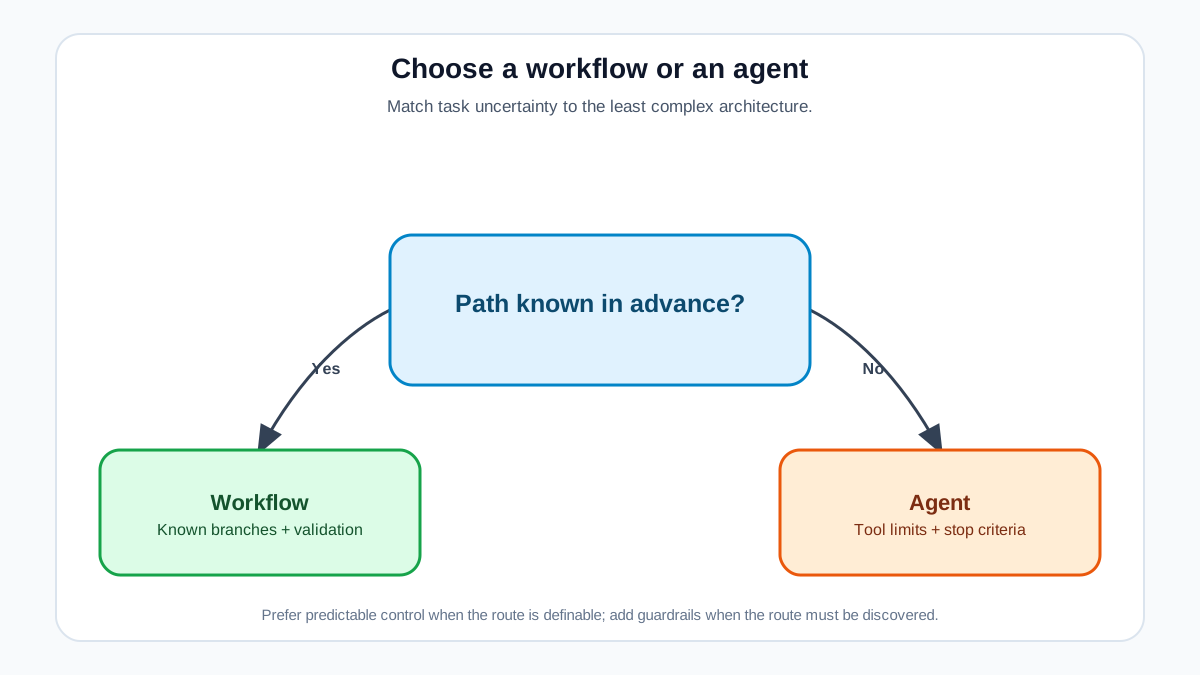
My rule is straightforward: start with the simplest structure that meets the task's uncertainty and control needs. Escalate to an agent only when the workflow cannot express the task.
Walk through this sequence:
- Can you draw the path in advance? Use a workflow. You get testability, predictable costs, and clear failure points.
- Can you bound the branching in advance? This is the subtle step. A router that chooses among three known handlers is still a workflow. The agent threshold is crossed when you can't enumerate the possible next actions—when the model needs to discover the path as it goes.
- Does the task need strict validation, audit, or cost bounds? Prefer a workflow, or constrain the agent with limits on tool calls and clear stopping criteria.
Don't force an agent onto a fixed process. You'll pay for autonomy you don't need. And don't force a workflow onto a genuinely open-ended task. You'll spend more time enumerating branches than the task deserves.
The most common mistake I see is over-engineering: builders reach for agents when a simple chain handles the task. The second most common is under-constraining: giving an agent too broad a toolset and too little guidance, then wondering why costs balloon.
Knowledge check
Check your understanding
Answer this question before you continue.
A Practical Example: Same Task, Two Approaches
Let's make this concrete. A customer asks: "Where's my order, and can I still return it?"
The workflow version: Route the question to a support handler. Retrieve the order record. Check the return policy window. Draft a response that combines both. Send it. Every step is known in advance. Cost is predictable—maybe three or four LLM calls. If the answer is wrong, you can trace which step produced the bad output.
The agent version: The model decides which tools to query and in what order. Maybe it checks the order database first, then the return policy, then the shipping status. Maybe it discovers the order was split into multiple shipments and needs to check each one. The agent adapts based on what it finds.
For this task, I'd choose the workflow. Customer support questions have a known shape. The data sources are predictable. The cost of an agent's flexibility—variable latency, harder debugging, higher cost—doesn't buy much here.
But change the task to "investigate why this customer's orders keep failing and recommend a fix," and the agent starts to earn its keep. The investigation path depends on what you find. The workflow version would force you to enumerate every possible failure branch in advance, which is exactly the kind of brittle system you want to avoid.
The Least Complex Approach That Works
Here's your next step: take one task you're currently building or planning and run it through the flowchart test. Can you draw the path before the LLM runs? If yes, build the workflow. If the path depends on what the model discovers beyond any branching you can define in advance, build the agent—and constrain it well.
The core takeaway is simple: choose the least complex structure that meets your task's uncertainty and control needs. Agents are powerful tools. They're just not the right tool for every job—and knowing when not to use one is what separates a thoughtful builder from someone chasing the shiny new thing.
Knowledge check
Final check
Finish the article by checking the ideas you just learned.
References
Research updated Sep 7, 2026


