
What Is Retrieval-Augmented Generation (RAG)?
Most people assume an LLM knows everything. Ask it about your company's return policy, and it will confidently answer—even if that policy changed last week…

Key topics
Most people assume an LLM knows everything. Ask it about your company's return policy, and it will confidently answer—even if that policy changed last week and the model was trained two years ago. The model isn't lying. It's doing exactly what it was built to do: generating the most plausible answer from knowledge frozen at training time.
RAG fixes this by giving the model something to consult before it speaks.
The Problem RAG Solves
Large language models answer from parametric knowledge—the patterns and facts encoded into their weights during training. That knowledge has a cutoff date. Anything that happened after training simply doesn't exist for the model, no matter how confidently it answers.
This creates three practical gaps:
- Stale information. Ask about a product that shipped after the training cutoff, and the model either guesses or tells you it doesn't exist.
- No access to private data. Your internal docs, customer records, and company policies were never in the public training corpus. The model has never seen them.
- Confident-sounding guesses. When an LLM lacks evidence, it doesn't say "I don't know." It generates the most plausible-sounding answer it can construct. That's what people mean by hallucination—not a malfunction, but a prediction without grounding.
Here's the mental model worth adopting: an LLM is a master of what it already knows, not a window into your data. If the knowledge isn't in the training set, the model is improvising.
Knowledge check
Check your understanding
Answer this question before you continue.
What RAG Actually Means
Retrieval-augmented generation is a technique that lets an LLM pull relevant information from an external knowledge source before generating an answer. The name breaks down cleanly:
- Retrieval finds relevant passages from a body of documents you control.
- Augmented means those passages are added to the prompt as context.
- Generation is the LLM writing an answer grounded in that context.
Think of it as giving the model a working desk. Before it answers, someone places the most relevant documents on the desk. The model reads what's there, then responds. The desk has limited space, so the quality of your answer depends on what you choose to put on it.
The analogy holds where it matters: selection is everything, and irrelevant documents waste valuable attention. It stops being exact if you imagine retrieval as the model "remembering" something. Retrieval isn't memory. It's context injection—temporarily placing evidence in front of the model for this one answer.
Knowledge check
Check your understanding
Answer this question before you continue.
How the RAG Loop Works
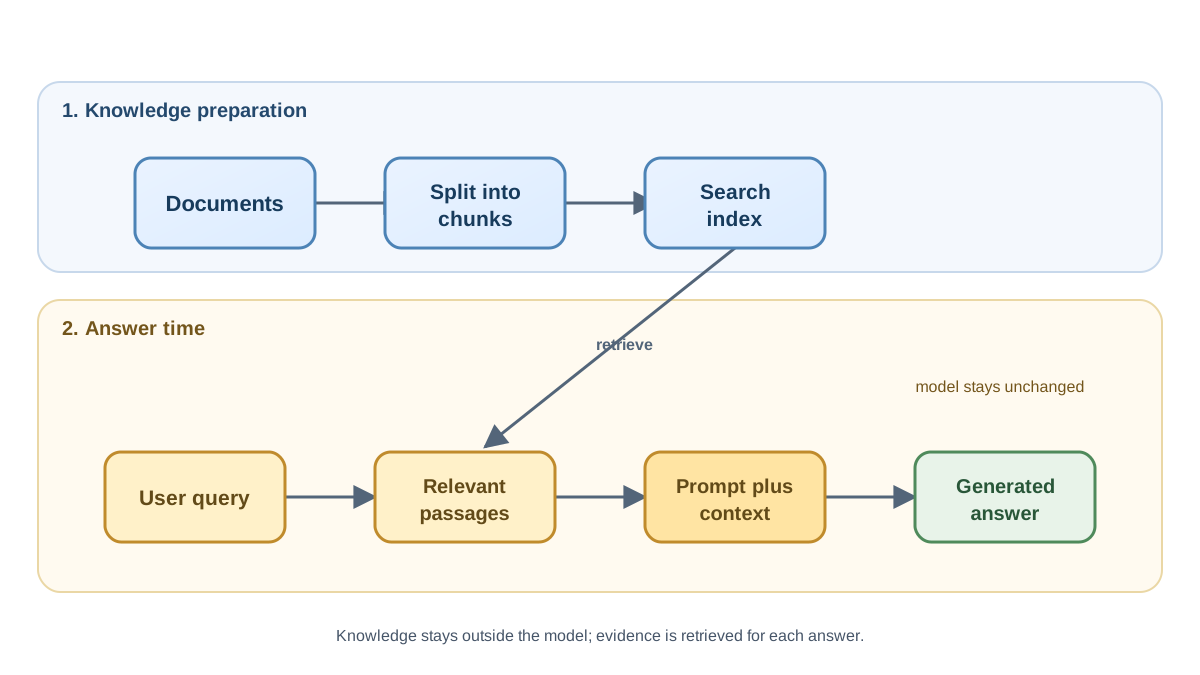
A RAG system has two distinct phases, and keeping them separate in your head matters more than you might think.
Before anyone asks a question, the system prepares its knowledge base. Documents are split into manageable chunks, converted into a searchable form, and stored in an index. Think of this as organizing the filing cabinet before the desk ever gets used.
When a user asks a question, the retrieval step searches that prepared index and pulls out the most relevant passages. Those passages are inserted into the prompt, and the LLM generates an answer grounded in them.
The standard flow looks like this:
- A user query arrives. Someone asks a question.
- The system retrieves relevant passages. It searches the prepared knowledge base for content related to the query.
- The retrieved snippets are inserted into the prompt. The original question is augmented with the retrieved context.
- The LLM generates an answer. It writes a response grounded in those snippets, ideally citing where the information came from.
User query → Retrieve relevant passages → Augmented prompt → Generated answer
The key detail is that the model itself never changes. The knowledge lives outside the model, in a store you control. When your policies change, you update the store—not the model.
That preparation phase matters more than beginners expect. If a document was split poorly or never made it into the index, no retrieval step can find it later. A retrieval failure can begin before the user ever asks the question. The desk can only hold what the filing cabinet contained in the first place.
Knowledge check
Check your understanding
Answer this question before you continue.
Why RAG Beats Retraining for Fresh or Private Knowledge
You might wonder: why not just retrain the model on the new information?
Because retraining is expensive, slow, and permanent. Every time your knowledge changes, you'd need to retrain again. For most organizations, that's not practical—and it's rarely necessary.
RAG keeps knowledge in an external store that you can update at any time. The model stays the same; the evidence changes. That's why RAG has become the default pattern for domain-specific chatbots, internal documentation Q&A, and support assistants. It's also why RAG systems can include citations: the retrieved passages are real documents, so the answer can point back to its source.
This is the crucial distinction between RAG and fine-tuning:
- Fine-tuning changes the model's behavior, style, or reasoning patterns. It's about shaping how the model responds.
- RAG supplies facts. It's about what the model knows at answer time.
They solve different problems—but they're not enemies. If you want a model to adopt a specific tone or follow a particular reasoning format, fine-tuning is the tool. If you want answers that reflect your current documentation, RAG is the tool. Many real systems use both: fine-tune for behavior, then use RAG to feed in fresh evidence at answer time.
Knowledge check
Check your understanding
Answer this question before you continue.
When RAG Is the Right Tool (and When It Is Not)
Use RAG when answers must reflect a specific, current, or private body of knowledge:
- Company documentation and internal policies
- Product manuals and release notes
- Support knowledge bases
- Research repositories that change frequently
Use RAG when you want source attribution—when users should be able to verify where an answer came from.
The decision rule is simple: does external evidence need to influence the answer? If yes, RAG earns its place. That's true even when the task also involves reasoning or writing. A support assistant that must explain a policy in plain language still needs the policy text retrieved first.
Don't use RAG when the question is about general reasoning, creative writing, or tasks that don't need external grounding. If you're asking for a poem or a brainstorming session, retrieval adds nothing.
And be honest about the limits: RAG quality depends on retrieval quality. If the retrieval step pulls the wrong documents, the model will confidently answer from the wrong evidence. Garbage in, grounded garbage out.
Common Beginner Misconceptions
Three mental models trip up beginners more than anything else:
"RAG makes the model smarter." No. RAG gives the model better evidence to work with. The model's reasoning ability is unchanged. A weak model with perfect documents will still reason poorly; a strong model with bad documents will still produce bad answers.
"RAG is the same as a bigger context window." Not quite. A larger context window gives the model more room, but everything in that window competes for attention. RAG selects the most relevant content. A bigger window with irrelevant content is just a bigger desk covered in the wrong papers.
"RAG eliminates hallucinations." RAG reduces hallucinations by grounding answers in evidence, but it doesn't eliminate them. If retrieval returns irrelevant or incorrect passages, the model will happily incorporate them. RAG shifts the failure mode—it doesn't remove it.
Common mistake: Treating RAG as a magic fix for every LLM limitation. RAG is a context-selection system. When an answer goes wrong, your first move should be checking the evidence, not blaming the model.
Your Next Step
Here's a diagnostic habit worth building: when a RAG system gives you a bad answer, inspect the retrieved passages before judging the response. Ask one question—did the retrieved context actually contain the answer?
If the passages don't contain the answer, the retrieval or indexing path failed. The model never had a chance. If the passages do contain the answer but the response is still wrong, then the generation step is the problem.
That single check separates the two failure modes and tells you where to focus. It's the difference between guessing at a system and debugging it.
Once you can spot the difference between retrieved answers and memorized ones, you'll understand why RAG matters—and you'll be ready to build a simple pipeline of your own. That's the natural next direction: taking a small set of documents, setting up retrieval, and watching what changes when the model has evidence to consult.
Knowledge check
Final check
Finish the article by checking the ideas you just learned.
References
Research updated Sep 7, 2026


