
RAG Citations and Grounded Answers: Linking Claims to Evidence
A citation is not proof. It is a pointer — and a pointer is only as trustworthy as the instruction that produced it and the check that verifies it.

Key topics
A citation is not proof. It is a pointer — and a pointer is only as trustworthy as the instruction that produced it and the check that verifies it.
Why a Citation Is Not Proof
Here is the uncomfortable truth about RAG citations: a model can attach a real-looking source number to a claim the source never made. It can quote a real passage that says the opposite of what the sentence claims. And standard retrieval metrics will not catch either failure.
Before we fix the problem, we need to separate two questions that sound alike but are not.
Factuality asks: is this claim true in the world? Grounding asks: is this claim supported by the documents the model was given? A grounded answer can still be wrong if the source itself is wrong. And a true statement can still be ungrounded if the model simply knew it from training and never pointed anywhere.
Now name the two failure modes you are actually fighting:
- A fabricated citation. The marker points to a source that does not exist, was never retrieved, or was never in the context at all.
- A real citation that does not support the claim. The source exists and was retrieved, but the passage says something different — or even the opposite — of what the sentence claims.
Retrieval metrics like recall@k and MRR cannot catch either one. They score whether the right document was retrieved, not whether the generated claim is faithful to it. You can have perfect retrieval and still produce an answer where every citation is decoration.
The design goal, then, is not to make the model cite. It is to make the citation verifiable — an answer users can inspect, where each claim points to evidence they can check.
Knowledge check
Check your understanding
Answer this question before you continue.
Attribution vs. Citation: Two Layers of the Same Idea
You will meet two terms in tooling and documentation, and keeping them straight will save you confusion later.
Attribution is the internal mechanism that ties generated content back to a source. It can be implicit: the model was grounded by the retrieved passages but shows nothing to the user.
Citation is the user-visible presentation of that link. A bracketed number, a link, a highlighted excerpt — that is the citation. The underlying claim-to-chunk mapping is the attribution.
The two can come apart. Attribution can exist without citation: the model answered strictly from the documents but displayed no markers. Citation can exist without real attribution: the marker is decoration, emitted because the model learned that citations tend to appear after claims.
When does the distinction matter? Attribution matters for auditing and debugging — you need to know which passage supported which claim so you can diagnose failures. Citation matters for user trust and inspectability — your users need to see where the answer came from. Build both, but know which layer you are working on when something breaks.
Knowledge check
Check your understanding
Answer this question before you continue.
The Grounded-Answer Flow: From Retrieval to Verifiable Claims
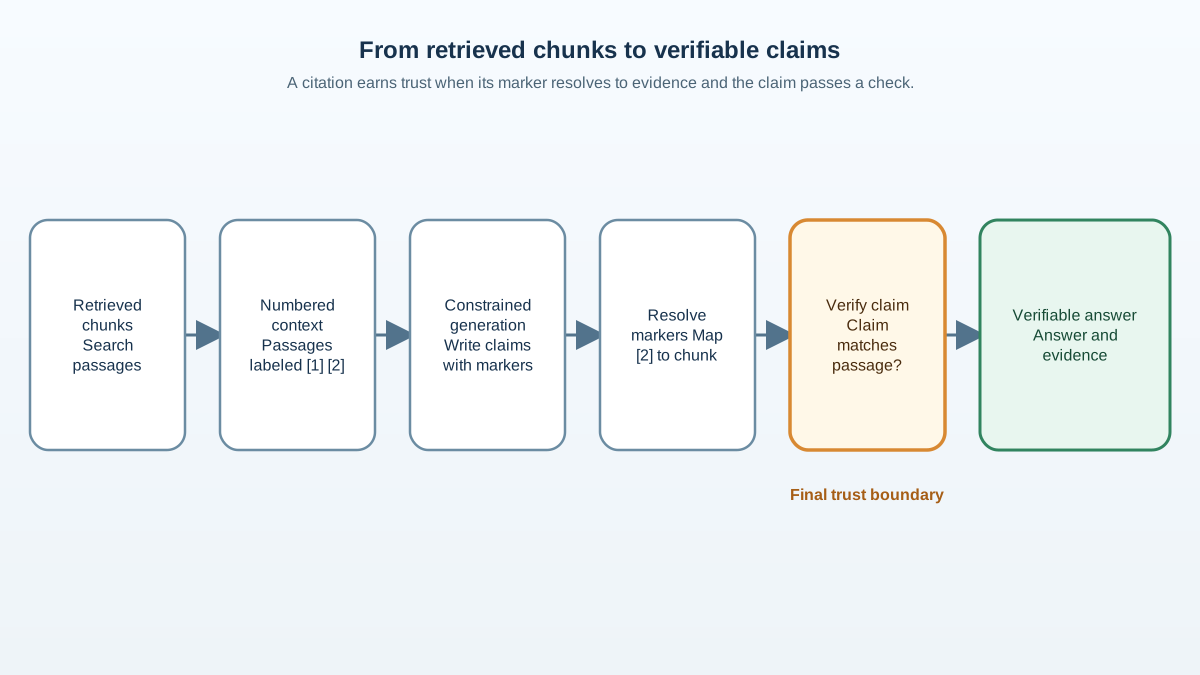
Assume you have already retrieved a set of relevant chunks. Your job now is to turn those chunks into an answer where every claim points at evidence the reader can check. Here is the workflow that produces inspectable answers.
Step 1 — Number the retrieved chunks. Give each chunk a stable identifier so the model has addressable evidence it can point to. Something like [1] (id=chunk_47) followed by the text. The model cannot cite what it cannot reference.
Step 2 — Instruct the model to answer only from the numbered sources. After every factual claim, it should attach the source number in brackets. The instruction matters less than the constraint behind it: the model must treat the numbered list as its entire world.
Step 3 — Add an explicit boundary. Tell the model not to add claims it cannot support with a source number, and to state when the sources are insufficient. This single instruction nudges the model toward acknowledged uncertainty rather than fabricated citations.
Step 4 — Parse the markers and resolve each number. When the response comes back, extract the [N] markers and resolve each one to its chunk_id. The citation becomes a real pointer — not a token the model happened to emit — because you control the mapping between the number and the underlying chunk.
Step 5 — Run a verification pass. Check each claim against its cited passage. This is where you catch the citation that looks right but is not.
The flow looks like this:
retrieval → numbered context → generation with markers → parse and resolve → verification
Every step shapes whether the final citation is trustworthy. Skip the numbering and the model has nothing stable to point at. Skip the boundary instruction and the model will happily synthesize claims it cannot support. Skip verification and you are back to trusting the model's confidence — which is exactly what you are trying to avoid.
Knowledge check
Check your understanding
Answer this question before you continue.
Why Models Produce Plausible-Looking Citations
You might wonder why prompt instructions alone are not enough. The answer is structural, not a simple model mistake.
Citation markers are discrete and symbolic. Language generation is continuous and statistical. The model learns that citations tend to appear after claims, but it does not maintain a perfect lookup table of which source holds which fact during generation. When generation pressure produces a plausible claim, that claim can attract a plausible-sounding citation that is wrong.
Think of it this way: the model is not consulting a database as it writes. It is predicting the next token, and citation markers are just more tokens in the sequence. Under pressure to produce a complete, confident answer, the model can pattern-match its way into a citation that looks right but points nowhere useful.
This is why the verification step is not optional. The model cannot reliably self-audit its own source mapping under generation pressure — it is too close to its own output to see where the link broke.
Verifying That a Citation Actually Supports Its Claim
Verification does not have to be expensive or exotic. Start cheap, then go deeper.
Start with a deterministic quote test. Does the cited text actually appear in the source passage? This catches fabricated quotes at near-zero cost. If the model claims the source says something and the exact words are not there, you have a problem worth flagging.
Move to claim-level support checks. Natural language inference (NLI) classifiers take a claim-evidence pair and return entailment, neutral, or contradiction. An LLM-as-judge does the same thing with a structured scoring prompt — grading the claim against only the cited passage, with no outside knowledge allowed. Both output a per-citation confidence score you can use to flag, suppress, or retry weak citations.
Watch the word-matching trap. A verifier that only counts matching words can be fooled by a source that uses the same terms to say the opposite thing. The source might mention the same entities and still contradict the claim. Support is a semantic judgment, not a vocabulary overlap.
Separate two evaluation questions:
- Faithfulness: does the cited chunk actually support the claim?
- Completeness: are all the important claims cited at all?
Frameworks like RAGAS and TruLens provide automated metrics for both. Run them on a held-out eval set before and after any citation-related change — otherwise you are guessing whether your fix helped or hurt.
Knowledge check
Check your understanding
Answer this question before you continue.
When a Citation Is Present but Not Supportive
Here is the failure mode that will cost you the most trust: grounding looks present, but it is broken. Learn to recognize the telltale signs.
A real quote attached to a claim it contradicts. The source exists, the words are real, but the sentence claims the opposite of what the passage says. This is the most dangerous case because every surface check passes.
A claim synthesized from multiple chunks that no single citation covers. The model drew from three passages, then pinned the result to one source number. The citation is real but incomplete — it cannot support the full claim on its own.
A source marker pointing to a passage that was never retrieved. The number resolves to nothing in the context. The model invented the pointer entirely.
There is also a design trap worth naming: post-hoc attribution. Some systems generate an answer first, then split it into sentences and retrieve a best-match chunk for each one. The retrieved chunk becomes the citation. This works reasonably well, but it is less reliable than generating citations during the response — because the model may have synthesized claims from multiple chunks in ways that are hard to disentangle after the fact.
My rule: if a claim draws on multiple passages, either cite all of them or flag the synthesis explicitly. Do not pin one source to a claim that needed three.
Then build the habit that separates demo-grade citations from answers users can trust. Read the answer as a skeptic. Pick one claim. Open its cited source. Ask whether the passage actually says what the sentence claims. Do this once on an existing RAG answer, and you will see exactly where your system stands.
If the retrieval is solid but the citations still fail, you know the bottleneck is in the generation layer. If the retrieval itself is missing the evidence, no citation design will save you. Fix the layer that is actually broken — and verify that the fix worked before you move on.
Knowledge check
Final check
Finish the article by checking the ideas you just learned.
References
Research updated Sep 7, 2026


