
What Is Prompting?
Prompting is how you tell a large language model what you want—and the first response you get is evidence to learn from, not a final verdict.

Key topics
Prompting is how you tell a large language model what you want—and the first response you get is evidence to learn from, not a final verdict.
Why Your First Prompt Probably Disappointed You
Remember the first time you asked an AI chatbot something? Maybe you typed:
"Tell me about marketing."
And got back a wall of generic text that could apply to any business, any product, and any audience on Earth. Or maybe you asked a factual question and got an answer that was confidently wrong.
That moment is frustrating. It feels like the tool failed you.
Here's what actually happened: large language models don't "know" things the way people do. They don't have a mental database of facts they look up when you ask a question. Instead, they predict the most likely useful sequence of text based on the pattern you gave them. Give them a vague pattern, and they produce a vague response. Give them a clearer pattern, and they can produce something far more useful.
Let me show you what I mean.
Vague prompt: "Summarize this article."
Specific prompt: "Summarize this article in three bullet points. Focus on the practical steps a small business owner could take this week. Keep each bullet under 50 words."
Same article. Same model. Notice the difference: the second prompt tells the model what format to use, what to focus on, and how long the output should be. The result will be more useful—not because the model suddenly knows more, but because you removed the guesswork.
Knowledge check
Check your understanding
Answer this question before you continue.
Prompting, in Plain Terms
A prompt is simply the text you give a language model to start a conversation or request a result. It can be a question, an instruction, a goal, or even a document you paste in and ask the model to work with. There's no rigid formula and no special syntax required. You write in plain language, the way you'd explain a task to a capable colleague.
Think of it like giving directions to someone who has never visited your neighborhood. If you say "come over sometime," they'll show up at the wrong time, possibly the wrong city. If you say "my apartment is the blue building on 5th and Main, unit 3B," they'll find you without a problem. The model isn't being difficult—it genuinely needs details to narrow down what you want.
The analogy has a limit, though. A person has memory, intent, and a lifetime of context they bring to a conversation. A language model has none of that. It doesn't remember you between sessions, it doesn't have hidden knowledge about your situation, and it isn't trying to read between the lines. It predicts the most likely useful continuation of the text you provided. That's the core mechanism—and it's why the details you include matter so much.
You'll sometimes hear the term prompt engineering thrown around. That's just the practice of designing and refining prompts deliberately to get better results. For now, don't worry about the fancy name. Prompting is the everyday act of asking clearly. Prompt engineering is what happens when you get serious about optimizing your requests.
Knowledge check
Check your understanding
Answer this question before you continue.
What a Good Prompt Actually Does
Here's the core insight: the model generates its response based on the pattern and detail in your request. Every piece of information you include narrows the range of possible responses. Every piece you leave out leaves room for the model to guess.
Let's walk through a practical example.
Say you want help summarizing a meeting transcript. Here's a weak prompt:
"Summarize this."
The model doesn't know why you want the summary, who will read it, how long it should be, or what matters to you. So it produces a generic recap that probably misses the point.
Now try this:
"Summarize this meeting transcript for my manager. I need to highlight the decisions we made, the action items with owners, and any risks that came up. Keep it under 200 words and use bullet points."
The model now knows the audience, the goal, the format, and the length. It can filter the transcript for what actually matters instead of guessing.
Notice something important: you don't need any technical skill to write that second prompt. You just need to think about what would help someone do the task well.
Note: A clearer prompt improves relevance, format, and direction. It does not guarantee the answer is factually correct. The model can still misunderstand, omit something important, or generate a confident-sounding error. Treat the response as a draft to check, not a verdict to accept.
Knowledge check
Check your understanding
Answer this question before you continue.
The Loop That Actually Matters
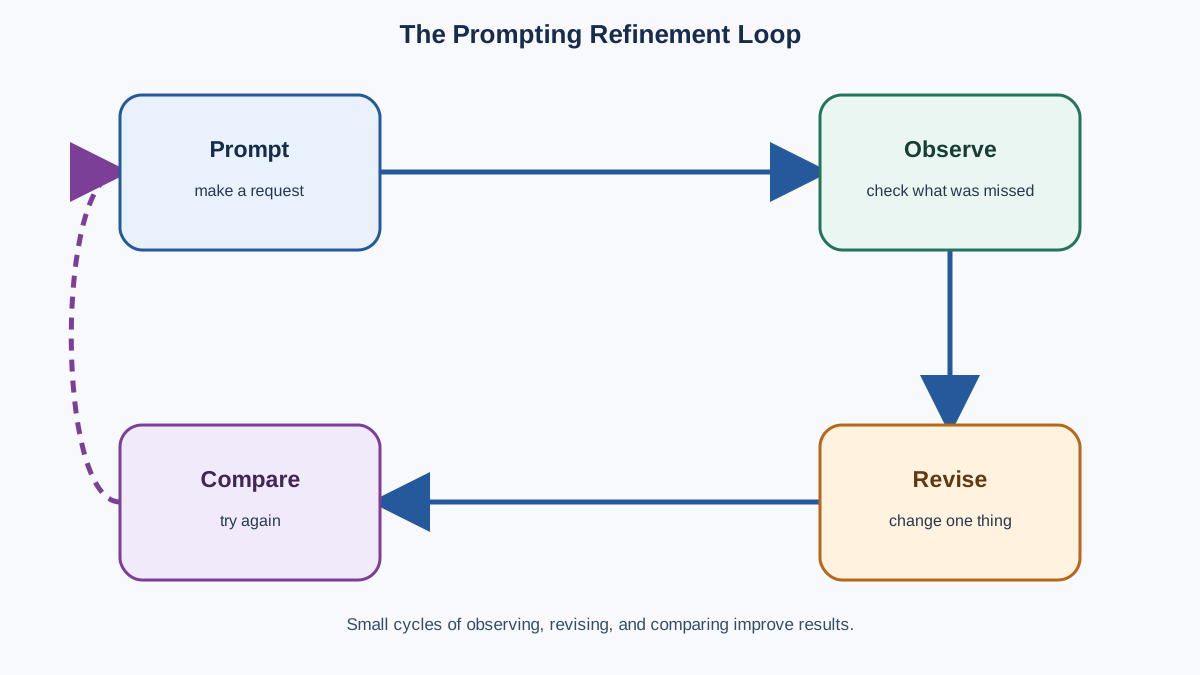
Here's the part most beginners miss: prompting is not a one-shot transaction. It's an iterative loop.
The first response is evidence. Look at what it got right, what it missed, and what it misunderstood. Then change one thing and try again.
If the first answer is too long, say: "That's too long—cut it to five bullets." If it buried the budget discussion, say: "Good, but focus more on the budget discussion." Each follow-up refines the model's understanding. Conversation is part of prompting.
This is the mental model I want you to keep: prompt, observe, revise, compare. You are not hunting for a magic formula. You are running small experiments and learning from the output.
Knowledge check
Check your understanding
Answer this question before you continue.
When Prompting Is Not Enough
Prompting has real limits, and knowing them will save you hours of frustration.
A clearer prompt can tell the model what to do with information—but it cannot supply information the model doesn't have. If you ask about your company's private sales figures, your client's payment history, or today's news, no amount of rewording will produce a reliable answer. The model only knows what it learned during training, plus whatever context you provide in the conversation.
Similarly, prompting cannot make an uncertain answer certain. If the model doesn't know something, it may guess—and it will often sound confident while doing it.
So use prompting to clarify the task, provide context, and shape the output. When you need current data, private information, or verified facts, bring the source material into the conversation yourself. And when the answer matters, check it.
Why Prompting Matters for Beginners
Prompting is the main way anyone controls a language model. Not just programmers—everyone. There's no code to write, no API to configure, no special interface to learn. The skill you need is the ability to communicate clearly about what you want.
That's genuinely good news. It means the barrier to getting useful output from AI tools is lower than almost any other technical skill you could learn.
Let me give you a realistic scenario. Suppose you need to draft an email to a client who's late on payment. A vague prompt like "write an email about a late payment" will produce something generic and probably too aggressive or too soft. A clearer prompt like "Draft a polite but firm email to a client who is 30 days late on an invoice. Remind them of the original due date, mention the late fee in our contract, and offer to set up a payment plan if needed. Keep the tone professional and friendly" gives the model everything it needs to write something you could actually send.
The same principle applies to brainstorming ideas, summarizing documents, planning projects, or explaining a confusing concept. The quality of what you get back tracks how clearly you communicated what you wanted.
I've seen beginners assume prompting is a secret skill that experts guard. It isn't. It's a communication habit, and it's learnable. The fastest way to improve is to experiment: try a prompt, look at the result, figure out what's missing, and try again.
Where Prompting Fits in Your Learning Path
Understanding what an LLM is gives you the foundation. Prompting is the first practical skill you build on top of that foundation. It's the bridge between knowing what these tools are and actually getting them to do useful work.
Later topics will build on this: designing better prompts for specific tasks, working with context and long documents, and using AI tools in real workflows. But every one of those skills rests on the same basic ability—communicating clearly with a system that predicts text.
So here's your next step. Think of a vague prompt you've actually typed before—something like "help me with my resume" or "explain this concept." Rewrite it with a clear goal and a little context. Tell the model who the audience is, what format you want, and what a good outcome looks like. Then run both prompts side by side and compare the answers.
The difference will teach you more about prompting than any article can. That's the whole point: prompting is a skill you build by doing, not by reading. Start with one prompt, make it clearer, and watch what changes.
Knowledge check
Final check
Finish the article by checking the ideas you just learned.
References
Research updated Sep 7, 2026


