
What Is a Large Language Model?
A large language model is a pattern-prediction engine for language: it learns how words and ideas tend to follow one another, then uses that fluency to…

Key topics
A large language model is a pattern-prediction engine for language: it learns how words and ideas tend to follow one another, then uses that fluency to generate text that sounds right—whether or not it is true. That single distinction, fluency versus truth, is the most useful thing to understand before you use one.
Why This Distinction Matters
LLMs power tools you have probably already used: ChatGPT, Claude, Gemini, Microsoft Copilot, and Meta AI. These products can answer questions, help you write, explain code, translate languages, and summarize long documents. That range is why so many people want to understand what sits underneath.
The most common beginner question is whether these models actually "understand" language the way people do. The honest answer is no—and getting that boundary clear early saves you confusion later. An LLM can model relationships in language and use context to produce useful text, but that does not give it awareness, intent, or a built-in way to check whether what it says is true.
Knowledge check
Check your understanding
Answer this question before you continue.
LLM Basics: What Is a Large Language Model?
A large language model (LLM) is a type of AI system trained on enormous amounts of text so it can generate human-like language. During training, it learns statistical patterns in how words and ideas commonly relate to one another, then uses those patterns to predict and produce plausible responses.
In plain terms: an LLM has absorbed a massive amount of text—books, articles, websites, and more—and learned how people put words and sentences together. That is the core of what a large language model is.
LLMs can:
- Answer questions in natural language
- Summarize long texts into shorter versions
- Translate between languages
- Write stories, emails, or code
- Break a larger problem into steps and work through them
Notice that every one of these is a language task. The model is not a general-purpose brain; it is a tool for transforming and generating text.
Here is the middle ground worth holding onto: an LLM can produce useful, step-by-step output that looks like reasoning, and that output can genuinely help you solve problems. But producing a convincing chain of steps is not the same as independently verifying that the answer is correct. The model generates what fits the pattern; it does not check the result against reality. Keep that boundary in mind now, because it becomes your practical rule later.
What Does "Large" Mean in LLM?
The word "large" points at two things:
- The amount of data the model was trained on—huge libraries of text measured in terabytes
- The number of parameters, or learned numerical values inside the model, which often run into the billions or trillions
Analogy: Imagine learning a new language by reading every book in a giant library, plus every article and website you could find. Over time you would notice patterns, common phrases, and how sentences fit together. That is roughly how an LLM learns—except it does this across far more text than any person could read in a lifetime.
Note: "Large" is a relative term. Today's models dwarf the language models of a few years ago, and the scale keeps shifting as the field advances.
Knowledge check
Check your understanding
Answer this question before you continue.
How LLMs Learn: Patterns, Not a Database
LLMs learn through a process called training, where the model is exposed to billions (sometimes trillions) of words collected from books, websites, and other sources. As it processes this text, it adjusts its internal parameters—learned numerical values, not settings you control—to capture patterns in how words and ideas connect.
Here is the key point: training does not store facts the way a database stores records. It shapes the model's internal patterns so that certain sequences of words tend to follow others. That is why an LLM can produce a sentence that reads like a fact even when no such fact was ever stored anywhere.
The result is a system that has absorbed statistical relationships between words and concepts—not a reliable encyclopedia, but a learned sense of what language tends to look like.
Knowledge check
Check your understanding
Answer this question before you continue.
How LLMs Generate Text: A Simple Mental Model
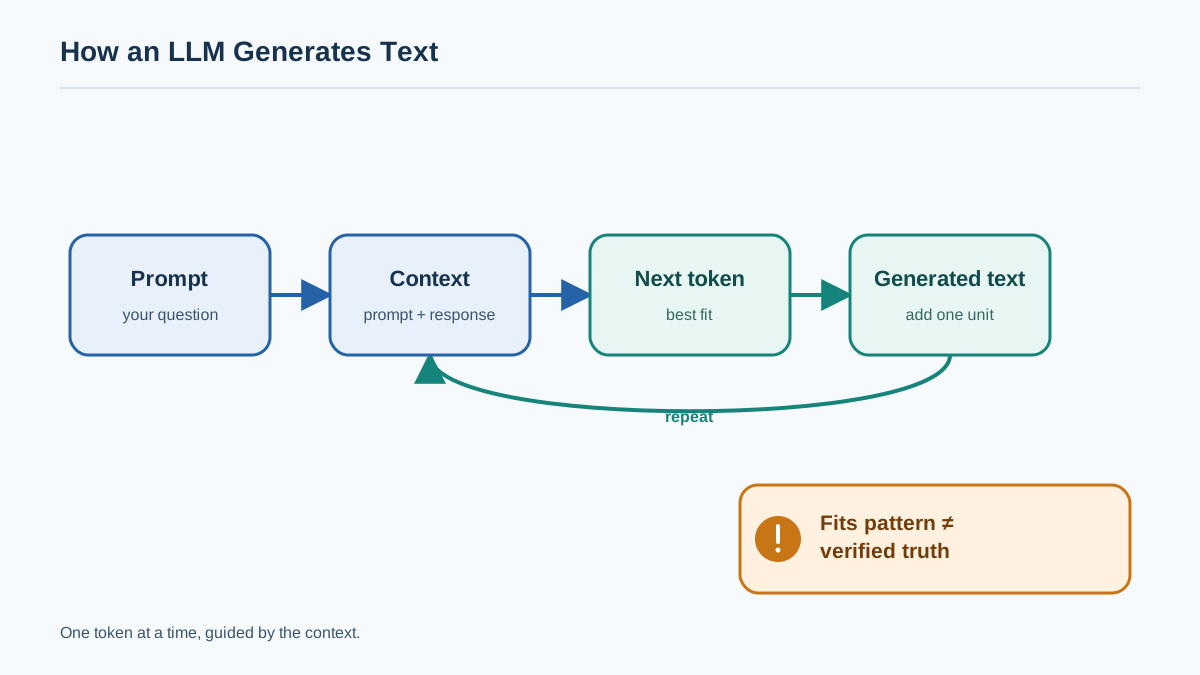
The clearest way to picture an LLM is as a super-powered autocomplete.
When you start typing a message on your phone, your keyboard may suggest the next word. An LLM does something similar, but far more sophisticated. It predicts what comes next based on everything before it, then repeats that process to build a full response.
How it works:
- You give the LLM a prompt—a question or a sentence.
- The LLM looks at the prompt and predicts what comes next.
- It repeats this process, assembling a complete response.
One clarification: saying it predicts "the next word" is a beginner-friendly simplification. Models actually generate smaller text units, often called tokens—chunks that can be whole words, parts of words, or single characters. The idea is the same either way: the model chooses the next unit that best fits the pattern, then moves on.
This single mechanism explains both the model's power and its weakness. Because it predicts what fits the pattern, it can draft, summarize, and brainstorm with remarkable fluency. But it is choosing text that fits, not checking facts against reality.
The autocomplete analogy is accurate for the prediction step, and that is where it stops being exact. An LLM is not just filling in a blank from a short phrase. It processes large amounts of context at once, which is why it can follow a long conversation, transform a whole document, or produce a chain of steps toward a goal. The mechanism is still pattern-based generation—but the patterns are rich enough to produce genuinely useful output, not just shallow word association.
Common mistake: Treating an LLM like a search engine or a database of truth. It is neither. It generates text that looks right based on patterns, which is why its answers need verification.
Knowledge check
Check your understanding
Answer this question before you continue.
Strengths and Limitations of LLMs
LLMs are powerful, but they are not perfect. Here is what they do well—and where they fall short.
Strengths:
- Handle many language tasks quickly
- Versatile across writing, summarizing, translating, and coding
- Available around the clock and can process large amounts of text
Limitations:
- Can give incorrect answers with total confidence
- May reflect biased or inappropriate content learned from real-world data
- Have no awareness or independent common sense
- Can "hallucinate"—make up facts or details that sound correct but are not
The honest framing is not "LLMs can't reason" or "LLMs are always right." It is that their output is generated from learned patterns and is never self-validating. Useful does not mean verified. That is the single most useful boundary to hold in your mind.
Why LLMs Matter
The real leverage of an LLM is that one language interface can serve many text transformations. The same model that drafts an email can summarize a report, translate a paragraph, or explain a concept in simpler words. You do not need a separate tool for each task—you talk to one system in plain language.
That flexibility is why LLMs are changing how people interact with computers. Instead of learning commands or code for every task, you can describe what you want in everyday language and get a useful draft back.
But that same fluency is why you need a trust boundary. Here is a compact rule that follows directly from how the model works:
- Use unaided generation for transformation and ideation—drafting, rewriting, summarizing, brainstorming, translating, explaining.
- Add trusted sources, tools, or human review when correctness matters—current facts, prices, medical or legal claims, citations, or any decision with real consequences.
An LLM is a fast, fluent first pass at almost any text task. It is not the final authority on anything.
Where to Go Next
To deepen this mental model, study how LLMs generate text one token at a time, compare language models with other kinds of AI, and look at the historical path that produced modern LLMs.
The practical takeaway: a large language model is a powerful pattern-prediction engine for language. Use it as a capable assistant that drafts, summarizes, and explores ideas—then verify what matters before you trust it.
Knowledge check
Final check
Finish the article by checking the ideas you just learned.


