
Prompting vs RAG vs Fine-Tuning: Which Changes What?
You keep hearing three answers to the same question: "Just prompt it better." "Add RAG." "Fine-tune the model." They get offered like interchangeable…

Key topics
You keep hearing three answers to the same question: "Just prompt it better." "Add RAG." "Fine-tune the model." They get offered like interchangeable upgrades, as if customization were a ladder you climb from weak to strong. That mental model will cost you time and money.
Prompting, RAG, and fine-tuning are not rungs on one ladder. They are three separate levers that change different parts of the system. Many strong production systems never climb past the first two. The skill that matters is naming your problem first, then picking the lever that actually moves it.
The Three Levers Are Not a Ladder
Here is the weak model most beginners carry: prompting is the cheap option, RAG is the mid-tier upgrade, and fine-tuning is the "real" solution you graduate to. That framing is wrong in a useful way.
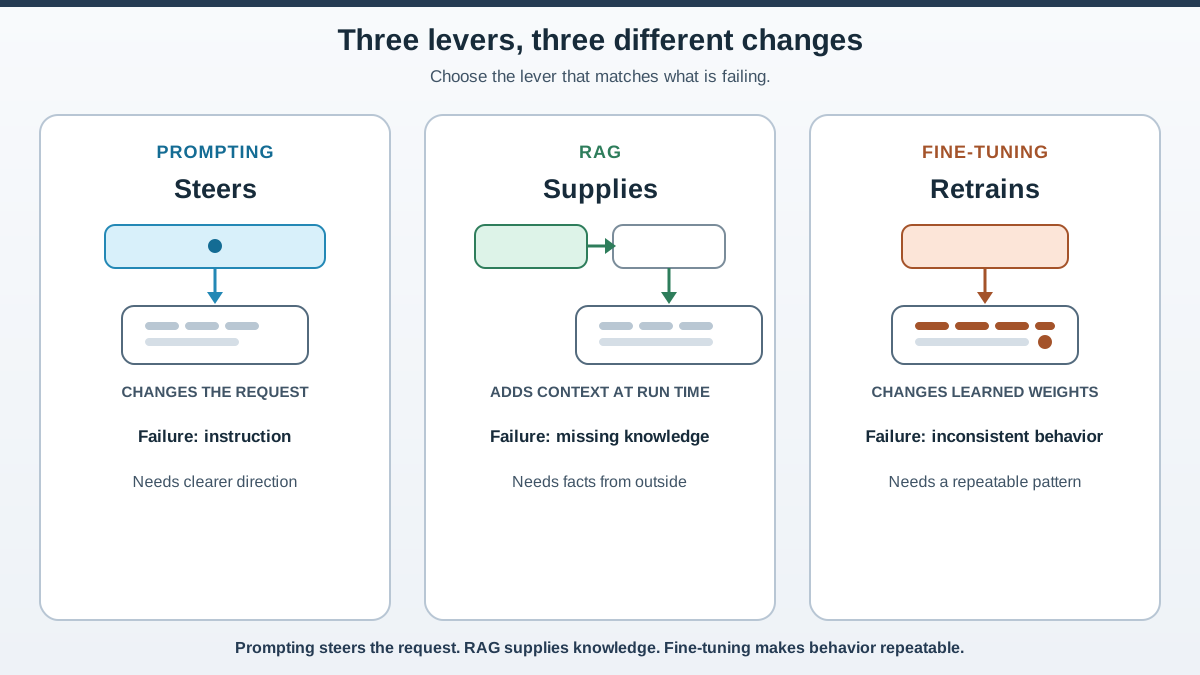
Each approach changes a different part of the system:
- Prompting changes what you say to the model at request time.
- RAG changes what the model can see by adding retrieved context.
- Fine-tuning changes what the model has learned before inference ever begins.
If you have read about the training-versus-inference distinction, this maps directly. Prompting and RAG both operate at inference time. Fine-tuning operates before it, altering the model's weights so the behavior is baked in.
The key insight: fine-tuning does not make a model smarter. It makes behavior more repeatable. RAG supplies knowledge the model never had. Prompting steers what is already there. Those are different jobs, not different levels of the same job.
So the anchor criterion for everything that follows: name the failure mode first, then choose the lever.
Knowledge check
Check your understanding
Answer this question before you continue.
Prompting: Steering What the Model Already Knows
Prompting is the cheapest lever because it changes nothing about the model. You send instructions, examples, and formatting requirements with each request. The model's weights stay untouched.
Prompting is excellent for:
- Instruction-following and task clarity
- Output format and tone
- Giving the model a clear role or constraint
- Few-shot examples that demonstrate the pattern you want
The boundary matters more than the capability. A prompt cannot conjure facts the model never learned during training. If you ask a general-purpose model about your private product details, no amount of clever wording will produce the correct answer. The knowledge simply is not there.
Similarly, prompting cannot reliably fix a model that consistently ignores instructions. If you have written a clear, specific prompt and the model still wanders off-format, the problem is not prompt wording. It is a behavior pattern that prompting cannot pin down.
A concrete example: asking a model to answer in a specific JSON structure usually works with a good prompt. Asking it to know your company's internal pricing tiers does not, because that information lives outside the model.
Use prompting when the model has the knowledge and capability but needs clearer direction.
Do not use prompting when the problem is missing knowledge or a persistent behavior failure. No prompt will fix either.
Knowledge check
Check your understanding
Answer this question before you continue.
RAG: Giving the Model Knowledge It Never Had
Retrieval-augmented generation solves the missing-knowledge problem by changing what the model sees at inference time. Instead of asking the model to recall facts from training, you retrieve relevant documents from an external source and add them to the prompt as context.
RAG is the right lever for:
- Current information that changed after the model's training cutoff
- Private or proprietary documents the model never saw
- Domain facts that shift by region, customer, or time
- Anything where the answer lives outside the model
The classic example is a support bot answering from your latest product documentation. Your docs change every release. The model cannot know what you shipped last week. RAG retrieves the relevant section and hands it to the model as context, so the answer reflects the current source of truth.
The tradeoff is retrieval quality. RAG depends entirely on whether the right document gets found. If the retrieval step misses the relevant chunk, the model answers from whatever it did retrieve—or from nothing at all. A weak retrieval pipeline produces confident wrong answers, and the model gets blamed for a failure that happened upstream.
Use RAG when the problem is missing, changing, or private knowledge that lives outside the model.
Do not use RAG when the model already has the knowledge but behaves inconsistently. Adding more context will not fix a behavior pattern that ignores the context it already has.
Knowledge check
Check your understanding
Answer this question before you continue.
Fine-Tuning: Changing the Model's Behavior Pattern
Fine-tuning updates the model's weights using labeled examples of the behavior you want. After training, the behavior is baked in. You no longer need long instructions or retrieved examples to get the model to act a certain way.
Fine-tuning is the right lever for:
- Consistent output formatting that prompting cannot enforce
- A specific tone or style the model should adopt by default
- A repeated task the model should perform reliably without lengthy instructions
- Domain adaptation where the model needs to internalize a pattern
The correction most beginners need: fine-tuning does not add factual knowledge. It does not increase the model's raw capability. It makes behavior more repeatable. If the model lacks the facts, fine-tuning will not supply them. If the model is too weak for the task, fine-tuning will not make it stronger.
The cost reality is equally important. Fine-tuning requires curated labeled examples, compute for training, and evaluation to confirm the behavior actually changed. It is the slowest and most expensive lever to move. A few hundred high-quality examples often beat thousands of mediocre ones, but you still need the examples, the training run, and the evaluation loop.
A concrete case: if your application must always output JSON matching your exact schema, and prompting consistently fails to enforce it, fine-tuning is a candidate. The model learns your schema as a behavior pattern, not as a fact to recall.
Use fine-tuning when the model has the right context but still behaves inconsistently on a repeated task.
Do not use fine-tuning when the problem is missing knowledge. That is RAG's job. And do not fine-tune before you have a prompt baseline to measure against.
Knowledge check
Check your understanding
Answer this question before you continue.
Side-by-Side: What Each Lever Changes
| Dimension | Prompting | RAG | Fine-Tuning |
|---|---|---|---|
| What changes | Instructions sent with each request | Context the model sees at inference | The model's weights |
| Problem it solves | Unclear instruction or format | Missing or changing knowledge | Repeated behavior patterns |
| Data needed | None | A searchable document store | Curated labeled examples |
| Cost | Low | Medium | High |
| Time to implement | Minutes to hours | Days to weeks | Days to weeks plus training runs |
The behavioral distinction compresses into three verbs: prompting steers, RAG supplies, fine-tuning retrains.
These approaches are not mutually exclusive. A common production pairing uses RAG to supply current facts and fine-tuning to enforce consistent output format. The fine-tuned model gets the right context from retrieval and reliably shapes the answer into the structure your system expects.
A Decision Rule for Choosing Your Lever
When you face a customization decision, resist the urge to start with a favorite technique. Start with a prompt baseline. Write the clearest prompt you can, evaluate the output, and diagnose what still fails.
Then apply the decision sequence:
- Is the problem missing or changing knowledge? The model cannot know your private documents or last week's data. Use RAG.
- Is the problem a repeated behavior pattern? The model has the facts but consistently ignores format, tone, or structure. Consider fine-tuning.
- Is the problem instruction or format? The model understands the task but needs clearer direction. Improve the prompt first.
Three beginner mistakes show up constantly. Fine-tuning to add facts the model lacks—that is RAG's job. Jumping to fine-tuning before building a prompt baseline—you cannot measure improvement without a starting point. Expecting fine-tuning to make the model smarter—it makes behavior repeatable, not capability stronger.
My rule is simple: many production systems stop at prompting plus RAG. Fine-tuning is the extra step only when behavior stays inconsistent even with the right context present.
The Diagnostic Question
Run one question against your own project: what exactly is failing?
If the model gives confident answers about things it cannot know, the failure is missing knowledge. Add RAG.
If the model knows the material but produces inconsistent format, tone, or structure, the failure is behavior. Fine-tune.
If the model seems confused about what you are asking, the failure is instruction. Improve the prompt.
Name the failure mode, and the lever chooses itself. The natural next step is to build a small RAG pipeline or write a prompt baseline for your own use case—then you will have concrete evidence about which lever your problem actually needs.
Knowledge check
Final check
Finish the article by checking the ideas you just learned.
References
Research updated Sep 7, 2026


