
LLMs vs Other AI Models
Someone says "I built an app with NLP" when they really mean "I called the ChatGPT API." Someone else asks "which LLM should I use" when they're actually…

Key topics
Someone says "I built an app with NLP" when they really mean "I called the ChatGPT API." Someone else asks "which LLM should I use" when they're actually choosing between GPT and Claude. The words overlap enough that the confusion is normal—but the distinctions start to matter the moment you pick a tool, read documentation, or explain what you actually built.
Here's the clean version: these terms aren't peers competing for the same slot. They sit on two different axes. One axis is model-category nesting—how AI, machine learning, and LLMs relate as broader and narrower ideas. The other axis is the field-to-tool relationship—how NLP, the decades-old discipline of working with language, relates to the LLMs that emerged from it. Keep those two axes separate, and the vocabulary stops fighting you.
The Two-Axis Mental Model
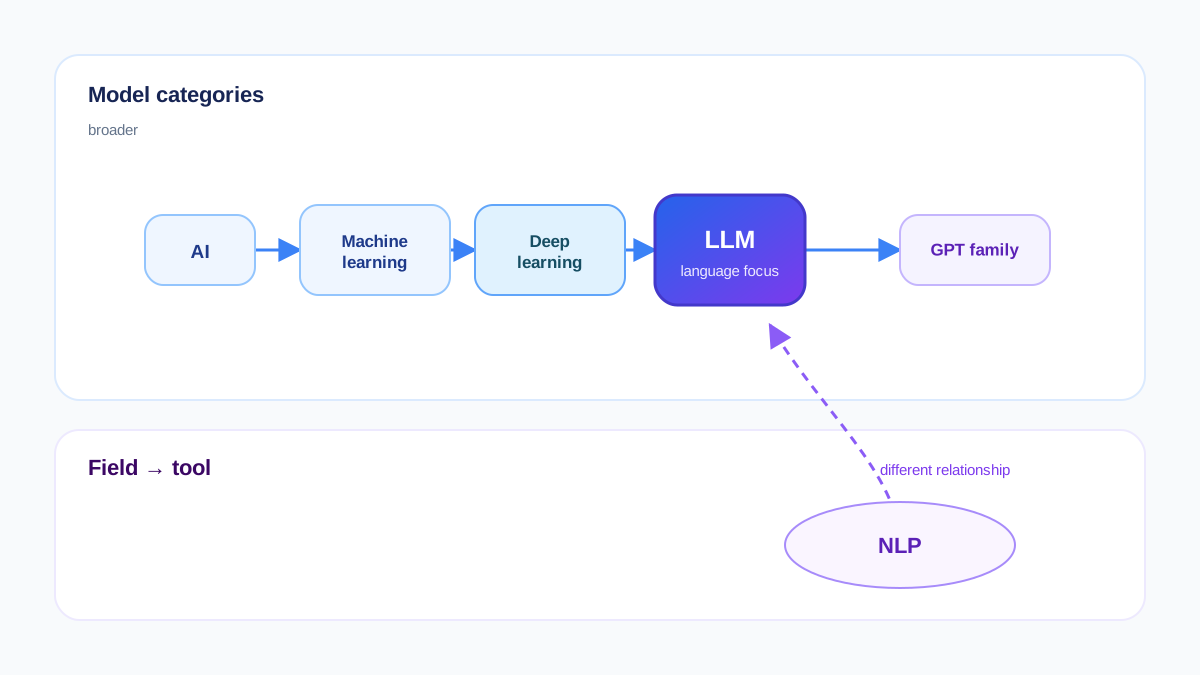
The root of the confusion is that these terms sit at different conceptual levels but get used interchangeably in conversation, documentation, and even technical writing.
That's not your fault. ChatGPT was many people's first exposure to large language models, so "GPT" became shorthand for the whole category. Meanwhile "NLP" has been around since the 1950s, and when LLMs exploded onto the scene, people folded the new thing into the old term. The result is a vocabulary soup where nobody is quite sure what anyone else means.
The fix is to keep two relationships straight.
Axis 1: Model-category nesting. Think of this as a zoom lens, not a set of airtight boxes. AI is the broadest umbrella: any system that performs a task normally requiring human intelligence. Machine learning is the subset that learns from data. Deep learning is the slice of machine learning built on multi-layered neural networks. Generative AI is a capability that creates new content—text, images, audio, or code—and it can span several of those layers. LLMs are the language-focused generative models inside that picture. GPT is one family within the LLM category.
The relationships aren't all the same kind. Machine learning is a true subset of AI. But generative AI is better understood as a capability that can appear across model types, and LLMs are a language-focused specialization of generative models. Labeling the relationship type matters more than memorizing a tidy chain.
Note: The beginner-safe takeaway is simple. LLMs are language-focused model systems and an important part of generative AI. AI remains the broad umbrella. Don't let the zoom lens become a rigid taxonomy.
Axis 2: Field-to-tool relationship. NLP is the research field—the academic and engineering discipline concerned with language. LLMs are one powerful tool that came out of that field. Not every NLP technique involves an LLM, and not every use of an LLM is an NLP research contribution. The field predates the tool by decades.
Once you separate those two axes, the terms stop overlapping in your head. You're no longer asking "is NLP the same as an LLM?" because you know one is a field and the other is a tool category. You're no longer asking "is GPT an LLM or something else?" because you know GPT is a family inside the LLM category.
Knowledge check
Check your understanding
Answer this question before you continue.
LLM vs GPT: Category vs. Family
A Large Language Model is a model trained to predict and generate language patterns at massive scale. It's defined by what it does—modeling language—not by who built it. GPT stands for Generative Pre-trained Transformer, and it's OpenAI's specific family of those models. Every GPT is an LLM, but not every LLM is a GPT.
To keep the levels straight, use this ladder: organization (OpenAI) → model family (GPT) → individual model (GPT-4o) → product (ChatGPT). When you say "I'm using GPT," you're naming the family. When precision matters—benchmarks, pricing, API selection—name the specific model.
Other LLM families include Claude, Gemini, Llama, and Mistral. They're all LLMs, just as a Camry, an Accord, and a Model 3 are all sedans. When someone says "I'm using an LLM," they're naming the tool category, not the specific tool.
Common mistake: Thinking "LLM" and "ChatGPT" are synonyms. They aren't. ChatGPT is a product that uses an LLM under the hood. The LLM is the engine; ChatGPT is the car.
Why does the confusion persist? Because ChatGPT was the product that brought LLMs into mainstream awareness. For millions of people, their first interaction with a language model was through ChatGPT, so the product name swallowed the category name. It's the Kleenex effect—a brand name that became the generic term.
Knowledge check
Check your understanding
Answer this question before you continue.
LLM vs NLP: Tool vs. Field
Natural Language Processing is the research field focused on teaching machines to understand and work with human language. It's been around since the 1950s, when researchers first tried to build systems that could translate between languages.
LLMs are one approach within NLP—a remarkably powerful one, but not the only one. Classic NLP techniques include rule-based systems (hand-crafted grammar rules for spell checking), statistical methods (pattern learning without deep neural networks), and traditional machine learning (classifiers trained on text features). These older methods still exist and are often the right tool for simpler tasks. You don't need a billion-parameter LLM to extract keywords from a document or check spelling.
A precise way to say it: an LLM is anchored in predicting and generating language patterns, and that capability can support many NLP tasks. But NLP is the broader field containing the tasks, methods, datasets, and systems—not just the models.
Common mistake: Saying "I built an app with NLP" when you mean "I used an LLM API." NLP is the field. The LLM is the specific tool you chose from that field. Be precise—it helps other people understand what you actually built.
Knowledge check
Check your understanding
Answer this question before you continue.
LLMs vs Other AI Model Types
The phrase "other AI models" reaches beyond language terminology. When you compare LLMs vs other AI models, the dividing line is almost always the model's primary input and output, not raw capability.
An LLM is built around language: it reads text and produces text. But that doesn't mean language models can never touch an image or a sound. Many modern LLM systems are multimodal—they can accept a photo or audio as part of the input and reason about it in words. The cleaner way to think about it is primary specialization. A text-focused LLM is specialized for language. A vision model is specialized for images. A speech model is specialized for audio. The boundary is which modality the model is built to handle best, not a hard wall that no model can ever cross.
| Model Type | Primary Input | Primary Output | Typical Task |
|---|---|---|---|
| Text-focused LLM | Text | Text | Answering questions, summarizing, drafting, translating |
| Vision model | Images | Labels or regions | Image classification, object detection |
| Speech model | Audio | Text or audio | Speech recognition, text-to-speech |
| Recommendation model | User and item signals | Ranked suggestions | Predicting what a user will engage with |
| Predictive/tabular model | Structured numbers and categories | A value or class | Forecasting, fraud detection, churn prediction |
The boundary is specialization, not intelligence. A vision model can be just as sophisticated as an LLM, but it can't hold a conversation. And a text-focused LLM is not the right tool to count objects in a photo—that's a job for a vision model, or for a multimodal system that pairs language understanding with vision capability. When someone says "AI model" without a qualifier, they might mean any of these. When they say "LLM," they mean the language-focused one.
Knowledge check
Check your understanding
Answer this question before you continue.
When to Use an LLM vs. a Specialized Model
The practical question hiding behind the taxonomy is: when do I reach for an LLM, and when is a narrower model the better choice?
The answer isn't a binary rule. It's a set of conditions. Ask yourself three questions about the task:
-
Does the input vary widely in structure and phrasing? If every request looks different—free-form questions, varied documents, unpredictable wording—an LLM's flexibility helps. If the input is consistently structured, a specialized model may be enough.
-
Can you tolerate probabilistic output? LLMs produce likely responses, not guaranteed-correct ones. If the task requires exact, auditable, deterministic results—like a financial calculation or a medical dosage—an LLM is the wrong tool regardless of how flexible the input is.
-
What are your constraints on speed, cost, and reliability? Specialized models are typically faster, cheaper, and more predictable for their narrow task. If you need millisecond responses at high volume with near-zero error tolerance, don't reach for an LLM.
Here's the same logic applied to two concrete scenarios:
| Scenario | Input | Required Output | Tolerates Variation? | Right Tool |
|---|---|---|---|---|
| Customer asks "Where is my order #4521?" | Free-form text, varied phrasing | Order status lookup | No—output must be exact | Specialized model (intent classifier + database lookup) |
| Customer asks "Can you help me understand why my bill is higher this month?" | Free-form text, unpredictable follow-ups | Conversational explanation | Yes—helpfulness matters more than exact wording | LLM |
The same input domain—customer support—produces different tool choices because the output requirements differ. One task needs a fixed answer from a database. The other needs flexible reasoning over unstructured information.
Decision rule: Reach for an LLM when the task combines open-ended language variation, tolerance for probabilistic output, and a need for broad adaptation. Reach for a specialized model when the output is fixed, strict reliability matters, or latency and cost are the dominant constraints.
One more thing worth saying: this is rarely a pick-one-model decision. In real systems, the LLM and the specialized component often work together. That order-status bot in the table above is really a pipeline—an LLM or intent classifier reads the customer's varied phrasing, then a database lookup supplies the exact answer. The useful question isn't "LLM or not?" It's "which component should handle which part of the task?" An LLM is excellent at understanding messy language; a database or a narrow classifier is excellent at returning a guaranteed-correct result. Build the boundary where each is strongest.
The Comparison Table
Here's the cheat sheet. When you're unsure which term to use, scan this table.
| Term | Concept Level | What It Is | Use This Term When… |
|---|---|---|---|
| AI Model | Umbrella category | Any system that performs a task normally requiring human intelligence. | The specific type doesn't matter or isn't known. |
| NLP | Research field | The decades-old discipline of teaching machines to understand human language. | You're talking about the field, not a specific tool. |
| LLM | Model category | A large-scale model that predicts and generates language patterns. | You're naming the tool category—GPT, Claude, Gemini all qualify. |
| GPT | Model family | OpenAI's specific family of generative pre-trained transformer models. | You're talking about OpenAI's models specifically. |
| Generative AI | Broader capability | AI that creates new content—text, images, audio, or code. | You're talking about content-creating models, not just language. |
The "Concept Level" column is the key. It tells you whether you're naming a field, a category, a family, an umbrella term, or a capability. Keep that column in mind, and the terms stop overlapping in your head.
The most common mistake I see: someone builds a project that calls the OpenAI API and describes it as "an NLP project." What they actually built is an application that uses an LLM. NLP is the broader field; their project uses one specific tool from that field. The distinction matters when you're explaining your work to other builders, writing documentation, or deciding what to learn next.
Try It Yourself
Take any AI headline or product description you've seen recently and run it through three questions:
- Is it naming a field, a category, a family, a capability, or a specific model?
- Is it describing a language task, or a vision, speech, or prediction task?
- If you had to build it, would you reach for an LLM, a specialized model, or a combination of both—and why?
Run that exercise once, and the framework stops being theory. It becomes a reflex.
A natural next layer is understanding what changes when you actually use an LLM—the difference between training and inference, and what that means for the answers you get back.
Knowledge check
Final check
Finish the article by checking the ideas you just learned.
References
Research updated Sep 5, 2026


