
A Brief History of LLMs
Large language models look like overnight magic, but they are the visible tip of decades of compounding engineering. If you want to use, trust, and build…

Key topics
Large language models look like overnight magic, but they are the visible tip of decades of compounding engineering. If you want to use, trust, and build with LLMs well, the fastest shortcut is understanding the journey that got us here.
Why LLMs Feel Like They Arrived Overnight
If your first encounter with an LLM was a chatbot that could write essays, translate languages, or debug code, you are not alone. One year computers struggled with basic conversation; the next they seemed to handle it fluently. That "overnight" leap is an illusion.
LLMs are the product of decades of work in artificial intelligence, linguistics, and computing. Each advance—no matter how incremental—expanded what machines could do with language. When the pieces finally fit, the result looked magical. But every "wow" moment is built on layers of visible and invisible engineering.
Common mistake: It is easy to treat LLMs as clever apps that appeared from nowhere. In reality, they are the result of long progress in algorithms, data, hardware, and theory.
Understanding the history of LLMs gives you a map: why certain approaches worked, why others failed, and which limits still remain. That is not trivia. It is practical context for anyone who wants to use these models well.
Knowledge check
Check your understanding
Answer this question before you continue.
One Question Drives the Whole Story
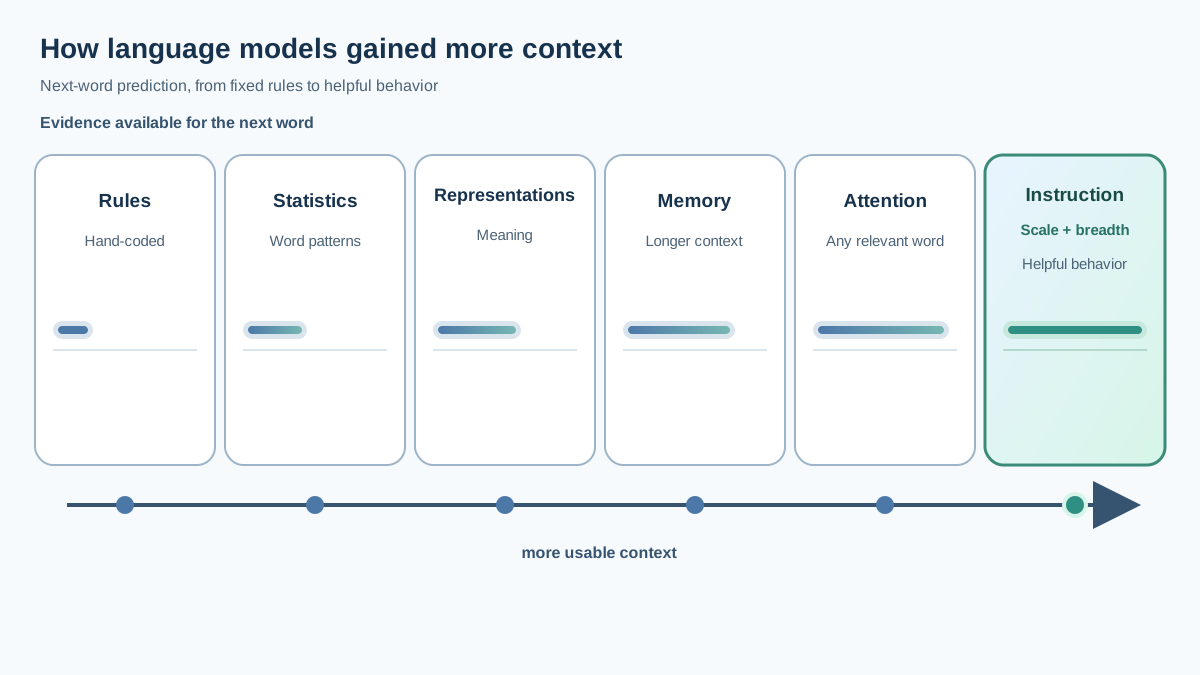
Every era in the history of LLMs has wrestled with the same core question: what evidence should the system use to choose the next word? The answer kept changing as technology advanced:
- Rules: Hand-coded grammar and dictionaries.
- Statistics: Local word patterns and frequencies.
- Learned representations: Embeddings and neural networks that capture meaning.
- Sequence memory: Models that remember longer stretches of text.
- Attention: Systems that can focus on any relevant part of the input, not just the most recent words.
- Scale and instruction: Models trained on massive data that can follow instructions and generalize.
Keep this through-line in mind. LLM evolution is not a list of inventions; it is a series of expanding capabilities, each generation using more context, more data, and more computation to make better predictions.
Knowledge check
Check your understanding
Answer this question before you continue.
From Rules to Learning: The First Language Models
The earliest language systems were rule-based. Developers wrote dictionaries, grammar rules, and lists of exceptions by hand. These systems could translate simple sentences or answer basic questions, but they broke down quickly when faced with ambiguity or creativity.
A major shift came with statistical models. Instead of relying only on rules, computers began to learn from data. One early approach was the n-gram model: by looking at short sequences of words, the computer could guess what word might come next. If "the cat sat on the" appeared often in its training data, it would learn that "mat" is a likely next word.
This made language models more flexible and robust. They handled typos, slang, and new phrases better than rigid rule-based systems. But they still lacked deep understanding—just a statistical sense of what "sounded right."
| Approach | How it works | Strengths | Weaknesses |
|---|---|---|---|
| Rule-based | Hand-coded grammar and dictionaries | Precise, explainable | Brittle, hard to scale |
| Statistical (n-gram) | Learns word patterns from data | Flexible, data-driven | Shallow, limited context |
Tip: Each new approach did not erase the old one. It built on it, expanding what the model could "see" when making decisions.
Knowledge check
Check your understanding
Answer this question before you continue.
Neural Networks: Learning Meaning and Remembering Context
The next leap came from neural networks—computational systems inspired, loosely, by the brain. Instead of relying on fixed rules or shallow statistics, neural networks could learn complex patterns from large datasets.
Two innovations mattered most, and each solved a specific problem:
- Word embeddings turned words into reusable numerical representations. Similar words ended up close together in that space, so the model could generalize: learn something about "dog" and apply part of it to "cat." In plain terms, the model stopped treating each word as an isolated label and started treating words as related points on a map.
- Sequence models (RNNs and LSTMs) carried a running state as they read text. Instead of only seeing a fixed window of nearby words, they could remember context across sentences. The catch: that memory faded over long stretches, and the models were slow to train because each word had to be processed in order.
So by the mid-2010s, language models could capture meaning and remember more context than ever before. But they still hit a wall: the further apart two relevant words were, the harder it was for the model to connect them.
The Transformer: Attention Changes the Game
In 2017, a new architecture changed everything: the transformer. Instead of processing words strictly in order, transformers use an attention mechanism that lets the model compare any part of the input with any other part—no matter how far apart they sit.
Think of the difference this way. A sequence model reads a sentence front to back, carrying a fading memory. A transformer can look across the whole sentence at once and decide which words deserve the most weight for the prediction it is about to make. That single change removed the bottleneck that had capped earlier models.
Why does this matter for LLM evolution?
- Attention: The model can "look back" at any relevant part of the input, not just the most recent words. That means better handling of context and relationships.
- Scalability: Transformers can process much of the input in parallel rather than one word at a time, which made it practical to train far larger models on modern hardware.
- Parameters: These are the learned, adjustable values inside the model. More parameters—billions of them—gave transformers the capacity to absorb richer patterns from huge datasets.
Today's LLMs are all built on transformer foundations. Understanding how these models actually produce words explains the mechanics behind that claim.
Knowledge check
Check your understanding
Answer this question before you continue.
From Predicting Text to Following Instructions
Here is the transition most beginners find confusing, and it is worth slowing down for.
A transformer trained at massive scale learns broad language patterns by predicting the next word over and over. That pretraining step is what gives the model its raw fluency. But a next-word predictor alone does not behave like a helpful assistant. Left to itself, it might complete a prompt in any plausible direction.
That is where a second stage comes in. After pretraining, models go through instruction tuning and related post-training, which shape how they respond to requests. This is what turns a fluent text generator into something that follows instructions, holds a conversation, and refuses to do what it should not.
Here is the key point to hold onto: neither stage guarantees truth. The model is still choosing the most likely next word given its training and your input. Instruction tuning makes it behave like an assistant; it does not make it a fact-checker.
Common mistake: People assume a model that sounds confident and follows instructions well must be reasoning from verified facts. It is not. Fluency and helpfulness come from training on patterns; accuracy is a separate problem.
Why This History Matters for Beginners
So why should you care about the history of LLMs?
- Stronger intuition: Knowing how LLMs evolved helps you understand why they behave the way they do—and where their limits come from.
- Realistic expectations: LLMs are not magic. They are the product of many small steps, each with strengths and weaknesses.
- Practical leverage: If you know the building blocks, you can use and build with LLMs more effectively. You will recognize when a model is guessing, when it is likely to fail, and how to get better results.
The history also gives you a sharper decision rule for working with these models. Context can constrain a prediction: give the model relevant source material and it has better evidence to draw on. But context is not proof. When correctness matters, check the model's claims against an independent source rather than assuming more context fixed the problem.
What's Next? Your Learning Path Forward
Now that you have context on the history of LLMs, you are ready for the next steps:
- How LLMs work: Dive into the mechanics of text generation, parameters, tokens, and context windows.
- Prompting basics: Learn how to communicate with LLMs to get the results you want.
- Practical applications: Explore how LLMs are used in real workflows, from writing and coding to research and automation.
Carry one durable mental model forward: capability expanded as systems learned richer representations, connected longer relationships in text, and followed broader instructions—while prediction remained the underlying mechanism the whole way. Today's LLMs are one chapter in an ongoing story, and the next breakthroughs will come from people who understand the past well enough to build on it.
Next step: Ground yourself in the basic LLM mental model, then compare language models with other kinds of AI to see where they fit in the wider landscape.
Knowledge check
Final check
Finish the article by checking the ideas you just learned.
References
Research updated Sep 5, 2026


