
What Is LLM Fine-Tuning? When Training Examples Change Model Behavior
You fine-tune a model on your own documents, ask it a factual question about them, and watch it hallucinate anyway. The training ran. The loss curve looked…

Key topics
You fine-tune a model on your own documents, ask it a factual question about them, and watch it hallucinate anyway. The training ran. The loss curve looked healthy. And still the model invents answers with total confidence.
This is the most common beginner trap in LLM customization, and it reveals a fundamental misunderstanding: fine-tuning is not a way to install a document database. It is a way to shape behavior.
By the end of this guide, you will know what fine-tuning actually changes inside a model, what kind of examples it needs, and when prompting or retrieval is the safer first intervention.
The Fine-Tuning Trap: Why Feeding Documents Doesn't Teach Facts
Imagine you have a hundred PDFs of internal documentation. You want a chatbot that can answer questions about them. Someone tells you fine-tuning will customize the model for your data, so you gather the documents, run the training, and wait.
Then you ask: "What is our refund policy for enterprise customers?"
The model responds with a confident, well-structured answer that is completely wrong. The policy it describes does not exist. The links it cites are fabricated. The tone is perfect. The facts are fiction.
What went wrong?
The weak mental model looks like this: fine-tuning works like adding a book to a library. The model reads your documents, memorizes them, and can now recall them on demand.
That model is wrong. Fine-tuning does not add books to a library. It coaches the librarian.
Fine-tuning changes how the model behaves and responds. It shapes style, format, tone, and task performance. It does not give the model a reliable way to look up facts it never learned during its original training. When you feed a model raw documents, you are not teaching it your content. You are teaching it to continue text in the statistical pattern of those documents—which is not the same as knowing your content.
Knowledge check
Check your understanding
Answer this question before you continue.
What Fine-Tuning Actually Changes Inside the Model
To understand fine-tuning, you need one piece of groundwork: the difference between training and inference.
When a model is pre-trained, its internal parameters—millions of numerical weights—are adjusted so the model can predict text. That is training. When you type a prompt and the model generates a response, it is running inference: using those already-trained weights to produce output.
Fine-tuning is continued training. You take a pre-trained model and run more training on a smaller, task-specific dataset. The model's weights are nudged so its outputs better match the style, format, and behavior shown in your examples.
Think of it like coaching. You start with a talented generalist who already knows language deeply. Fine-tuning is not handing them a new encyclopedia. It is coaching them to speak in a specific voice, follow a specific format, or handle a specific type of task reliably.
The boundary matters, and it has three parts:
- Fine-tuning changes the mapping from inputs to outputs. It teaches the model which kind of response should follow which kind of request.
- Training examples can teach task and domain patterns. A model fine-tuned on legal language will produce text that sounds and behaves more like legal writing. That is real adaptation, not just surface style.
- Fine-tuning does not give the model reliable, query-time access to specific facts. If the model never learned a fact during pre-training, fine-tuning will not install it in a way you can depend on. The model can imitate the shape of knowledge—confident sentences, proper formatting, plausible structure—without being able to ground an answer in a source.
This is why the document-feeding approach fails. The model learns to sound like your documents. It does not learn to retrieve what your documents say.
Knowledge check
Check your understanding
Answer this question before you continue.
What Training Examples Look Like
Fine-tuning examples are typically prompt-response pairs. Each pair shows the model a question or instruction and the ideal output you want.
Suppose you run a support team and want a model that writes replies in your brand's voice. Your fine-tuning dataset would look like this:
-
Prompt: "Customer: My order arrived damaged. What do I do?"
-
Desired response: "We are sorry your order arrived damaged. Please reply with your order number and a photo, and we will ship a replacement within two business days."
-
Prompt: "Customer: How do I change my shipping address?"
-
Desired response: "You can update your shipping address from your account page up until your order enters fulfillment. Here is how..."
The model learns the pattern: given this type of question, produce this type of response, in this tone, with this structure.
The quality of these examples matters more than the quantity. Fine-tuning follows the same rule as all machine learning: garbage in, garbage out. The model learns the patterns in your examples, including their mistakes, sloppiness, and inconsistencies. If half your examples use a formal tone and half use slang, the model will produce an inconsistent blend. If some examples contain factual errors, the model will learn to repeat those errors with confidence.
Common mistake: Fine-tuning on raw documents and expecting fact recall. Raw documents are not prompt-response pairs. They do not demonstrate the behavior you want. They demonstrate text continuation, which the model already knows how to do.
Knowledge check
Check your understanding
Answer this question before you continue.
When Fine-Tuning Makes Sense
Fine-tuning earns its cost when you need a consistent, durable behavior that prompting cannot achieve.
The key word is durable. A well-written prompt can demonstrate a behavior once. Fine-tuning bakes it into the model so it persists across every request, without you repeating instructions each time.
Fine-tuning makes sense when:
- You need a fixed output format. The model must always return JSON with specific fields, or always structure responses in a particular template.
- You need a specific tone or persona. The model must sound like your brand, not like a generic assistant.
- You need reliable task performance at scale. Prompting works for a demo. Fine-tuning is worth evaluating when the behavior must hold across thousands of requests without drift.
- Prompting keeps failing on a narrow task. If you have tried detailed instructions, tried in-context examples, and the model still makes the same mistakes, fine-tuning can push it past that plateau.
Fine-tuning can also reduce hallucinations for narrow, well-defined tasks. If the model keeps inventing output formats or misclassifying inputs despite good prompting, training on clean examples of the correct behavior can help.
But notice what is missing from this list: using fine-tuning as your fact-retrieval system. Fine-tuning is for changing how the model responds. It is not the tool for giving it reliable access to facts it never learned.
Knowledge check
Check your understanding
Answer this question before you continue.
When Prompting or Retrieval Is the Safer First Move
Before you invest in fine-tuning, ask whether a cheaper tool solves the problem.
Prompting first. Clear instructions and a few in-context examples often change behavior enough without any training. You can iterate on a prompt in minutes. You cannot iterate on a fine-tune in minutes. Prompting is free to revise, free to test, and free to discard when it does not work.
Retrieval for facts. If your goal is answering questions about your own documents, retrieval-augmented generation (RAG) is the tool. Retrieval pulls the relevant text into the model's context window at query time. The model reads the actual passage from your document and answers from it. This is exactly what fine-tuning cannot do reliably.
The contrast is clean:
| Problem | Right tool | Why |
|---|---|---|
| Model needs a new behavior, format, or tone | Prompting, then fine-tuning | Training examples shape how the model responds |
| Model needs to answer from your specific documents | Retrieval (RAG) | Relevant text is pulled into context at query time |
| Model needs up-to-date or proprietary knowledge | Retrieval (RAG) | Documents can be updated without retraining |
Fine-tuning durably changes behavior and style. Retrieval provides dynamic access to knowledge. They are complementary, not interchangeable.
Decision rule: Name the problem first. Do you need a repeatable behavior, do you need source-grounded facts at request time, or both? If behavior, try prompting before fine-tuning. If facts, use retrieval. If both, combine them.
Here is what "both" looks like in practice. Suppose you build a support chatbot for a policy that changes quarterly. Retrieval supplies the current policy passage so the model answers from the latest text. Fine-tuning teaches the response format, the escalation behavior when the policy is unclear, and the refusal pattern when no relevant passage is found. Retrieval handles the knowledge that changes. Fine-tuning handles the behavior that should stay consistent.
Fine-tuning also carries real costs and risks. It requires curated data, compute, and careful evaluation. It risks overfitting—the model becomes so specialized it loses general ability. It risks degrading performance on tasks outside your narrow dataset. And every time your data changes, you must retrain.
Common Beginner Mistakes and How to Avoid Them
These failure modes repeat constantly. Recognize them and you will save yourself weeks of frustration.
Mistake 1: Fine-tuning on raw documents and expecting fact recall. This is the trap from the opening. The model cannot reliably memorize your PDFs through fine-tuning. If you need the model to answer questions about your documents, use retrieval.
Mistake 2: Using a messy dataset and wondering why behavior is inconsistent. Inconsistent examples will teach inconsistent behavior. If some examples use a formal tone and others use slang, the model will blend them. If some contain errors, the model will repeat them confidently.
Mistake 3: Skipping evaluation and assuming the model improved because training "finished." Training completing means the training objective improved on your training data. It does not prove the model behaves correctly on new inputs. Build a small evaluation set that includes the failure cases you care about, test the fine-tuned model on examples it never saw during training, and compare it against the base model. Measure whether the behavior actually improved.
Mistake 4: Fine-tuning for a behavior a well-written prompt already achieves. If a prompt with clear instructions and a few examples produces the output you need, you are done. Fine-tuning adds cost, complexity, and risk for zero benefit.
Each mistake reveals the same truth: fine-tuning changes behavior, not your retrieval system. When you remember that, the mistakes become predictable—and avoidable.
The Practical Decision Rule
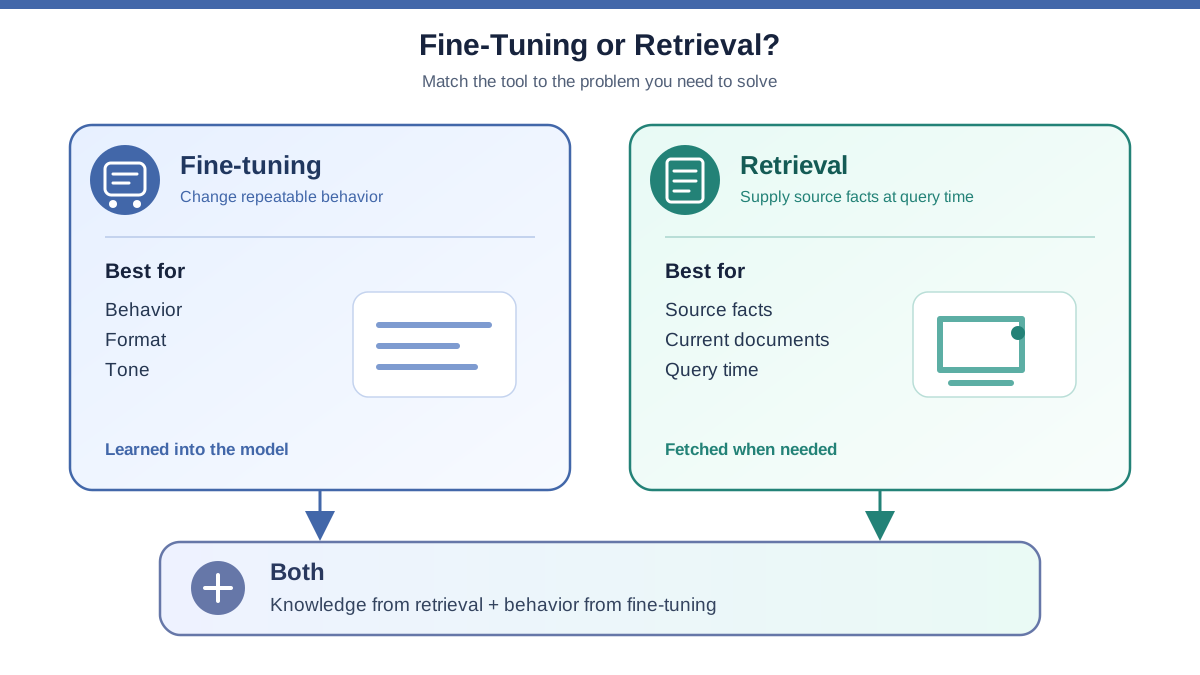
Here is the rule I want you to keep:
- Name the problem. Do you need a repeatable behavior, source-grounded facts at request time, or both?
- If facts: Use retrieval. Pull the relevant text into context at query time.
- If behavior: Try prompting first. Clear instructions and a few examples often suffice.
- If prompting fails: Consider fine-tuning on clean, consistent prompt-response pairs that demonstrate the exact behavior you want.
- If both: Combine retrieval for the knowledge that changes with fine-tuning for the behavior that should stay consistent.
Fine-tuning is a powerful tool, but it is a behavior-shaping process, not a knowledge-injection process. Use it to make the model respond the way you need. Use retrieval to give it the facts it needs.
Your next learning step is retrieval-augmented generation—the complement to fine-tuning and the tool you will reach for when the model needs to answer from your specific documents.
Knowledge check
Final check
Finish the article by checking the ideas you just learned.
References
Research updated Sep 7, 2026


