
How Do LLMs Work?
Large language models are not digital minds. They are probability engines that turn a conversation into a series of next-token guesses. The guesswork is…

Key topics
Large language models are not digital minds. They are probability engines that turn a conversation into a series of next-token guesses. The guesswork is far more sophisticated than autocomplete, and the difference between "plausible" and "verified" is where the real insight lives.
The Illusion of Understanding
It is easy to believe an LLM "understands" you. It writes fluent sentences, remembers earlier context, and sometimes even jokes. But that fluency is surface-level. As a practical model of how these systems operate, an LLM does not hold beliefs, intentions, or real-world experience the way a person does.
When you give an LLM a prompt, it predicts what comes next—one token at a time—using patterns learned from enormous amounts of text. It does not verify its answer against a grounded source. It produces the most plausible continuation it can, based on statistical patterns absorbed during training.
Common mistake: Expecting an LLM to reason or "know" like a person leads to confusion. Treat it as a tool for generating plausible text, not as a digital mind.
The One Pipeline That Explains Everything
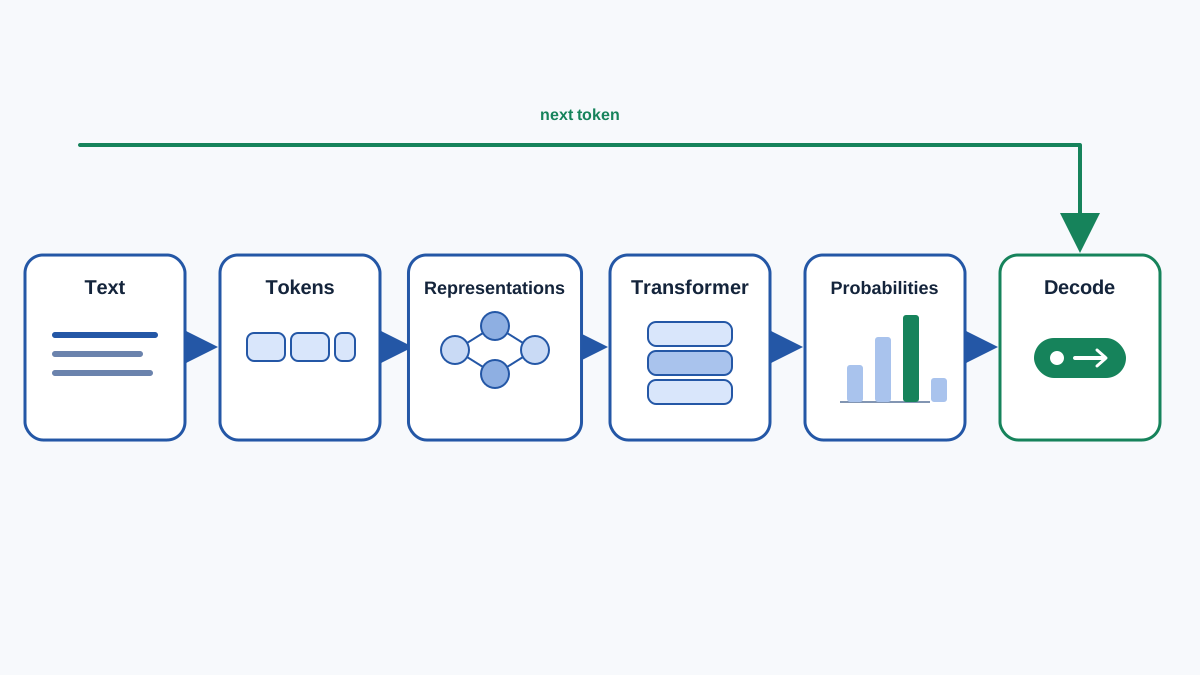
Before we zoom in anywhere, hold one picture in your head. Every LLM, no matter how large, runs the same loop:
Text → tokens → numerical representations → transformer computation → token probabilities → decoding → next token
That is the whole machine. Everything else—training, inference, hallucination, delegation—is a variation on this pipeline. So let me label the two moments that matter most, because they will keep the rest of the article from feeling like two separate explanations.
- Training is how the model learns the numbers that drive the pipeline.
- Inference is how the model uses those fixed numbers when you type a prompt.
Same pipeline. Two different moments. Keep that distinction and the rest clicks into place.
Knowledge check
Check your understanding
Answer this question before you continue.
The Core Mechanism: Predicting the Next Token
The best starting mental model for an LLM is an extremely advanced autocomplete. Imagine your phone's text suggestions, scaled up to entire paragraphs, stories, or code snippets.
Here is how that works in practice:
- You provide a prompt, such as "The Eiffel Tower is located in."
- The model breaks the text into tokens—chunks that can be whole words, parts of words, or punctuation.
- For the next position, the model assigns a probability to every token it knows: "Paris" might get a high score, "London" a tiny one, and thousands of others something in between.
- A decoding method—sampling, or simply picking the highest-probability token—chooses one.
- That token is added to the prompt, and the whole process repeats.
This loop continues until the model emits a special end-of-sequence token or hits a length limit. Everything an LLM writes is the result of this cycle running many times per second.
Note: The autocomplete analogy describes the output loop, not the internal computation. Autocomplete suggests the next word from a short list of nearby options. An LLM transforms your entire input into rich numerical representations and weighs relationships across all of it before it produces even one candidate. The loop looks the same; the machinery behind it does not.
A Mini Walkthrough: Branching Paths
Let's make this visible. Start with the prompt "Once upon a."
The model might assign probabilities like these to the next token:
- "time" — high probability
- "midnight" — lower
- "dream" — lower still
- and thousands of other candidates with tiny scores
Suppose the model picks "time." Now the prompt is "Once upon a time," and the next prediction might favor "there" or "the." But if the model had picked "midnight" instead, the entire story would branch in a different direction.
This is why the same prompt can produce different answers. The model is not recalling a fixed response; it is walking a branching path where each choice shapes the next.
Common mistake: Expecting the same answer every time. LLMs can generate different outputs for the same prompt because of randomness in sampling.
Knowledge check
Check your understanding
Answer this question before you continue.
What's Inside: Architecture in Plain English
To understand how do llms work beyond the surface loop, you need to see what happens between your prompt and the final guess. The pipeline above is the map; here is what each stage actually does.
Tokens: The Building Blocks
LLMs do not read text the way we do. They read tokens—chunks that can be a whole common word, a fragment of a rare word, or a piece of punctuation. Tokenization lets one model handle many languages, styles, and formats with the same machinery.
From Tokens to Numbers: Representations
A token ID alone carries no meaning. Before the model can work with it, each token is converted into a numerical representation—a vector that places it in a high-dimensional space where words with similar meanings sit closer together. "Take" ends up near "grab," far from "we."
Note: That "similar words sit closer together" image is useful but approximate. It is not a literal map of meaning. It is a mathematical convenience that lets the model compute relationships instead of matching phrases.
Parameters: The Learned Settings
An LLM's capability lives in billions of parameters—adjustable settings learned during training. Those settings shape how the model transforms each numerical representation as it moves through the network. They encode which patterns are likely and which are rare, based on the data the model saw.
Note: Parameters are not the same as context. Parameters are the fixed, learned settings that stay constant while the model runs. Context is the temporary working information in your current prompt. One is the model's long-term configuration; the other is what you hand it in the moment.
The Transformer: Attention in Action
Most modern LLMs use the transformer architecture. Its key innovation is attention: as each token's representation passes through layer after layer, the model can look back at earlier tokens and decide which ones matter most for predicting the next one.
Attention is easiest to see through a concrete shift in prediction. Consider the sentence "Alice gave her book to Bob because she was finished with it." When the model needs to figure out who "she" refers to, attention lets it weigh "Alice" against "Bob" and lean on the evidence. That weighting changes the probability scores for the next token: after "she was finished with," the model leans toward "it" referring to the book, not toward some unrelated object. Attention is how the model tracks context, resolves ambiguity, and keeps a thread coherent across long passages.
Note: Attention is not human focus. It is a mathematical way for the model to assign more weight to relevant earlier tokens when making a prediction.
Knowledge check
Check your understanding
Answer this question before you continue.
How LLMs Learn: Training Shapes the Probability Map
An LLM starts as a blank slate of random settings. It learns by being trained on massive collections of text—books, articles, code, and more.
The training loop is deceptively simple:
- The model is shown a sequence of tokens and asked to predict the next one.
- If its guess is wrong, its parameters are nudged to make future guesses better.
- This repeats billions of times, gradually shaping the model's internal probability map.
Two phases matter:
- Pre-training: The model learns broad language patterns from general data. This is where most of its capability comes from.
- Fine-tuning: The model is further trained on narrower, curated data to behave more helpfully and follow instructions.
Note: Once training is complete, the model's knowledge is fixed until it is retrained or fine-tuned. It does not update from your conversation.
Training vs. Inference: What Changes When You Use It
When you use an LLM, you are running it in inference mode. It is no longer learning. It is using its trained probability map to generate output.
Most of the generation loop stays the same as the walkthrough above. What changes is what is fixed and what is flexible:
- Parameters are fixed. The model is not updating its learned settings while it answers you.
- Context is current. The prompt you supply is the temporary working information the model weighs.
- Decoding is a choice. Sampling introduces variety; always picking the top token makes output more repetitive but more stable.
- Stopping is a condition. The model stops when it emits an end-of-sequence token or hits a length limit.
Tip: The decoding method controls how creative or predictable the output is. If you want stable, repeatable answers, lean toward picking the most likely token. If you want variety in drafts or brainstorming, sampling gives you more paths to explore.
Knowledge check
Check your understanding
Answer this question before you continue.
Why LLMs Sometimes "Hallucinate" or Get It Wrong
Because an LLM generates what is likely to come next—not what is verified to be true—it can produce fluent but incorrect or invented answers. This is called hallucination.
Here is the nuance that matters. The model can learn patterns that correlate strongly with accurate statements, and it will often produce correct answers. But its generation objective does not guarantee truth, and it has no independent way to check. When the needed evidence is absent from the context, the model does not stop and say "I don't know"—it invents the most likely continuation.
A few reasons errors happen:
- The training data contained errors, and the model repeats them.
- The prompt asks for a fact or detail that was not in the training data, so the model fills the gap with its most plausible guess.
- Sampling randomness means different runs can yield different results.
The deeper point: the model is not trying to be correct. It is trying to be probable. That single fact explains most of what surprises beginners. It also explains the boundary you should respect: an LLM can transform material you give it with surprising skill, but it has no built-in way to check whether the details it adds are real.
Warning: Never trust LLM output blindly for critical or factual tasks. Always verify important information against a reliable source.
When to Delegate, When to Verify
Here is where the mechanism turns into a decision rule. The real question is not "is the LLM good at reasoning?" It is "can a human review this output before it matters?" Use that as your decision rule.
The boundary is reviewability and consequence, not whether the raw material happens to be in the prompt. A model can answer from learned patterns without any supplied source, and supplied context does not by itself make a summary correct. So judge by what happens if the output is wrong.
Low-cost review: Ask the model to draft an email, brainstorm product names, rephrase a paragraph, or translate a rough passage. You review the result before it ships. If it is wrong, you catch it cheaply. The cost of a mistake is small, so delegation is safe.
High-consequence use: Ask the model for a factual claim, a code snippet, a legal summary, or a number you will act on. Here the output is a starting point, not an answer. Check the fact against a source, run the code against tests, and confirm the number before you rely on it. The cost of a mistake is high, so verification is mandatory.
The pattern is consistent: the more the output feeds directly into a decision or a shipped artifact, the more verification you owe it. Summarization can preserve errors. Code generation still needs tests. A fluent wrong answer is still wrong.
Practical rule: Delegate transformation and drafting to the model, then review. Add external evidence, deterministic checks, tests, or human review whenever correctness matters.
Four Levers, One Decision
Everything in this article reduces to four levers you can pull, and one decision you own.
- Learned parameters shape what the model knows. They are fixed at inference time.
- Current context is what you supply. Rephrasing a prompt can change the output dramatically.
- Decoding controls variation. Pick the most likely token for stability; sample for variety.
- External verification is the only lever that checks truth. It is yours, not the model's.
The decision: delegate the transformation, verify the consequence. When you treat the model as a fluent transformer of the material you give it—and add your own check where correctness matters—you get the leverage without the blind trust.
Tip: If you get a strange or wrong answer, rephrase your prompt or add context. LLMs are sensitive to how the input is phrased.
Your Next Step
LLMs generate text by predicting one token at a time, using patterns learned from massive data. They are not digital minds—they are probability-driven pattern completers whose usefulness depends on how you delegate and verify.
Try this: Give an LLM a prompt you care about. Change a word or two. Watch how the answer shifts. Then take one output you would act on and verify it against a source. That is the real mechanism at work—one token, one probability, one branching path, and one verification step at a time.
Knowledge check
Final check
Finish the article by checking the ideas you just learned.
References
Research updated Sep 5, 2026


