
LLM Portfolio Project Ideas
A portfolio is not a trophy shelf. It is evidence of judgment — proof that you can pick a real problem, make the right tradeoffs, and ship something that…

Key topics
A portfolio is not a trophy shelf. It is evidence of judgment — proof that you can pick a real problem, make the right tradeoffs, and ship something that works past the demo.
Most beginners get this backwards. They stack five impressive-sounding projects, and every single one proves the same narrow skill: calling an API with a prompt. A chatbot that answers from Wikipedia. A chatbot that summarizes articles. A chatbot with a nicer front end. A reviewer looks at that collection and sees one project repeated five times.
The fix is not more projects. It is a sharper selection rule. Each project should prove at least one skill beyond "I can write a prompt" — retrieval, evaluation, state management, tool use, or deployment. The LLM should be one component of a real system, not the whole product.
This guide walks through a framework for choosing projects, three archetypes that teach genuinely useful skills, and how to present the work so it actually counts.
What a Portfolio Actually Proves
When I review someone's LLM showcase, I am not looking for clever prompts. I am looking for how you handled constraints, errors, and tradeoffs. Did you notice when the model returned garbage? Did you build a check for it? Can you explain why you chose one approach over another?
A portfolio built from tutorial reproductions answers none of those questions. It tells me you can follow instructions. It does not tell me you can build.
The anchor criterion for every project: it must force you past a single API call. If you can build the whole thing in one afternoon with a prompt and a prayer, it is not portfolio material. It is practice. Practice is fine — you need it — but it does not belong on the showcase.
Knowledge check
Check your understanding
Answer this question before you continue.
The Project Selection Framework
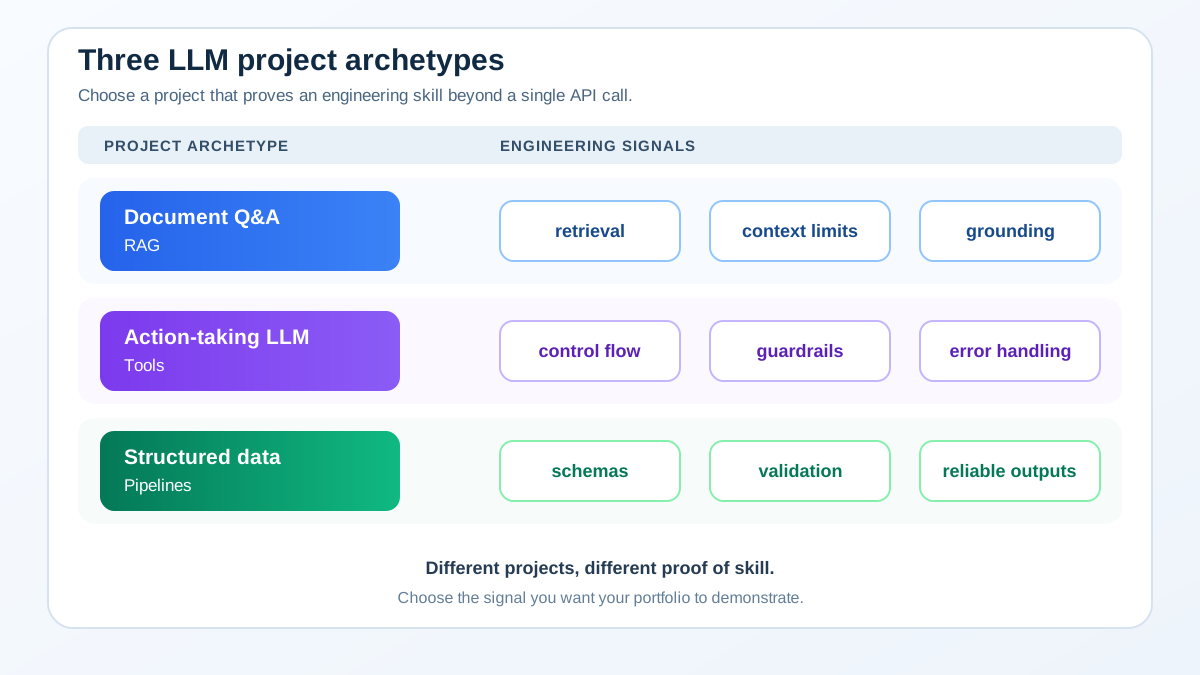
Before you pick a project, run it through three filters:
- Does it solve a problem you actually have or care about? Boring and specific beats broad and generic. A tool that answers questions about your own course notes is more honest — and more impressive — than another customer-support chatbot.
- Does it force you past a single API call? If the answer is no, the project will not teach you anything new.
- Can you explain the failure modes and tradeoffs you hit? If you cannot name what broke and why, you have not learned the material deeply enough to present it.
Match difficulty to your current stage. A beginner who jumps straight to a multi-agent system will spend all their time fighting infrastructure instead of learning. The goal is to finish something and understand it, not to start something impressive and abandon it.
My rule: pick the smallest project that forces you to learn one new skill. Finish it. Then pick the next.
Knowledge check
Check your understanding
Answer this question before you continue.
Project Archetype 1: Chat with Your Own Documents (RAG)
Retrieval-augmented generation — RAG — is the classic first project for good reason. It forces you to understand retrieval, chunking, embeddings, and context limits. Not just prompting.
The real lesson is not "build a RAG app." It is learning why retrieval quality matters more than model choice. Think of the context window as a crowded desk. Every irrelevant chunk you retrieve steals space from the evidence the model actually needs. A better model cannot compensate for a desk buried in noise.
A concrete version: build a Q&A tool over your own course notes, saved articles, or project documentation. You genuinely have this problem. You have files you cannot easily search. That makes the project real instead of synthetic.
The common beginner mistake is treating RAG as a magic box. When answers come back wrong, they blame the model. In most cases, the actual problem is bad chunking or weak retrieval. The model never saw the right evidence because your pipeline failed to find it.
What this project proves to a reviewer: you understand context limits, retrieval quality, and how to evaluate whether your system actually works.
Knowledge check
Check your understanding
Answer this question before you continue.
Project Archetype 2: An LLM That Takes Action (Tool Use and Agents)
The next step up is moving from generating text to taking action. Here the LLM becomes a decision-maker. It calls functions, reads results, and decides what to do next.
A beginner-friendly version: a workflow automation that watches an inbox or a folder, then routes, summarizes, or files content based on rules you define. The LLM is the judgment layer. Your code is the control layer.
The debugging lesson here is valuable: agent failures are usually not "the model is dumb." They are "the tool contract was ambiguous" or "the error path was invisible." The model called a function with the wrong arguments because your instructions did not specify the format. It failed silently because you never checked the result.
The common mistake is building an agent with too many tools and no guardrails, then spending weeks debugging unpredictable behavior. Start with one tool. Make the contract explicit. Add a second only when the first is reliable.
What this project proves: you understand control flow, error handling, and how to constrain an LLM's decisions. That is real engineering.
Knowledge check
Check your understanding
Answer this question before you continue.
Project Archetype 3: Structured Output and Data Pipelines
The least glamorous project type is often the most valuable. Many real LLM jobs are not chatbots. They are pipelines that turn messy text into structured data — extracting fields, classifying documents, summarizing at scale.
A concrete example: a tool that reads invoices, resumes, or support tickets and outputs clean JSON or a spreadsheet. The input is messy. The output must be reliable. That gap is where the engineering lives.
The skill this proves: you understand output schemas, validation, retries, and what to do when the model returns garbage. The difference between a demo and a pipeline is checking and correcting output. A demo prints whatever the model says. A pipeline validates it, rejects what fails, and retries with better instructions.
The common mistake is trusting model output without validation. Models are confident even when wrong. If your pipeline runs unattended, every unvalidated assumption becomes a silent failure.
Reviewers value this project because it shows you can build something that runs without supervision and produces dependable results. That is production-ready thinking.
How to Present Your Work So It Counts
The write-up matters as much as the code. A README that explains the problem, the design decision, the failure you hit, and how you fixed it is worth more than clean code with no context.
Show the failure, not just the success. A short "what broke and how I debugged it" section signals real experience. Every builder has debugged something confusing. Demonstrating that you can work through it is the strongest signal you can send.
Include a demo a non-technical person can run. Then add a technical walkthrough for reviewers. Host the live app or record a clear walkthrough. A repository that only exists on your laptop proves nothing to anyone.
The common mistake is polishing the demo and hiding the mess. That makes the work look like a tutorial reproduction. The mess is the evidence. Show it.
Common Portfolio Mistakes to Avoid
Before you invest weeks in a project, check it against these failure patterns:
- Five projects that prove the same skill. That is one project repeated five times. Diversify what you demonstrate.
- A tutorial copy with nothing changed. Reviewers can tell. It proves nothing about your judgment.
- A project so large you never finish. A small, finished, well-documented project beats an ambitious half-built one. Every time.
- No evaluation. If you cannot say how you know your project works, you have not demonstrated engineering judgment.
Here is the decision rule I use: if you cannot explain in one sentence what problem your project solves and what skill it proves, pick a different project.
The Next Step
Stop collecting ideas. Pick one small, real problem you actually have. Map it to one of the three archetypes. Commit to shipping a working version within a defined window — two to four weeks is reasonable.
The fastest way to build a portfolio that proves judgment is to finish one honest project rather than start five impressive ones. The work you finish and understand will always outweigh the work you began and abandoned.
Knowledge check
Final check
Finish the article by checking the ideas you just learned.
References
Research updated Sep 7, 2026


