
What to Learn Before LLM Frameworks: A First-Principles Path
Frameworks change. The model underneath them doesn't. Learn the mechanism first, and every new tool becomes just another wrapper around something you…

Key topics
Frameworks change. The model underneath them doesn't. Learn the mechanism first, and every new tool becomes just another wrapper around something you already understand.
If you're new to large language models, the landscape probably feels like it's shifting weekly. One month everyone is talking about LangChain. The next, it's LlamaIndex. Then a new agent framework appears, and suddenly you wonder whether the hours you spent learning the last tool were wasted.
That anxiety is reasonable, but it points at the wrong target. The tools are not the durable asset. Your understanding of how the model actually behaves is what transfers across every framework, every version, and every new release. This article maps the sequence that survives framework churn: model behavior, prompting, retrieval, tools, evaluation, and safety—before you touch a single abstraction-heavy library.
Why Frameworks Keep Changing (and Fundamentals Don't)
Let me name the pain directly: you see a new framework announced, you worry your learning is obsolete, and you wonder whether you should have started somewhere else.
Here's what a framework actually is: a library of abstractions that hides repeated steps behind simplified syntax. LangChain, LlamaIndex, and similar tools bundle common operations—sending prompts, managing conversation history, connecting to document stores—so you don't have to wire everything by hand.
Think about driving a car. You can drive without knowing how the engine works. You turn the key, press the pedal, and the car moves. That's fine until the car breaks down on the highway. Then you need to know which system failed, or at least be able to describe the symptom accurately to someone who can fix it.
LLM frameworks are the same. They let you build things quickly when everything works. But when output is wrong, retrieval returns garbage, or the model refuses to do what you asked, the framework won't save you. You need to understand the mechanism underneath.
The thesis of this article is simple: the model's behavior, not the framework's API, is what transfers across tools and versions. This isn't a full curriculum—it's the sequence of fundamentals worth mastering first, and the reasoning behind that order.
Start With How the Model Actually Behaves
Before you learn any tool, you need one mental model above all others: an LLM is a next-token predictor. It is not a reasoning engine. It is not a database. It does not "know" facts the way you do, and it does not "remember" your conversation.
If you haven't already, take time to understand the basic mechanics of how these models work—tokenization, context windows, and the step-by-step generation of output. That foundation matters because nearly every mistake beginners make traces back to misunderstanding what the model is doing.
Here's the misconception that causes the most trouble: people treat the model like a smart assistant with a perfect memory and a reliable knowledge base. Then they're confused when it confidently states something false or forgets what they said three messages ago.
The model generates text one token at a time, predicting the most likely next piece based on everything in its context. That context is like a limited working desk. Everything you send—your instructions, the documents you include, the conversation history—competes for space on that desk. When the desk gets crowded, the model works with less clarity.
You can observe this yourself. Open any chat interface and ask a question. Then ask the same question again with a long, irrelevant preamble added first. Notice how the quality changes. That's not the model being moody. That's a limited working desk getting cluttered.
Knowledge check
Check your understanding
Answer this question before you continue.
Prompting Is the First Real Skill
Once you understand that the model predicts tokens, prompting becomes clearer. A prompt is not a magic incantation. It's the skill of giving a next-token predictor clear, bounded instructions.
The core moves are straightforward:
- State the task clearly.
- Provide relevant context.
- Specify the output format.
- Set constraints.
Here's a before-and-after example. A vague prompt: "Tell me about machine learning." The model doesn't know what you actually want—an overview for a beginner? A technical deep dive? A comparison with other fields? It will guess, and guessing produces generic output.
A structured prompt: "Explain machine learning in three paragraphs to a beginner who knows programming but has no AI background. Use one concrete example from email spam filtering. Do not use jargon without defining it."
Same model. Same knowledge. Dramatically better output, because you gave the predictor clear boundaries.
This skill transfers everywhere because every framework still ends in a prompt sent to a model. LangChain doesn't change that. Agents don't change that. The framework might assemble the prompt for you, but the quality of your instructions still determines the quality of the output.
One warning: don't memorize prompt templates. Learn why structured prompts work—clear task, relevant context, defined output, explicit constraints—and you can write effective prompts for any model, any framework, any version.
Knowledge check
Check your understanding
Answer this question before you continue.
Retrieval: Giving the Model a Working Desk
Retrieval-augmented generation, often called RAG, sounds technical. The concept underneath is simple: when you want the model to answer questions about your documents, you need to find the relevant pieces and place them on the model's working desk.
The model's context window is limited. You cannot feed it your entire company wiki or your whole book collection. So you split documents into chunks, store their meaning in a searchable form, and when a question arrives, you fetch the most relevant chunks and include them in the prompt.
Why does this matter? Because it grounds answers in your actual data. Instead of the model guessing from its training, it has relevant evidence right in front of it. That reduces confident fabrication—though it doesn't eliminate it.
Here's the beginner mistake I see constantly: people think more documents means better answers. It doesn't. Every irrelevant chunk you add steals space on the working desk. If you retrieve ten chunks and only two are relevant, you've diluted the model's attention with eight pieces of noise.
Retrieval is a selection problem. The skill is choosing which pieces of information deserve space on the desk, not accumulating as much information as possible. Frameworks can automate the mechanics of splitting, storing, and fetching, but the judgment about what counts as relevant is yours.
Knowledge check
Check your understanding
Answer this question before you continue.
Tools: The Model Can Ask, Not Act
Here's a fact that surprises many beginners: an LLM cannot browse the web, query a database, or call an API on its own. It only generates tokens. That's it.
So how do models "use tools"? The answer is elegant: the model is trained to output a structured request that looks like a tool call. Your application code reads that request, executes the actual function, and feeds the result back to the model.
The model doesn't run anything. It proposes. Your code disposes.
This separation is a critical safety boundary. The model can suggest calling a tool—say, fetching weather data or sending an email—but it never executes that action. Your application decides whether to honor the request. That means you, the builder, always have a checkpoint where you can approve, reject, or modify what the model wants to do.
Tool quality also depends on training. Some models are fine-tuned extensively on tool-use examples, which makes them better at knowing when to call a tool and how to format the request. Others are weaker at this. That's not a framework issue. That's a model capability issue.
Why learn this before frameworks? Because agent frameworks automate this loop—model proposes, code executes, result returns. If you don't understand the loop, you can't debug it when the agent calls the wrong tool or formats a request incorrectly. The framework hides the mechanism, and hidden mechanisms are hard to repair.
Knowledge check
Check your understanding
Answer this question before you continue.
Evaluation: How You Know It Works
LLM output is variable by nature. Ask the same model the same question twice, and you may get two different answers. That variability is not a bug you can fix. It's the fundamental character of the technology.
This is why evaluation matters more than almost anything else you'll learn. You cannot improve what you cannot measure, and with LLMs, you cannot trust that a single successful demo means your application works.
Start with a practical baseline: define what a good answer looks like for your task before you build anything. If you're building a support bot, what does a good response contain? The correct answer to the question? A polite tone? A pointer to the right documentation? Write that down.
Then build lightweight evaluation habits. Test on a small set of known inputs. Compare outputs across runs. Watch for regressions when you change a prompt or add new context. If an answer that used to work suddenly degrades, you need to know what changed.
This skill is framework-resistant because the measurement problem exists no matter which library you use. LangChain won't tell you whether your output is good. LlamaIndex won't tell you whether your retrieval is selecting the right chunks. Those are questions you answer with your own judgment, informed by consistent testing.
A demo that works once is not evidence of reliability. Variability is the norm. Build your evaluation habit early, and you'll save yourself from shipping something that works in the demo and fails in production.
Safety and Limits: Know Where the Model Breaks
Every tool has failure modes, and LLMs have distinctive ones worth understanding before you build anything important.
The main failure modes, in plain terms:
- Hallucination: The model confidently states something false. It's not lying. It's predicting tokens that sound plausible based on its training.
- Outdated knowledge: The model knows what was in its training data, not what happened yesterday. If you ask about recent events, it may be wrong or may refuse to answer.
- Sensitivity to phrasing: Small changes in how you ask can produce very different answers. The same question phrased two ways can yield different results.
Here's the mental model that helps: LLMs are masters of the known, not pioneers of the unknown. They excel at recombining patterns from their training data. They can sound authoritative while being completely wrong, because authority in language is just another pattern they've learned.
Practical safety habits for beginners:
- Verify important outputs against reliable sources.
- Keep sensitive data out of prompts. Anything you send to a model may be processed by a third-party service.
- Treat model output as a draft to check, not a final answer to trust.
Some of this is well documented—model behavior, context limits, the mechanics of generation. Other parts, like best practices for safety in production systems, are still evolving. That's okay. You don't need to master safety engineering now. You need a healthy skepticism that informs how you build.
When You're Ready for Frameworks
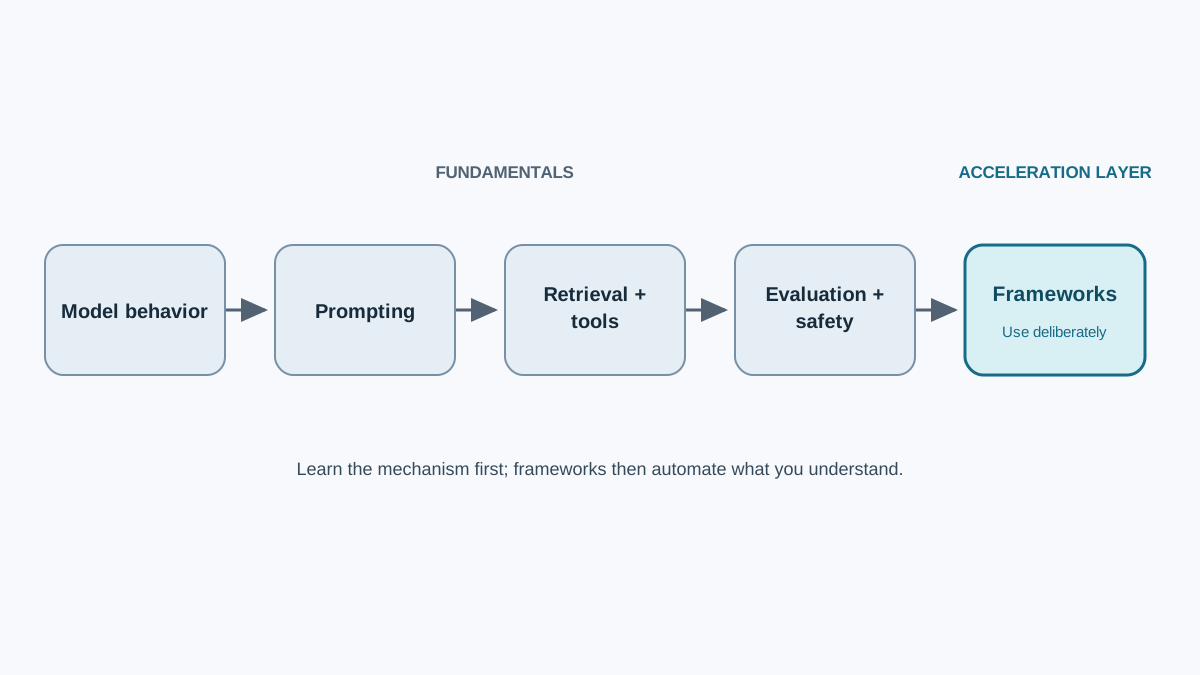
So, should you learn LangChain first? No. Learn the fundamentals first, and frameworks become tools you choose deliberately rather than crutches you depend on.
Here's a practical readiness check. You're ready for frameworks when you can answer three questions:
- Can you explain how the model generates output, including why context matters?
- Can you explain why retrieval helps ground answers in your data?
- Can you describe how you would test whether a change to your prompt or pipeline improved results?
If you can answer those, frameworks will accelerate your work. They automate repeated wiring—document loading, prompt assembly, tool-call parsing—so you can focus on application logic instead of plumbing.
If you can't answer those questions, frameworks will hide the mechanism from you. You'll build things that work by accident and fail without explanation, and you won't know which layer to debug.
The honest answer to "should I learn LangChain first?" is this: learn the model first. Learn how it behaves, how to prompt it, how retrieval feeds it relevant context, how tools extend its reach, how to evaluate its output, and where it breaks. Then pick a framework and watch how much faster everything clicks.
Your Next Step
Pick one small project that exercises prompting, retrieval, and evaluation together. Build a question-answering system over a handful of documents you care about—your own notes, a few articles, a manual you reference often.
Write prompts that pull answers from those documents. Test which chunks of context produce better responses. Keep a small set of test questions and check whether your changes improve or degrade the answers.
You don't need a framework for this. You need an API key, a few documents, and the willingness to observe how the model behaves when you change what you feed it. That project will teach you more about LLMs than any framework tutorial, because it forces you to engage with the mechanism directly.
Frameworks will keep changing. Your understanding of the model, your prompting judgment, your retrieval intuition, your evaluation habit, and your safety awareness will transfer everywhere. Build those first, and you'll be ready for whatever comes next.
Knowledge check
Final check
Finish the article by checking the ideas you just learned.
References
Research updated Sep 7, 2026


