
LLM Learning Paths and Next Steps
You have a folder of saved tutorials, a list of half-finished courses, and no project to show for any of it. That is not a learning problem. It is a…

Key topics
You have a folder of saved tutorials, a list of half-finished courses, and no project to show for any of it. That is not a learning problem. It is a direction problem.
Most LLM study plans stall because they treat learning as content consumption. Watch another video. Read another guide. Bookmark another roadmap. The knowledge never compounds because it never gets spent on anything. A real LLM learning path is not a playlist. It is a sequence of choices where each skill unlocks the next project, and each project proves the skill actually stuck.
Here is the anchor criterion to judge every next step against: does this move you closer to a concrete, buildable output? If a course, tutorial, or topic does not feed a project you can ship, it is entertainment, not training.
Why Most LLM Study Plans Stall
The symptom is familiar. You have watched the transformer explainer videos. You can define tokens and temperature. You have a vague sense that retrieval-augmented generation (RAG) matters. But when someone asks what you can do with LLMs, the answer trails off.
The weak model underneath is this: more exposure equals more skill.
It does not. Watching someone else build a RAG pipeline teaches you about RAG the way watching cooking shows teaches you to cook. You recognize the ingredients. You could not reproduce the dish under time pressure.
The stronger frame treats learning as capability building. Every concept you study should either remove a blocker from your current project or unlock the next one. Prompting fundamentals matter because they make your first API calls useful. Retrieval matters because it lets you ground a model in data it was not trained on. Evaluation matters because you cannot improve a system you cannot measure.
When you sequence skills this way, each one compounds. The alternative—collecting unrelated topics in the hope that they eventually assemble into expertise—produces the familiar outcome: a graveyard of bookmarks and no working system.
Pick a Destination, Then a Direction
Beginners waste the most time choosing courses before choosing a destination. A course is a tool. A direction is a target. Pick the target first, then select the tool that moves you toward it.
The four directions below are not competing techniques. They are different outcomes. Techniques like prompting, retrieval, and evaluation are layers you will use inside whichever direction you choose. What changes is the project you are building toward.
Ship applications. You use hosted models through their interfaces to build tools, automations, and products. This requires solid prompting skills, basic Python, and an understanding of context windows, cost, and latency. The output is working software: a summarization tool, a support bot, a content pipeline.
Choose this if you want visible results fast and enjoy turning an idea into something people can use. Do not choose this yet if you have no specific tool or product in mind—you will drift without a concrete build to anchor each skill.
Build knowledge systems with retrieval. You build systems that fetch relevant information and feed it to a model at query time. This requires understanding embeddings, vector databases, chunking strategies, and search quality. The output is grounded applications: question-answering over your own documents, research assistants, knowledge tools.
Choose this if you have a specific corpus you want to make queryable—your notes, your company's docs, a public dataset. Do not choose this yet if you have no retrieval problem worth solving. Retrieval is a component of many applications, not a separate career island. You can start with a simple application and add retrieval when missing knowledge becomes the bottleneck.
Customize models through fine-tuning. You take an existing model and adapt it to a domain or behavior through additional training. This requires deeper machine learning knowledge, dataset preparation skills, and comfort with training infrastructure. The output is specialized models: a model that writes in your style, classifies your domain's text, or follows your format reliably.
Choose this if you have hit the ceiling of prompting and retrieval and need behavior changes those techniques cannot deliver. Do not choose this yet if you have not mastered prompting—fine-tuning before basics is the most common expensive mistake in this field.
Go deeper into model internals. You study architectures, training methods, and research directions. This is the path toward research or advanced engineering roles. It requires substantial math, deep learning fundamentals, and the patience for slow, cumulative progress. The output is understanding: you can read papers, reason about model behavior, and contribute to the field.
Choose this if you are genuinely fascinated by how these systems work and want years of study ahead. Do not choose this yet if you want to build things—this direction delays visible output the longest.
The decision rule is simple: match the direction to the project you want to ship, not the topic that sounds most impressive. Fine-tuning sounds more advanced than prompt engineering. It is also slower, costlier, and often unnecessary. Build the thing you can actually finish.
Knowledge check
Check your understanding
Answer this question before you continue.
Map Your Starting Point to a First Build
You can choose a direction more precisely by answering four quick questions. These are the variables that actually change your first project and first skill.
What do you want to produce? A working tool, a queryable knowledge base, a specialized model, or deep understanding? Your answer names the direction.
How comfortable are you with code? If you can write basic Python, start with API calls and structured output. If you are still learning Python, your first learning block is not LLM theory—it is enough Python to make your first request and parse the response.
What data do you have access to? A pile of documents, notes, or records makes retrieval a natural early project. No useful data means focus on prompting and structured output first.
How many hours per week can you spend? Two hours a week supports small, incremental builds. Ten hours a week supports a more ambitious project. Size the first build to your real calendar, not your ideal one.
Here is how the answers combine into a first step:
| Your situation | First project | First skill to learn |
|---|---|---|
| Comfortable with code, wants to ship tools | A small automation that summarizes or transforms text | Prompting and structured output |
| Has a document collection to query | A question-answering tool over those documents | Retrieval basics, after prompting fundamentals |
| Comfortable with code, limited weekly time | A single-purpose script, not a full product | Prompting, then evaluation on one test case |
| Still learning Python | A script that calls an API and prints a formatted result | Python basics plus one API call |
The pattern matters more than the specific row: choose the smallest project that forces you to learn the skill you are missing. If you cannot yet make a reliable API call, no amount of retrieval theory helps you. Remove the blocker closest to your current position.
Knowledge check
Check your understanding
Answer this question before you continue.
Sequence Skills So Each One Unlocks the Next
Once you have a direction and a first project, the sequencing question becomes: what do I learn next?
The compounding principle: choose the next skill that removes the biggest blocker from your current project. Do not follow a generic syllabus. Look at what you are trying to build, identify the step you cannot yet do, and learn exactly that.
A sample progression for the application-building direction looks like this:
- Prompting fundamentals. Learn how to structure instructions, use context effectively, and iterate on outputs. This unlocks your first working API calls.
- Structured output and tool use. Learn to get reliable, parseable responses. This unlocks integration with real systems.
- Evaluation. Learn to measure whether your system actually works. Set up a small test set of inputs with known-good answers before you start changing anything.
- Retrieval basics. Learn to bring external data into your context window—but only when missing or changing knowledge is the demonstrated bottleneck.
Each step produces something you can use. You do not study prompting to pass a quiz; you study it to make your first bot answer correctly. When the bot fails on questions that require information it was never trained on, you have a reason to learn retrieval. When retrieval returns irrelevant chunks, you have a reason to learn chunking and search quality.
Common mistake: Adding retrieval before you know what is actually broken. If your model gives wrong answers because your prompt is confusing or your output format is unstable, external data will not fix that. It will add a new layer of failure on top of the old one.
Retrieval also does not guarantee correct answers. It brings more relevant context into the window, but the model can still misinterpret or misquote that context. That is why evaluation comes before retrieval in the sequence above: you need a way to measure whether the change actually helped.
The common mistake is jumping to fine-tuning before mastering prompting and retrieval. Beginners assume fine-tuning is the "real" technique and prompting is a stopgap. In practice, prompting and retrieval solve most application problems. Fine-tuning is a precision tool for a narrower set of cases—and you will know you need it when simpler methods stop working.
A useful mental map: the application-building direction forks from the model-customization direction. Both start with prompting and retrieval fundamentals. From there, one branch goes toward building products with existing models. The other goes toward training and adapting models. You can switch branches later, but the fundamentals at the trunk serve both.
Knowledge check
Check your understanding
Answer this question before you continue.
Turn Study Into a Portfolio You Can Show
A finished project is the proof that a study plan worked. Without one, your learning is invisible—to employers, to collaborators, and honestly, to yourself.
The habit that works: one small build per learning block, each slightly harder than the last. After you learn prompting, build a tool that uses it. After evaluation, measure where it fails and fix one weakness. After retrieval, extend that tool to answer questions from your own documents. The projects stack, and so does your skill.
You do not need a polished, product-ready application. You need evidence that you can take an idea from concept to working system. A scrappy tool that runs is worth more than a pristine tutorial you followed and forgot.
Mistakes and failed attempts count as progress. A build that breaks teaches you more than a demo that works. Debugging is where the mental model gets tested against reality. When your retrieval system returns irrelevant chunks, you learn more about chunking in one debugging session than in five tutorials.
For concrete project ideas that match your skill level, the portfolio project guide covers specific builds you can start with. The point here is the pattern: study a block, build something, observe the failure, fix it, move on.
Knowledge check
Check your understanding
Answer this question before you continue.
Keep the Path Alive: Review, Adjust, Repeat
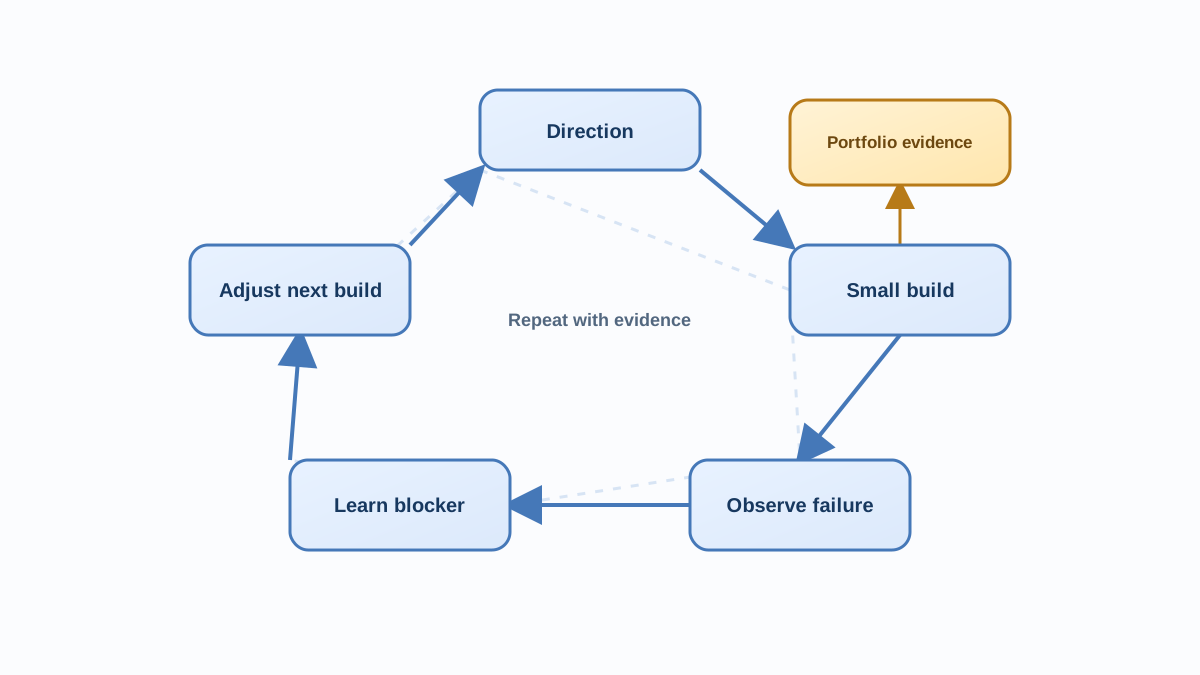
A static roadmap goes stale fast. LLM tooling and best practices shift quickly. Chunk sizes, embedding choices, and prompt patterns that worked six months ago get revised as models improve. If you treat your study plan as a fixed syllabus, you will spend time on skills that no longer matter.
The maintenance loop is lightweight. Every few weeks, review the evidence from your last build:
- What failed? Name the specific breakdown, not a vague feeling of frustration. Did the output format break? Did retrieval return irrelevant chunks? Did the model ignore your instructions?
- Which blocker repeated? If the same failure appears across multiple builds, that skill is your next learning block.
- What changed the output? Notice which adjustment actually improved results. That tells you which technique deserves deeper study.
- Should the next step be smaller, deeper, or redirected? If you keep missing your build deadline, shrink the project. If a skill keeps failing, go deeper on it. If the work no longer interests you, change direction.
It also helps to distinguish between two kinds of learning:
Learning that compounds. Reusable skills and mental models: how to structure prompts, how retrieval works, how to evaluate a system, how to debug a pipeline. These transfer across tools and versions.
Learning that expires. Specific tool versions, API details, and framework syntax. These change constantly. Learn them just-in-time for the project that needs them, not in advance.
Spend your study energy on the compounding layer. Pick up the expiring details when you need them.
Here is your next action. Choose one direction from the four above. Name one small project that direction enables. Schedule the first build within the next week. Put a review date on your calendar for three weeks out.
A learning path is not a syllabus to finish. It is a direction you adjust based on evidence from real builds. Start the loop, and let the projects tell you what to learn next.
Knowledge check
Final check
Finish the article by checking the ideas you just learned.
References
Research updated Sep 7, 2026


