
LLM Career Paths
Most people assume a career in large language models means training models from scratch—years inside a research lab, clusters of GPUs, and published…

Key topics
Most people assume a career in large language models means training models from scratch—years inside a research lab, clusters of GPUs, and published papers. That picture is not wrong. It is dramatically incomplete.
The wider LLM job market runs on a different kind of work: applying, evaluating, integrating, and governing models that someone else already built. That is also where most beginners realistically enter. The skill that transfers across nearly every LLM career is not the ability to build a foundation model. It is the ability to understand how models behave, where they fail, and how to make them useful inside a specific domain.
The LLM job market is wider than model training
Two very different kinds of work sit under the same acronym.
Building foundation models—the large, general-purpose models released by major AI labs—is research-heavy work. It demands deep machine learning expertise, massive computational resources, and often years of specialized study. The number of people doing this work is small, and the barrier to entry is high.
Applying and integrating those models is a different game. Someone needs to figure out how a legal firm reviews contracts with an LLM, how a hospital summarizes patient records, how an e-commerce company builds a support chatbot that does not invent shipping policies. That work happens everywhere, and it does not require training a model from scratch.
If you have read about how LLMs are transforming business, education, or coding, you have already seen where these roles live. They sit inside organizations that want the capability without building the underlying technology themselves.
Knowledge check
Check your understanding
Answer this question before you continue.
The main LLM job roles, mapped by what you do
Different LLM job roles cluster around different activities. Here is a map of the main archetypes, organized by what you actually do day to day.
| Role | Core activity | Typical background |
|---|---|---|
| AI application builder | Designs prompts, workflows, and tools that wrap models for a specific use | Writing, UX, domain expertise, some scripting |
| ML engineer / LLM engineer | Integrates models into products, builds retrieval pipelines, handles evaluation and deployment | Software engineering, systems thinking |
| Data scientist / ML researcher | Fine-tunes models, benchmarks performance, improves behavior for a domain | Statistics, machine learning, experimentation |
| AI product manager | Decides what to build, defines success, translates model capabilities into product requirements | Product management, strategy, user research |
| AI governance specialist | Evaluates risk, sets guardrails, navigates regulation and policy | Law, policy, ethics, risk management |
| Domain expert using LLMs | Applies models inside a specific field like law, medicine, marketing, or education | Deep domain knowledge plus applied AI skills |
The boundaries blur in practice. A small team might expect one person to handle prompt design, retrieval, and evaluation. A large organization might split those across three specialists. What matters is recognizing which cluster of activities fits your strengths.
How to choose between the roles
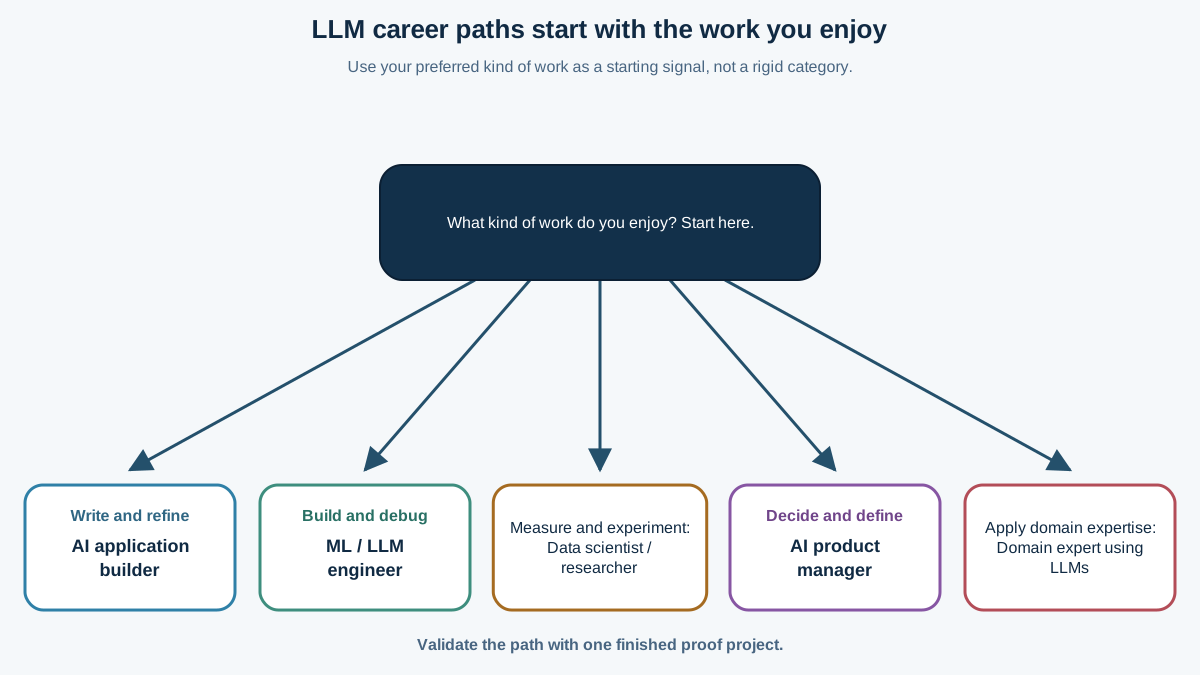
The table tells you what each role does, but not which one fits you. Use this decision frame instead:
- Do you enjoy writing, observing model behavior, and refining instructions? Start with AI application building. Your first proof artifact: a prompt system that performs one real task reliably.
- Do you enjoy building systems and debugging pipelines? Aim toward LLM engineering. Your first proof artifact: a retrieval system over documents you know well, with measured results.
- Do you enjoy measurement and experimentation? Look at data science. Your first proof artifact: an evaluation harness comparing two models on a specific task.
- Do you enjoy deciding what to build and defining success? Consider product management. Your first proof artifact: a product brief with success metrics and failure thresholds.
- Do you already have deep expertise in a field? The domain expert route may be your strongest entry. Your first proof artifact: a tool that solves a real problem in your industry.
One clarification matters here. Prompt iteration—writing and refining instructions—is not a standalone career. It is a component inside many roles. AI application building is broader: it means designing a complete workflow, choosing when a model is needed, evaluating output quality, and handling failures. That distinction matters because employers rarely hire for prompt writing alone. They hire for the judgment that surrounds it.
Knowledge check
Check your understanding
Answer this question before you continue.
What employers actually look for
Job postings are full of vague language. "Strong understanding of LLMs." "Experience with prompt engineering." "Familiarity with RAG architectures." Translate that language into what employers actually want to see, and a clearer picture emerges.
Most employers want evidence of applied judgment, not credentials alone. A certificate saying you completed a course matters far less than a project showing you can take a messy problem, choose an appropriate model, build a workflow around it, evaluate the results, and explain the tradeoffs you made.
The transferable skills that matter across LLM career paths are concrete:
- Prompt design: structuring instructions that reliably produce useful output
- Evaluation: measuring whether a system is actually good enough for its purpose
- Debugging model output: diagnosing why a model fails and fixing the cause
- Retrieval: building pipelines that give the model the right context at the right time
- Knowing when not to use an LLM: recognizing tasks where a simpler solution is better
That last one is more valuable than it sounds. Employers are drowning in demos that work on clean examples and fall apart in production. Someone who can say "this task does not need an LLM" with clear reasoning is worth listening to.
Domain knowledge is often the differentiator. Two candidates might have similar technical skills, but the one who understands the field—its jargon, its workflows, its failure modes—will produce better results faster. If you already have expertise in an industry, do not abandon it to chase generic AI skills. Layer the AI skills on top.
One warning: do not chase every new tool. The landscape shifts weekly, and shallow familiarity with many tools does not signal capability. Depth in one workflow—understanding its failure modes, its evaluation challenges, its deployment realities—signals something far more useful.
Knowledge check
Check your understanding
Answer this question before you continue.
Building a portfolio that proves your skills
The most convincing portfolio item is a small, finished project that shows a complete workflow. Not a tutorial you followed. Not a demo that works only on the one example you tested. A project with a real problem, a model choice, an evaluation, and a documented limitation.
Here is a lightweight completion contract to test whether your project is actually finished:
- A small test set. Gather ten to twenty representative cases that reflect real inputs, including tricky ones.
- A stated success criterion. Write down what "good enough" means before you evaluate. Subjective impressions do not count.
- Observed failures. Run your system against the test set and record where it breaks.
- One documented revision. Fix something based on what you observed and note what changed.
That last step—documenting failures—is where most beginners skip ahead. They show the wins and hide the rough edges. But employers know real systems have rough edges. A candidate who can say "here is where this system breaks, here is why, and here is what I would try next" demonstrates the engineering judgment that separates useful builders from demo makers.
Project ideas that map to specific roles:
- For AI application building: build a prompt system that performs a real task—drafting emails in your industry, summarizing research papers, generating structured data from messy text. Document the prompt iterations and what you learned from each failure.
- For LLM engineering: build a retrieval system over documents you know well—your own notes, public reports, a corpus you understand deeply. Measure whether retrieval actually surfaces relevant context and where it fails.
- For data science: build an evaluation harness that compares two models on a specific task. Document the metrics, the edge cases, and the judgment calls.
- For product management: write a product brief for an LLM feature, including success metrics, failure thresholds, and a risk analysis. Show you can think beyond the demo.
The value of shipping observable output over accumulating tutorials cannot be overstated. A finished project, however small, teaches you more than ten half-completed courses. It forces you to confront the gap between what you expected and what the model actually did—and that gap is where real learning happens.
Knowledge check
Check your understanding
Answer this question before you continue.
Common mistakes beginners make
The fastest way to slow your progress is to repeat mistakes that others have already made. Here are the ones I see most often.
Chasing model training before mastering application. Most beginners never need to pretrain a model. The skills involved—distributed training, data curation at scale, evaluation against benchmarks—are largely irrelevant to application work. Learn how models behave before you worry about how they are built.
Confusing tool familiarity with capability. Knowing how to call an API is not the same as knowing how to evaluate and debug the system you built with it. The first is a few hours of reading documentation. The second is the actual job.
Ignoring evaluation. If you cannot measure whether your system is good enough, you cannot improve it, and you cannot convince anyone it works. Evaluation is not a final step; it is the discipline that makes every other step meaningful. Being unable to measure quality is a career blocker.
Over-indexing on hype and job titles. Titles like "AI Engineer" and "Prompt Specialist" mean different things at different companies. Look past the title to the underlying work. A role that involves writing prompts all day is very different from one that involves building production systems.
Neglecting domain depth. Generic AI skills are becoming easier to acquire as tools improve. The people who stand out combine those skills with real knowledge of a field. Your existing expertise is an asset, not a liability.
Choosing your next step
By now you have a map of the main LLM career paths. The question is which one to pursue. Ask yourself three questions:
- What do I already know deeply? Your existing domain knowledge is your differentiator. A lawyer, a marketer, and a software engineer will each find a different natural entry point.
- What kind of work do I actually enjoy? Do you like writing and iterating on instructions? Building systems and debugging pipelines? Measuring and analyzing results? Making decisions under uncertainty? Each of those maps to a different role.
- What can I finish? A project that plays to your strengths and interests is one you will actually complete. An ambitious project that does not match your skills will stall.
Once you have answered those questions, pick one role and build one small project that demonstrates its core skill. Not two roles. Not three projects. One role, one project, finished and documented.
My rule is simple: choose the role that fits your existing strengths, build the smallest project that proves you can do its core work, and write down both what worked and what did not. The project does not need to be impressive by industry standards. It needs to be complete enough to show your judgment.
The durable asset in any LLM career is applied judgment about how models behave—knowing where they succeed, where they fail, and how to make them useful in a real context. That judgment compounds. It transfers across tools, models, and job titles. It is what survives when the hype fades and the next new thing arrives.
Pick your role. Build your project. Document what you learned. That is the path.
Knowledge check
Final check
Finish the article by checking the ideas you just learned.
Research updated Sep 7, 2026


