
Structured Output vs Tool Calling: Data Returned or Action Requested?
Structured output and tool calling look almost identical from the outside. Both accept a JSON schema. Both return clean key-value pairs instead of…

Key topics
Structured output and tool calling look almost identical from the outside. Both accept a JSON schema. Both return clean key-value pairs instead of conversational prose. If you've only seen the API shapes side by side, "they're basically the same thing" is a reasonable conclusion—and a costly one.
The difference is not the shape of the output. It's what happens next.
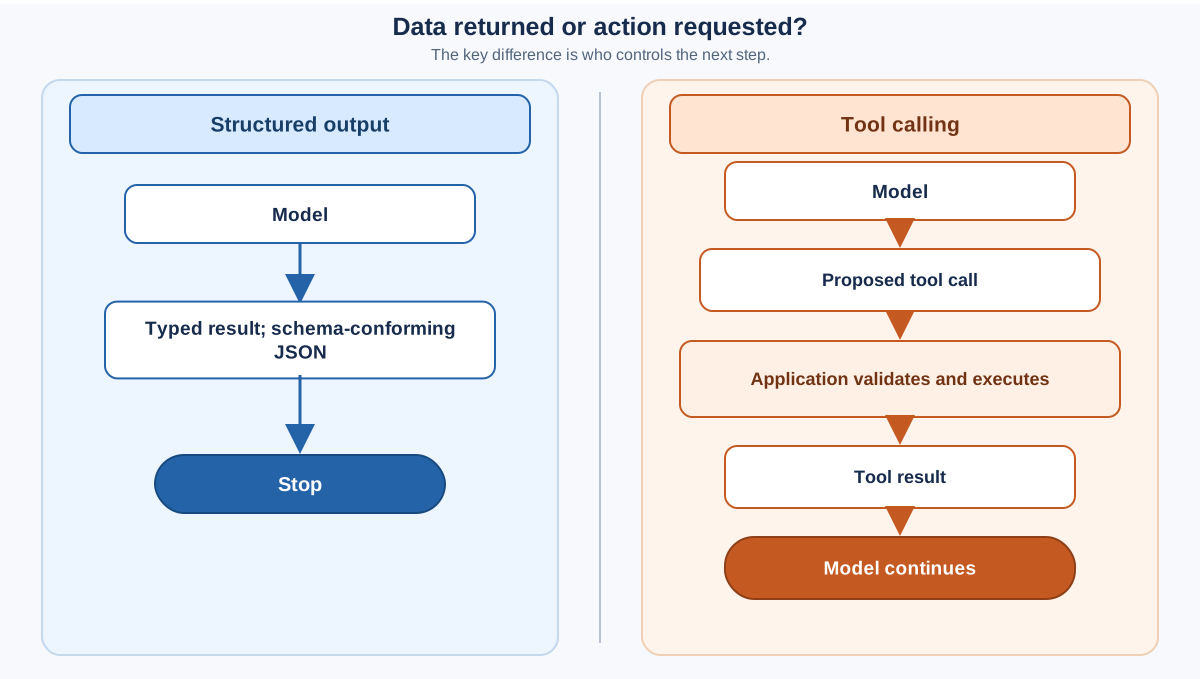
Structured output ends the model's turn with a typed result. Tool calling pauses the model so your code can act, observe the result, and let the model continue. One is a delivery. The other is a handoff.
Why These Two Features Feel Identical (and Why That's the Trap)
Here's what confuses everyone at first: both features are configured with a JSON schema, and both can produce perfectly formatted JSON responses. If you squint at the request and response structures, they look like two routes to the same destination.
They are not.
The real difference lives in control flow—who gets to do something after the model responds.
With structured output, the model returns data that conforms to your schema, and the turn ends. Your application receives the result, validates it, and moves on. There is no second act.
With tool calling, the model returns a proposal: "I want to call get_weather with these arguments." The model cannot execute anything itself. Your application receives that proposal, decides whether to honor it, runs the actual function, and sends the result back into the conversation. The model then continues—maybe with a final answer, maybe with another tool call.
One clarification matters before we go further. Structured output is not limited to describing passive data. It can describe a proposed action, a routing decision, or a plan—anything you can express as a schema. And tool-call arguments are themselves structured data. So the real boundary is not "data versus action." It's whether the protocol gives the model a selectable operation plus an explicit execution loop, or whether it simply constrains the shape of a message.
Knowledge check
Check your understanding
Answer this question before you continue.
Structured Output: The Model Hands You a Typed Result, Then Stops
Structured output is a single-turn contract. The model reshapes information it already has into a format you specified—and then it's done.
Think of extraction, classification, parsing, or standardization. You have a pile of unstructured text, a support ticket, a product review, a meeting transcript. You want the model to pull out the fields you care about and return them as reliable JSON. The model has everything it needs inside the prompt or context window. The job is reshaping, not investigating.
That's why structured output shines for batch work. Want to extract the same schema from 500 documents? Send 500 independent calls. No state to track, no conversation to manage, no tool results to feed back. Each call is self-contained, which makes it fast, cheap, and easy to parallelize.
There's an important reliability distinction hiding here. Asking a model to "return JSON" is not the same as schema-constrained decoding. Many providers now offer strict structured output that constrains the model's generation to match your schema, which eliminates malformed JSON and most schema violations. But support varies by provider and model, and some providers restrict strict mode from being combined with streaming or tool use in a single call. Check what your provider actually guarantees before you assume "structured output" means "guaranteed valid schema."
Structured output is the wrong tool when the model needs information it doesn't already possess at that step. If the answer depends on a database query, an API call, or any external system, structured output has no way to get there. The model can only reshape what's already in front of it.
That last condition matters more than beginners expect. Structured output can absolutely participate in an active workflow—it's often the final step after retrieval or tool calling has gathered the needed context. The question is not whether your overall application is "active." It's whether the model has what it needs right now to produce the typed result you're asking for.
Knowledge check
Check your understanding
Answer this question before you continue.
Tool Calling: The Model Proposes an Action, Your Code Decides
Tool calling is a control-flow handoff. The model returns a tool name and arguments—a proposed action—and then stops. Your code takes over.
The loop looks like this:
- The model decides a tool is needed and emits a tool call.
- Your application receives the proposal.
- Your code executes the actual function.
- The result is added back to the conversation.
- The model continues—maybe with a final answer, maybe with another tool call.
Decide, act, observe, decide again. That loop is the engine of agentic behavior. It's what lets a model fetch information it lacks, query multiple systems, and chain actions together across several steps.
Here's the mistake I see beginners make constantly: they assume the tool ran just because the model emitted a tool call.
It didn't. The model cannot execute code, touch external systems, or send emails. It can only propose that your code do those things. If your application never executes the function, nothing happens. The model's tool call is a suggestion, not a side effect.
That separation is a feature, not a limitation. Because the model only proposes, your application owns validation and permissions. You decide whether the proposed action is safe, whether the arguments are sane, whether this user is allowed to trigger this tool. The model proposes; your code disposes.
This is also why tool calling costs more than structured output. Each loop iteration adds round trips: model call, your execution, result fed back, model call again. Every step appends to the context window, accumulating tokens and latency. For a single extraction task, that overhead is pure waste. For a multi-step workflow that genuinely needs external information, it's the price of admission.
Knowledge check
Check your understanding
Answer this question before you continue.
Structured Output vs Tool Calling: A Side-by-Side Comparison
| Structured Output | Tool Calling | |
|---|---|---|
| What it returns | A typed result conforming to your schema | A proposed tool name and arguments |
| Who controls what happens next | Your code, after receiving the result | Your code, which must execute the tool and feed results back |
| API round trips | One | Two or more (model → your code → model) |
| External systems touched | None directly | Only if your code executes the proposed tool |
| Validation focus | Schema conformance | Whether the action was correct and safe |
| Typical use cases | Extraction, classification, parsing, standardization | Fetching missing information, multi-step workflows, triggering actions |
The table makes the boundary clear: structured output is about the shape of a result. Tool calling is about the flow of control.
The Hybrid Pattern: When You Need Both
Here's what most production systems actually look like: they use both.
Tool calling handles the orchestration—the steps where the model needs to fetch information, query systems, or navigate uncertainty. Structured output handles the final contract—locking the result into a shape your downstream code can consume reliably.
Consider an agent that needs to look up a customer's account, check their recent orders, and return a strictly formatted summary. Tool calling gets the model to the answer by retrieving the account data and order history. Structured output makes that answer machine-consumable by enforcing the exact output schema your application expects.
Why not force one mechanism to do both jobs? Because some providers can't combine strict structured output with tool use or streaming in a single call. And even when they can, the two features have different failure modes and different validation needs. Treating them as separate contracts—tool calling to reach a decision point, structured output to lock in the result—keeps each mechanism doing what it does best.
My rule: use tool calling to get the model to a decision point, then use structured output to make the answer machine-consumable.
Knowledge check
Check your understanding
Answer this question before you continue.
A Decision Rule for Your Next Build
When you're building a feature and aren't sure which mechanism to reach for, ask three questions in order:
- Is the needed information already in context, and is a typed result enough? The model has everything it needs inside the context window, and you just want it reshaped into a reliable format. Use structured output.
- Must the model select among operations, or must external results return to the model before it can continue? The model needs to choose which tool to use, or whether to use one at all. Use tool calling.
- Must a real side effect occur? Something in the real world must actually happen—a database write, an API call, an email sent. Require application-side authorization and execution, regardless of which output format initiated the request.
Three mistakes account for most of the pain I see:
Expecting the tool to have executed when the model only proposed it. The model emits a tool call; nothing runs until your code runs it. Always verify execution happened, not just that the model said it should.
Using structured output when the model lacks information. If the answer depends on data outside the context window, no amount of schema enforcement will help. The model can't extract what it can't see.
Building an unbounded tool-calling loop. A loop without a maximum iteration count is a production incident waiting to happen. If the model keeps calling tools and never converges, you need a hard stop.
Here's your next step: take one small task you already automate and classify it. Is it reshaping information the model already has into structured fields? Or is it selecting and requesting external work—fetching missing information or triggering a real-world effect? Answer that question honestly, and the mechanism choice follows.
Structured output and tool calling aren't rivals. They're complementary contracts, and most serious systems end up using both. The skill is knowing which one each step of your application needs—and that starts with knowing whether you're asking for a typed result or requesting a handoff.
Knowledge check
Final check
Finish the article by checking the ideas you just learned.
References
Research updated Sep 7, 2026


