
LLM Routing Workflows: Classify the Task Before Choosing a Path
When builders hit a multi-path LLM application, many reach for an agent. That instinct costs them. The real mechanism for most of these systems is a…

Key topics
When builders hit a multi-path LLM application, many reach for an agent. That instinct costs them. The real mechanism for most of these systems is a router: classify the request up front, then hand off to a bounded path. The difference matters because agents decide their next action as they go, and that flexibility brings unpredictable behavior, runaway tool calls, and debugging pain. Most of the time, you do not need an agent. You need a router.
Why a Router Is Not an Agent
The confusion between routing and agentic systems is the most expensive mistake in this design space. Let me make the distinction sharp.
A router selects from predefined paths. It looks at the incoming request, assigns it to a category, and hands it to the handler for that category. The router does not reason about the answer. It does triage.
An agent, by contrast, chooses its actions during execution. It decides which tool to call, interprets the result, decides whether to call another tool, and repeats until it judges the task complete. That loop is powerful, but it is also where cost, latency, and unpredictable behavior enter the system.
The real contrast is not "one decision versus many decisions." A route can lead to a multi-step workflow, and that workflow may include a bounded second decision. The contrast is about who owns the control flow:
- Routing: the system designer defines the allowed paths, their boundaries, and their stopping conditions in advance.
- Agents: the model selects actions dynamically, and the path emerges from what it decides along the way.
The practical rule: if you can enumerate the possible task types in advance, and each type has a clear handler, routing is the least-complex approach that works. You are choosing a path, not orchestrating a conversation.
This connects directly to the broader agents-versus-workflows decision. A routing workflow is one specific bounded pattern within that landscape. If you have already decided that a fixed workflow fits your problem better than an open-ended agent, routing is often the workflow you actually want.
Knowledge check
Check your understanding
Answer this question before you continue.
What a Routing Workflow Actually Looks Like
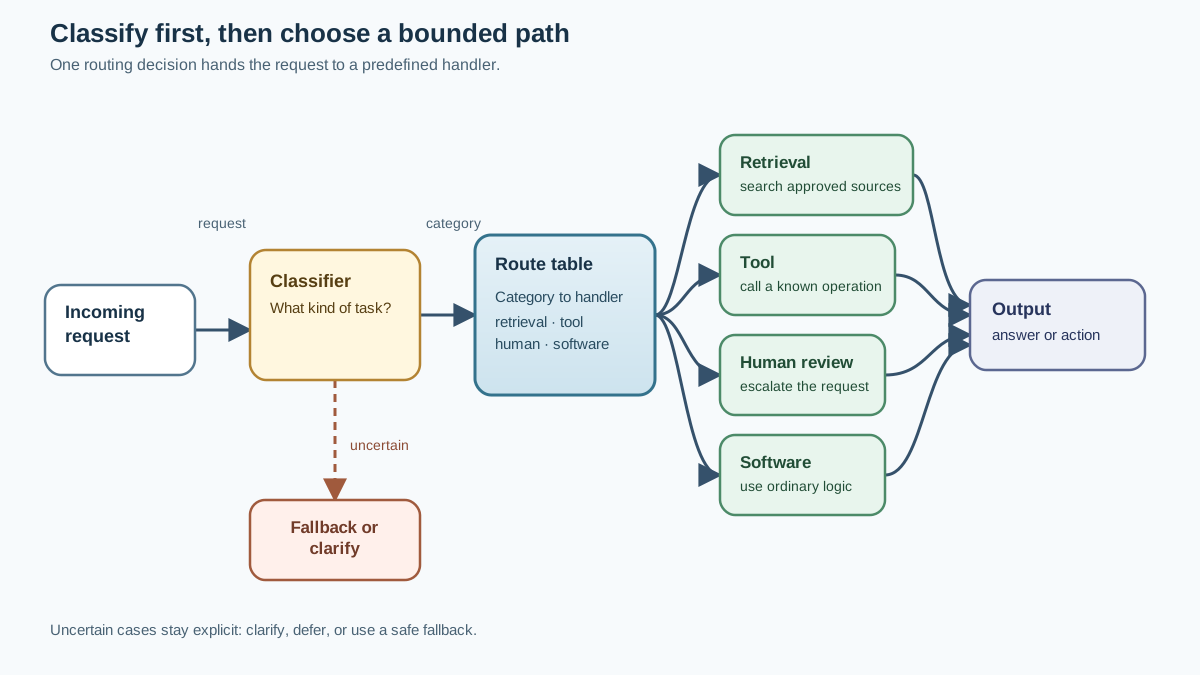
A routing workflow has five parts, and it helps to name them before you build anything:
- Input — the user request enters the system.
- Classifier — a mechanism assigns the request to a category.
- Route table — a mapping from category to handler.
- Downstream handler — the code, model call, or workflow that does the work.
- Output — the result returns to the user.
The route table is the contract that keeps the whole system bounded. It is a plain, auditable list: if the classifier says category A, run handler A; if category B, run handler B. Nothing about that mapping is mysterious, and that is the point.
Here is the part builders often miss: routes do not have to point at other LLM calls. A route can point to:
- Retrieval — a RAG path that pulls documents and answers from them.
- A tool call — a calculator, a database query, an API request.
- A specialized model — a small fast model for simple tasks, a larger one for complex reasoning.
- A human review queue — requests that need judgment or approval.
- Plain software — ordinary code that needs no LLM at all.
Each downstream path is itself a bounded workflow, not an open-ended agent. The router's job ends at the handoff.
Knowledge check
Check your understanding
Answer this question before you continue.
Designing the Route Table: Boundaries Before Prompts
The most important design work in a routing workflow happens before you write any classifier prompt. You need to define the categories themselves, and you need to define them well.
Two properties matter:
Distinguishable. A request should map to a route without depending on luck. If your categories overlap, the classifier's answer depends on prompt phrasing rather than on the genuine task type. "Answer a question about our product" and "Help with a billing issue" overlap constantly. "Look up a fact from our documentation" and "Resolve a billing dispute" overlap far less.
That does not mean every request must fit exactly one route. Some requests legitimately need multiple handlers, parallel paths, or a clarifying question back to the user. The design question is whether you have defined those outcomes explicitly instead of letting the classifier improvise.
Exhaustive with a named default. Every request that enters the system needs a destination. If you do not define the fallback route explicitly, the classifier will invent one, which means it will route unpredictably.
Keep the route set small. Every added route multiplies classification ambiguity. Five well-separated routes beat twelve overlapping ones. My rule: if you cannot explain each route boundary to a non-technical teammate in one sentence, the boundary is too fuzzy to classify reliably.
Route boundaries should follow the capabilities of your downstream handlers, not the surface wording of user requests. A user might say "I need a refund" or "My order arrived broken" or "This charge is wrong." Those sound different, but if they all lead to the same refund-handling workflow, they belong to one route.
Common mistake: Routes that overlap because they were named after user phrasing rather than handler capabilities. The classifier then becomes a coin flip between two paths that should have been one.
Knowledge check
Check your understanding
Answer this question before you continue.
Choosing How to Classify: Rules, Embeddings, or an LLM
Once the route table is clean, you choose the classifier. Three main mechanisms exist, and each has a real tradeoff.
Rule-based and keyword matching. Cheap, transparent, and brittle. You match on specific words, phrases, or metadata tags. This works well when the route set is small and stable, and when your upstream systems already tag requests. It fails when users phrase the same intent in wildly different words.
Embedding-based semantic classification. You convert the query into a vector and measure similarity against labeled reference prompts, each representing a route category. This handles varied wording better than keywords while staying cheaper and more predictable than an LLM call. It is a strong middle ground when categories are stable but phrasing varies.
LLM classifier with structured output. You ask a model to classify the request and return a structured category. This handles nuance and edge cases best, but it adds latency and cost. And structured output constrains the format, not the reasoning: the model can still misclassify in ways that are harder to debug than a rule you can read.
Here is the insight that frees most design decisions: the classifier choice is independent of the downstream handlers. You can route to an expensive, capable LLM path using a cheap rule-based classifier. The classifier only needs to be good enough to sort requests into your route categories. It does not need to be as smart as the handler that follows it.
The tradeoff ladder looks like this:
| Mechanism | Transparency | Cost | Flexibility |
|---|---|---|---|
| Rules / keywords | High | Very low | Low |
| Embedding similarity | Medium | Low | Medium |
| LLM classifier | Low | Medium | High |
Start with the cheapest classifier that can separate your routes reliably. Upgrade only when misclassification data tells you to.
Knowledge check
Check your understanding
Answer this question before you continue.
Handling the Uncertain Middle: Abstention and Fallbacks
Every router faces requests that do not fit cleanly into any category. Ambiguous phrasing, out-of-scope questions, adversarial inputs, or requests that genuinely straddle two routes. If you have not planned for this, you have not designed the router.
The failure mode is forcing every request into a route. That guarantees confident wrong answers instead of honest uncertainty.
Three mechanisms make misclassification safe:
An abstention signal. The classifier needs a way to say "I cannot tell." That signal can take several forms: an explicit "unsure" category, a weak rule match, a close embedding score, or a low confidence score. The form matters less than the behavior: below the threshold, the request does not go down the chosen path.
A safe default path. Design what happens to uncertain requests: a generalist handler that can address a wide range of inputs, a clarifying question back to the user, or a human handoff.
A fallback chain. When the first choice fails or the classification looks wrong, the request escalates to the next appropriate handler instead of returning a bad answer.
One warning about confidence scores: a number from an LLM is not automatically a dependable probability. Models can report high confidence and still be wrong. A confidence threshold only helps when you have tested it against labeled examples or observed route outcomes. Treat confidence as a signal to evaluate, not a guarantee to trust.
The cost of a wrong route is not just a wrong answer. A wrong route can trigger the wrong tool, waste tokens on an irrelevant retrieval, surface the wrong data, or send a request to a human queue that should have been automated. In a system with real downstream effects, misclassification is an operational risk, not just a quality issue.
Common mistake: Routing everything uncertain to the most capable model as a "safe" default. That defeats the purpose of routing entirely. You have rebuilt the single-model system you were trying to escape, with extra latency and cost added by the router in front of it.
When Routing Is the Wrong Tool
Routing is a pattern with a clear boundary. Learn where it stops applying.
Routing fits when task types are known, bounded, and map to distinct handlers. A customer support front door, a document processing pipeline, a content system that separates summarization from extraction from generation. If you can define the allowed paths in advance, routing is the right shape.
Routing is overkill when there is effectively one task type. A single prompt or model handles everything. Adding a router here is ceremony that adds latency and a new failure point.
Routing is insufficient when the correct path depends on intermediate results. If you cannot know whether you need retrieval until you see what the first model call produces, you do not have a routing problem. You have a multi-step workflow or an agent problem.
Two neighboring decisions deserve separation. Model routing — choosing which model handles a task — is a different question from task routing, though the two often appear together. And caching is a separate optimization for repeated requests, not a routing strategy.
The decision rule that ends the confusion: if you cannot define the allowed paths, their boundaries, and their stopping conditions in advance, you do not have a routing problem yet. You have an exploration problem, and you should solve that before you build any router.
The Design Exercise That Puts This Together
Take a real application you are building or maintaining. A support bot, a content pipeline, an internal tool. Now do three things:
- Name the routes. Write down every distinct task type the system must handle. Aim for three to seven. Check that each route maps to a handler that actually exists or is worth building.
- Define the default. Decide what happens to requests that fit no route. A generalist handler, a clarifying question, a human queue. Name it explicitly.
- Choose the classifier. Start with the cheapest mechanism that can separate your routes. Upgrade only when misclassification data proves you need to.
The core decision rule is worth repeating: routing is the pattern for systems where the paths are knowable in advance. If you cannot define the route boundaries, routing is not the right pattern yet. If you can, a router gives you a system that is cheaper, more predictable, and far easier to debug than an agent doing the same job.
Design the route table first. The classifier will follow.
Knowledge check
Final check
Finish the article by checking the ideas you just learned.
References
Research updated Sep 7, 2026


