
LLM Model Routing Explained: Choosing the Right Model Per Task
Here's a scenario I see constantly: an application sends every request to one frontier model. Summarize this email in two sentences? Frontier model.…

Key topics
Here's a scenario I see constantly: an application sends every request to one frontier model. Summarize this email in two sentences? Frontier model. Classify this support ticket? Frontier model. Extract a date from a paragraph? Frontier model. The bill arrives, and you're paying premium prices for work a much smaller model could handle flawlessly.
The instinct is to call this a cost problem and reach for model routing as a money-saving hack. That's the wrong mental model. LLM model routing is a decision layer between your application and your model providers. Done well, it preserves quality per task while spending less. Done poorly, it quietly degrades the exact requests your users care about while you celebrate the savings.
This guide walks through what a router actually decides, how to design a routing decision from task requirements, and how to verify routing improves outcomes rather than just cutting spend.
Why One Model for Everything Is the Wrong Default
The single-model default feels safe. One model, one quality bar, one integration. But it hides a real cost that isn't just line-item price: you're paying frontier capability for trivial work while adding latency to simple requests.
A frontier model might be the right choice for a complex reasoning task. It's overkill for "summarize this in two sentences." The quality gap between a frontier model and a small, fast model on that kind of structured, simple task is often near zero. You aren't paying for better answers. You're paying for capability you aren't using.
Routing fixes this by asking one question before every request: which model in my pool can do this task well at the lowest cost? Simple requests go to small, cheap models. Hard requests go to frontier models. The routing layer sits between your application and providers, inspecting each incoming request and mapping it to the right destination.
But here's the reframe that matters: routing is a quality-preserving cost optimization. The goal is to keep output quality per task within your threshold while spending less. If routing cuts costs by 50% but silently fails on a class of requests your users depend on, that's not a win. It's a false economy.
If you've already worked through the cost, latency, and quality tradeoffs of model selection, you know the tension. This article is about operationalizing that tradeoff per request instead of per application.
The Routing Decision Model: Requirements First, Labels Second
Most routing discussions start with classification: how do we label this request as "simple" or "complex"? That puts the cart before the horse. A label like "simple" is only useful if it predicts something about which model will succeed. The actual decision needs three steps.
Step 1: Define the task requirements. Every task type in your application has a quality threshold, a latency budget, and an allowable cost. A support-ticket classifier might tolerate occasional mislabels. A medical summarization task might not. Name the bar before you name the model.
Step 2: Determine which models meet the bar. For each candidate model, ask: does it meet the quality threshold for this task type? Does it fit the latency budget? If a small model produces acceptable output for 90% of your extraction requests, it's eligible for those requests—regardless of what a frontier model could do better.
Step 3: Select the cheapest eligible model. Among models that clear the quality and latency bar, pick the lowest-cost option. That's the entire decision rule. Difficulty labels and task types are useful signals, but they're proxies. The real question is always: which eligible model costs least?
Let's trace one request through this model. A user submits a support ticket: "My invoice shows a charge from last month that I already paid." Your application needs to classify the ticket into a category.
- Task requirements: Classification accuracy above 95%, response under two seconds, cost per request under a cent.
- Candidate check: A small, fast model classifies this ticket correctly in your evaluation set. A frontier model also classifies it correctly, but takes longer and costs 20x more.
- Decision: Route to the small model. The frontier model offers no quality advantage on this task, so its extra cost buys nothing.
Now consider a different request: "I was charged twice and my account is locked and I need this resolved before my business audit tomorrow." Same task type—ticket classification—but the stakes are higher. If your quality threshold for urgent billing issues is stricter, or if the small model confuses urgency with billing category, the frontier model becomes the eligible choice.
This is why routing on labels alone fails. "Simple" and "complex" are summaries of a decision, not the decision itself. The requirements come first.
Knowledge check
Check your understanding
Answer this question before you continue.
The Routing Workflow: From Request to Evaluation
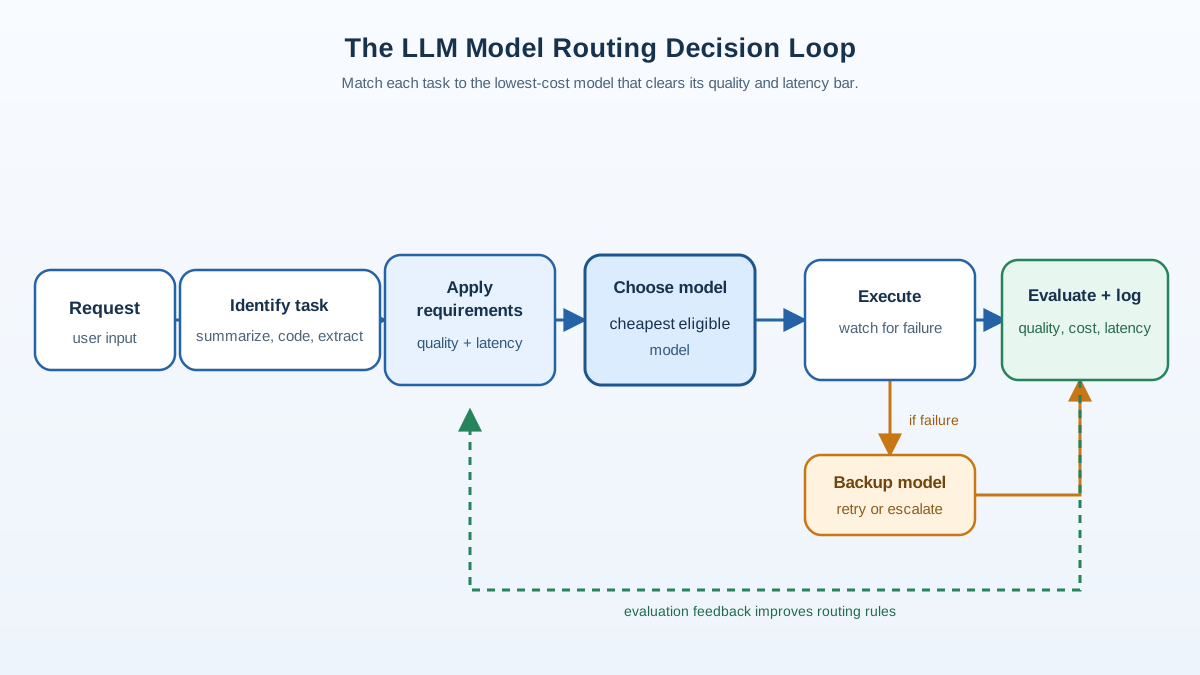
A router isn't a single decision point. It's a small pipeline that runs for every request. Here's the full flow:
- Receive the request. The router inspects the input, along with any metadata like endpoint, user tier, or request type.
- Identify the task. Classify what kind of task this is: summarization, extraction, classification, code generation, or something else.
- Filter candidates. Apply the quality threshold and latency budget for that task type to your model pool. Remove models that don't qualify.
- Select the model. From the remaining eligible models, choose the cheapest.
- Execute with fallback. Send the request to the selected model. If it errors, times out, or returns a low-confidence result, redirect to a backup model.
- Log the decision. Record which model handled the request, why it was chosen, and whether fallback fired.
- Feed evaluation. Periodically compare routed outputs against your baseline on representative cases.
The key insight: classification happens early, but it only narrows the candidate pool. Selection happens after you've applied task requirements. And evaluation happens continuously, not once at launch.
Knowledge check
Check your understanding
Answer this question before you continue.
Two Routing Questions: Difficulty or Task Type?
Within that workflow, the router answers one of two distinct questions.
Complexity routing asks: how hard is this? A short classification task routes to a small model. A multi-step reasoning problem routes to a frontier model. The router estimates difficulty and matches it to model capability.
Semantic or task routing asks: what kind of task is this? Code queries go to a code-specialist model. Medical queries go to a clinical model. General conversation goes to the cheapest capable option. A simple medical question and a complex medical question both route to the medical model. The dimension being optimized is task type, not difficulty.
These two questions often blend in practice. A routing layer might first classify the task type, then estimate complexity within that type to pick between a small and large model in the same domain.
| Signal | Complexity routing | Task/semantic routing |
|---|---|---|
| Question asked | How hard is this request? | What kind of request is this? |
| Best when | Quality varies by difficulty within one task type | You run specialized models for distinct domains |
| Example | Easy extraction to small model, hard reasoning to frontier | All code queries to code model, all medical queries to clinical model |
| Weakness | Difficulty is hard to estimate reliably | Doesn't help when one domain needs multiple capability levels |
Choose complexity routing when your application handles one dominant task type with wide difficulty variation. Choose task routing when you have genuinely different domains that benefit from specialized models. Many production systems need both: classify the domain first, then estimate difficulty within that domain.
Knowledge check
Check your understanding
Answer this question before you continue.
How the Router Makes the Call
The router itself can be built several ways, and each approach carries different tradeoffs.
Rule-based routing uses metadata, keywords, or request fields to make the decision. Request length, detected language, endpoint path, or explicit user flags can all drive the route. This approach is transparent, cheap, and debuggable. When a request routes somewhere unexpected, you can trace exactly which rule fired. The weakness is brittleness. Rules break when tasks don't separate cleanly. A support ticket about a billing error and a support ticket about a Python bug might look identical by keyword, but they need very different model capabilities.
Classifier routing uses a small, cheap LLM to label the task before selecting the model. The classifier handles fuzzy boundaries that defeat keyword rules. A sentence like "my code won't deploy and now my customers are angry" needs classification, not keyword matching. The cost is an extra routing call. That adds latency and spend to every request, which can erase the savings on short, simple requests. The classifier also has its own failure modes. If it mislabels a task, the entire system inherits that error.
Learned routing trains a router on preference data to predict which model will produce the better response for a given query. Research systems have demonstrated this approach, using human preference data to learn efficient router models that dynamically select between stronger and weaker models. Learned routers can handle complex routing decisions and adapt as new models enter the pool. But they require training data and ongoing evaluation to trust. You need a stable request distribution before investing in this approach.
| Approach | Overhead | Best starting point |
|---|---|---|
| Rules | Near zero | Clean task separation, or first version for visibility |
| Small classifier | One extra call per request | Fuzzy task boundaries, routing call cheap relative to generation |
| Learned router | Training + evaluation setup | Stable traffic, enough data, savings justify complexity |
Common mistake: Overbuilding the router before you've defined your task taxonomy. You can't classify tasks intelligently if you haven't named the categories that matter for your application. Start with rules or a small classifier. Add learned routing only when your request distribution is stable enough to train and evaluate against.
Fallbacks: Routing Is Also a Reliability Layer
Routing and fallback are related but distinct jobs. Routing picks the best model for the task. Fallback protects the request when that model fails.
A fallback is what happens when the chosen model errors, times out, or returns a low-confidence answer. The request redirects to a backup model. Without fallback logic, a routing layer that works beautifully under normal conditions breaks exactly when things go wrong—provider outages, rate limits, or unexpected input that stumps the chosen model.
Design your fallback order deliberately. A cheaper primary model with a frontier fallback handles the common case efficiently while reserving capability for hard requests. A frontier primary with a cheaper fallback prioritizes quality while maintaining resilience.
Common mistake: Treating fallback as an afterthought and letting every failure cascade to the most expensive model. If your fallback logic always escalates to the frontier model, you silently erase your routing savings on every failure. Log which fallback fired and why, so you can spot patterns and adjust.
Knowledge check
Check your understanding
Answer this question before you continue.
How to Verify Routing Improves Outcomes
The trap is assuming routing works because the bill went down. Cost reduction without quality verification is not success. It's an unexamined trade.
Here's the verification method I recommend:
Build a representative evaluation set. Cover each task type you route. Include the easy cases and the hard cases within each type. Your routing win on easy tasks can hide a loss on the hard ones that matter most to your users.
Run the same cases through both systems. The single-model baseline (your current setup) and the routed system. Compare outputs on task-specific quality criteria, not just aggregate accuracy.
Track the routing decision itself. Log which model handled each request, why it was chosen, and whether the fallback fired. This lets you audit misroutes and spot patterns where the router consistently sends the wrong model to a particular task type.
If you've built an evaluation framework for your LLM application, this is that framework applied to the routing decision. The same principles hold: representative cases, task-specific criteria, and evidence over assumption.
Here's what a routed evaluation might reveal. Suppose your application handles two task types: ticket classification and contract summarization. Your aggregate quality looks fine—95% on both. But when you break it down by task, the picture changes:
| Task type | Baseline quality | Routed quality | Route share | Fallback rate |
|---|---|---|---|---|
| Ticket classification | 96% | 95% | 80% of traffic | 1% |
| Contract summarization | 94% | 88% | 20% of traffic | 12% |
The aggregate hides the problem. Your router is sending too many contract summaries to a small model that can't handle their length and nuance. The 12% fallback rate confirms it: the small model fails often enough that requests escalate anyway, adding latency and cost. The fix isn't to abandon routing. It's to tighten the quality threshold for contract summarization so the small model is only eligible for short, simple contracts.
The decision rule: Routing is justified when it keeps per-task quality within your threshold while measurably cutting cost or latency. It is not justified merely because it spends less. If a task class regresses, adjust the threshold for that class—or route it conservatively.
The Practical Path Forward
Start with your task taxonomy. Name the categories of requests your application handles and the quality bar each one needs. Then choose the simplest routing pattern that covers that taxonomy—rules if your tasks separate cleanly, a small classifier if they don't.
Add fallbacks deliberately, with a designed order and logging. Build a small evaluation set that covers each task type. And from day one, log every routing decision: which model was chosen, why, and whether the fallback fired.
Routing is not a set-and-forget cost optimization. It's a decision layer that earns its keep by preserving quality per task while spending less. Prove that quality is preserved before you celebrate the savings. The bill dropping is necessary, but it is not sufficient.
Knowledge check
Final check
Finish the article by checking the ideas you just learned.
References
Research updated Sep 7, 2026


