
What Are LLM Parameters? A Practical Mental Model for Model Size
You are comparing models and you see it everywhere: a name, a letter, and a number. Llama 3.1 8B. Mistral 7B. Qwen 72B. The reflex is almost automatic:…

Key topics
You are comparing models and you see it everywhere: a name, a letter, and a number. Llama 3.1 8B. Mistral 7B. Qwen 72B. The reflex is almost automatic: bigger number, better model. But that reflex will lead you astray more often than it helps.
Here is the mental model worth keeping: LLM parameters are the learned numerical values inside a model, and the parameter count is one rough signal among several—not a quality scoreboard.
Let's build that model properly, starting with what a parameter actually is.
Why "Bigger Model" Is a Trap
The trap is easy to fall into because the numbers look so definitive. 7 billion. 70 billion. 405 billion. They feel like horsepower ratings—objective measures where higher means better.
The problem is that parameter count doesn't measure quality. It measures capacity—how much a model can potentially learn. And potential is not the same as delivery.
There is a narrow case where bigger does help. Larger models generally have more room to learn complex patterns, which is why the biggest frontier models tend to excel at difficult reasoning tasks. But that is a tendency, not a guarantee. A 70B model trained on messy, low-quality data can easily lose to a well-trained 7B model on a specific task.
To understand why, you need to know what a parameter actually is.
Knowledge check
Check your understanding
Answer this question before you continue.
What a Parameter Actually Is
Think of a model as a giant network of connections. Each connection has a small dial attached to it—a number that determines how strongly that connection influences the next step. During training, the model reads massive amounts of text and slowly adjusts all those dials, trying to get better at predicting what comes next.
Each of those dials is a parameter.
More precisely, a parameter is a single numerical value that the model learned from data. No human sat down and set these numbers by hand. The model discovered them through millions of small adjustments during training, each one nudging the dials to reduce prediction errors.
There are two main kinds of learned values you will hear about:
- Weights control how strongly one piece of information influences another. A high weight means "pay attention to this connection."
- Biases shift the output in a particular direction, helping the model fine-tune its predictions.
Together, weights and biases make up the vast majority of a model's parameters.
Now for the scale. A 7B model holds roughly 7 billion of these numbers. A 70B model holds ten times as many. That is not a metaphor—it is literally ten times more dials, each storing a value the model learned.
Common mistake: Treating parameters as stored facts or individual knowledge slots. A parameter is not a memory cell holding one fact, like "Paris is the capital of France." It is a learned coefficient that shapes how information flows through the network. The model's knowledge emerges from billions of these coefficients working together, not from any single one.
The dial analogy is useful, but it breaks down in one important way: you cannot reach into a trained model and adjust individual parameters to change its behavior. These are not user controls. They are internal settings that only change during training or fine-tuning. When you use a model, you are watching the dials work together—not turning them yourself.
This distinction matters because "parameter" gets used loosely. The settings you adjust in a chat interface—temperature, max output length, top-p—are sometimes called parameters too. They are not. Those are generation controls, external settings that shape how the model responds. The learned parameters we are discussing are internal values fixed after training.
Knowledge check
Check your understanding
Answer this question before you continue.
What the Parameter Count Tells You
So what is the parameter count good for? Three things.
Capacity. More parameters generally mean more room to learn patterns. A larger model can capture more linguistic nuance and more complex reasoning. Think of it as the size of the model's mental workspace.
A rough capability ceiling. Parameter count is a proxy for what the model could learn, not what it did learn. A 70B model has a higher ceiling than a 7B model, but it only reaches that ceiling if the training data and process were good enough.
Hardware requirements. This is where the number becomes practically important. Every parameter takes up memory when the model runs. A 7B model needs roughly 14 GB of memory in standard precision (16-bit). A 70B model needs roughly 140 GB. That is the difference between running on a single consumer GPU and needing multiple enterprise-grade GPUs or cloud infrastructure.
There is a catch that makes this less scary: precision tricks. Techniques like quantization reduce the precision of those stored numbers, shrinking memory requirements significantly. The same 7B model that needs 14 GB at full precision can run in about 3.5 GB at 4-bit precision. That is why you can run surprisingly capable models on a laptop—they have been compressed.
Here is a quick reference for how precision affects memory:
| Model size | 16-bit precision | 8-bit precision | 4-bit precision |
|---|---|---|---|
| 7B | ~14 GB | ~7 GB | ~3.5 GB |
| 70B | ~140 GB | ~70 GB | ~35 GB |
Note: These are rough weight-memory estimates, not total hardware requirements. Running a model also needs memory for runtime overhead and the context you feed it. And quantization's quality impact varies by model and task—the only reliable way to know is to test it.
Knowledge check
Check your understanding
Answer this question before you continue.
What the Parameter Count Does NOT Tell You
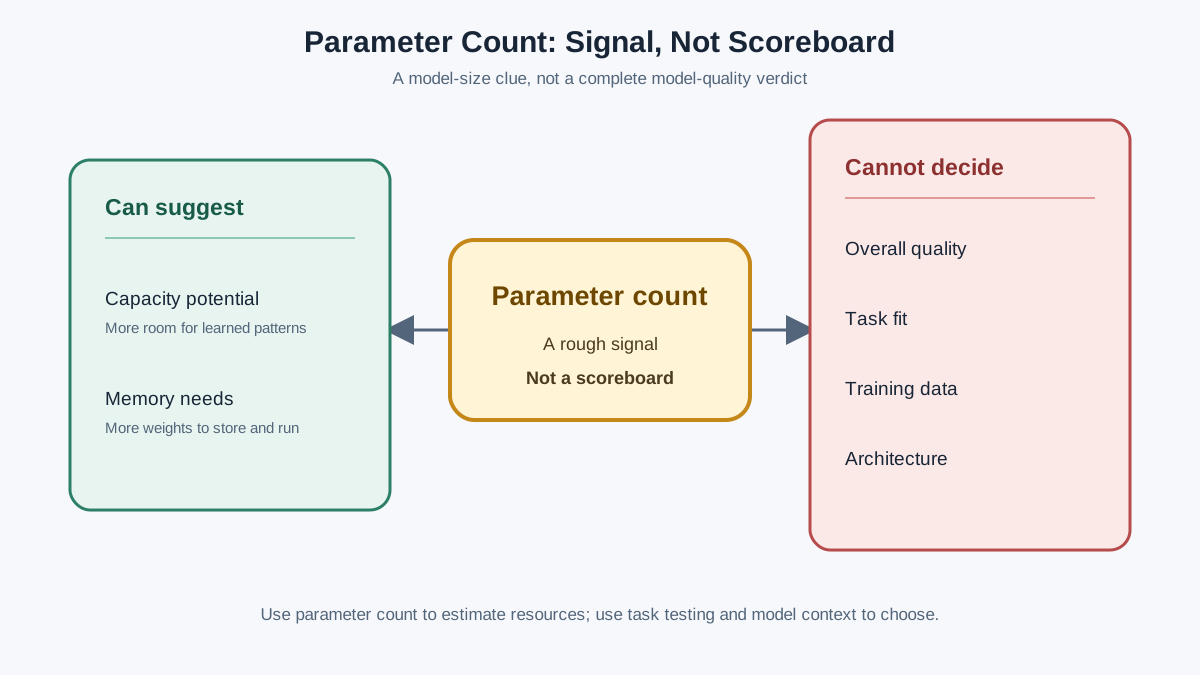
Here is where the mental model gets sharp. The parameter count is silent on the factors that often matter most.
Training data quality. A model trained on carefully curated, diverse, high-quality data will outperform a larger model trained on noisy, repetitive, or biased data. Data quality often matters more than model size.
Architecture and design. Two models with the same parameter count can perform very differently. Architectural choices—how layers are organized, how attention works, what training techniques were used—can make a smaller model punch well above its weight.
Task fit. A model's usefulness depends on what it was trained and tuned for. A specialized 7B model fine-tuned for code optimization can beat a general-purpose 70B model on that specific task. The bigger model knows more overall; the smaller model knows your problem better.
Availability. Some of the most capable frontier models don't publish their parameter counts at all. Several major providers have never officially disclosed exact numbers for their flagship models. If parameter count were the definitive quality metric, you couldn't even compare the models you are most likely to use.
The concrete contrast is worth stating plainly: a well-tuned smaller model can beat a larger general model on a narrow task. This is not a rare edge case—it is the entire business model behind fine-tuned open-source models.
Knowledge check
Check your understanding
Answer this question before you continue.
A Better Way to Compare Models
When you are choosing a model, stop leading with the parameter count. Lead with these questions instead:
What was this model trained to do? Read the model card. Was it trained for general conversation, code, math, translation, or something narrower? A specialized model will often beat a generalist on its home turf.
How does it perform on your actual task? Benchmarks are useful, but they are someone else's test. Run your own. Take a few real examples from your work and try them on the models you are considering. This takes fifteen minutes and tells you more than an hour of spec-sheet reading.
What hardware do you actually have? A 405B model is impressive until you realize you can't run it. If you are deploying locally, your hardware budget is a hard constraint. If you are using an API, your cost per request matters more than the model's internal size.
Here is my practical rule: use parameter count as a starting hint, not a verdict. When you see a 7B model and a 70B model, the parameter count tells you the 70B model might be more capable. It also hints that it will need more memory and compute to run locally. It does not tell you which one will solve your problem better—and it certainly doesn't tell you which API will cost more, since pricing depends on the provider's serving setup, not just model size.
For many everyday tasks—summarization, drafting, basic Q&A, classification—a smaller model is plenty. The biggest model is often overkill, like renting a moving truck to carry a backpack.
The durable mental model is this: parameter count is one rough signal among several. The real test is your own task, your own data, and your own hardware. Run the experiment. Compare the outputs. Let the results decide.
That is the builder's approach: don't trust the spec sheet. Test the system.
Knowledge check
Final check
Finish the article by checking the ideas you just learned.
References
Research updated Sep 7, 2026


