
Prompting Practice Exercises
Reading about prompting feels like it should be enough. You nod along with the advice: be specific, add context, show the model what you want. Then you run…

Key topics
Reading about prompting feels like it should be enough. You nod along with the advice: be specific, add context, show the model what you want. Then you run your first real prompt, and the output misses in a way that makes you wonder if you read a different article.
That gap is normal. Prompts look easy until the model quietly guesses what you meant instead of doing what you asked. The fix is not more reading. It is deliberate practice: write a prompt, run it, compare the output to what you wanted, and revise. Each miss is evidence about how the model reads your words.
These prompting exercises are built for that loop. You will need a chatbot or LLM interface open alongside this article. Each exercise takes a few minutes and builds on the basics you already know: clear instructions, useful context, and explicit format. If you have not reviewed those yet, skim the fundamentals first, then come back here for the hands-on work.
A prompt is a spark, not an engine. The model does the heavy lifting, but your instructions decide whether the output lands close to what you imagined or somewhere in the general vicinity of it.
How to Judge an Output
Before you start, pick a simple checklist. You will use it for every exercise in this article:
- Did the output follow the requested format?
- Did it include the details you asked for?
- Did it stay within the length you set?
- Did it match the audience you named?
- Did it avoid adding things you did not ask for?
Judge the output against this list, not against how fluent or confident it sounds. A polished paragraph that ignores your format is still a miss.
Knowledge check
Check your understanding
Answer this question before you continue.
Exercise 1: Spot the Missing Context
Goal: See how vague prompts produce vague output, then fix the prompt by adding context.
Start with this prompt:
Summarize the benefits of exercise.
Before you run it, predict what the model will produce. How long will the summary be? Who is it written for? What format will it use?
Run it and look closely at what comes back. You will likely get a short, generic paragraph that could appear in a hundred different contexts. The model did not make a mistake. It made a guess—because you gave it nothing to work with.
The problem is not the instruction. It is the missing context. The model has no idea who the audience is, how long the summary should be, or what format you want.
Now rewrite the prompt by adding three constraints:
Summarize the benefits of exercise for a busy parent who has not worked out in years. Keep it to three short paragraphs and end with one suggestion for starting slowly.
Run this version and compare. Check the output against the checklist above. The second version should feel more specific, more useful, and closer to something you could actually send to someone.
Hint: If the second output still misses, check whether you named the audience, the length, and the format. Those three details do most of the work.
What changed: The model stopped guessing and started targeting. The audience shaped the tone and examples. The length forced the model to compress. The closing instruction gave the output a purpose beyond listing facts. The failure signal was generic content; the smallest fix was adding context, not rewriting the whole prompt.
Knowledge check
Check your understanding
Answer this question before you continue.
Exercise 2: Give the Model a Role
Goal: Practice persona-based prompting and see how a role changes tone, vocabulary, and structure.
Some tasks benefit from a clear role. Explaining a concept is a good example, because the right role tells the model how much detail to include and what language to use.
Pick a concept you understand well—something like how a refrigerator keeps food cold, how interest on a loan works, or how a search engine finds results.
First, write a plain prompt:
Explain how a refrigerator keeps food cold.
Run it and note the output. It will probably be accurate and forgettable, pitched at a generic reader who does not exist.
Now write a version with a specific role and audience:
You are a friendly high school science teacher. Explain how a refrigerator keeps food cold to a 14-year-old who is curious but has not taken physics yet. Use an analogy they would recognize and keep it under 200 words.
Run this version and compare the two outputs side by side.
Hint: Pair the role with a concrete audience and a goal. "You are a teacher" is weaker than "You are a teacher explaining to a 14-year-old who likes soccer and has not taken physics."
What changed: The role changed the model's word choice, level of detail, and structure. The plain version gave you a neutral explanation. The role version gave you a lesson—with an analogy, simpler vocabulary, and a shape designed for a specific reader. If the output still misses, check whether the role or the audience is the weak link, and change only that part.
Knowledge check
Check your understanding
Answer this question before you continue.
Exercise 3: Check the Work, Not Just the Answer
Goal: Learn to inspect a multi-step answer instead of trusting a final result that appears from nowhere.
This exercise works best with a problem that has multiple steps. Try a calculation task like this one:
A family is driving 240 miles to visit relatives. They drive 60 miles per hour for the first 2 hours, then stop for a 30-minute lunch break. If they drive 55 miles per hour for the rest of the trip, what time will they arrive if they left at 9:00 AM?
First, prompt for a direct answer:
Solve this problem and give me the answer: [paste the problem above]
Run it. The model may get the answer right, but you cannot see how it got there. If the answer is wrong, you have no way to spot where the reasoning broke.
Now ask for the intermediate values you can verify:
Solve this problem. Show the distance covered in the first 2 hours, the remaining distance, the time needed for the rest of the trip, and the final arrival time. State any assumptions you make.
Run this version and compare. Here is the key move: do not just read the explanation and nod. Check the numbers yourself. The first leg is 120 miles. The remaining distance is 120 miles. At 55 miles per hour, that is roughly 2 hours and 11 minutes. Add the 30-minute break. The arrival time should be around 1:41 PM. Does the model's answer match?
Hint: If the model makes an error, point at the exact step that went wrong and ask it to fix just that part. If the model states an assumption you did not intend, correct the assumption rather than rewriting the whole prompt.
What changed: Asking for intermediate values gives you a way to inspect the model's work. But a readable explanation is not proof. A model can produce a confident, well-structured chain of steps and still land on the wrong number. The explanation helps you find where things broke; your own check is what tells you whether the answer is right. For any task where the result matters, verify against an independent source: your own calculation, a tool, or a trusted reference.
Knowledge check
Check your understanding
Answer this question before you continue.
Exercise 4: Repair a Weak Prompt
Goal: Practice diagnosing what makes a prompt fail, then fix it.
Here is a prompt that tries to do too much without giving the model any real guidance:
Write something about remote work. Make it good and cover the pros and cons. Also maybe mention productivity and how to stay focused. Keep it interesting.
Before rewriting, list what is wrong. You will probably notice: no audience, no format, no length, too many vague instructions ("make it good," "keep it interesting"), and no clear goal.
Now rewrite it with one clear goal, a format, and a constraint. Here is one possible repair:
Write a 400-word blog post for managers who are new to leading remote teams. Cover two benefits and two challenges of remote work, then give three practical tips for keeping a remote team focused. Use a professional but approachable tone.
Run the repaired prompt and compare it to the original output using the checklist.
Hint: If the repaired version still feels off, check whether you left any vague words in place. Replace "interesting" with a specific quality: informative, actionable, encouraging, or direct.
What changed: Each added element steered the output. The audience set the perspective. The format and length set the shape. The constraint on benefits, challenges, and tips gave the model a structure to fill instead of a blank space to wander through.
Now try the same repair habit on a second weak prompt:
Give me some tips for learning to cook. I want to get better.
Write down what is missing, then rewrite it with an audience, a format, and a constraint. Run both versions and compare.
Your Practice Loop and Next Steps
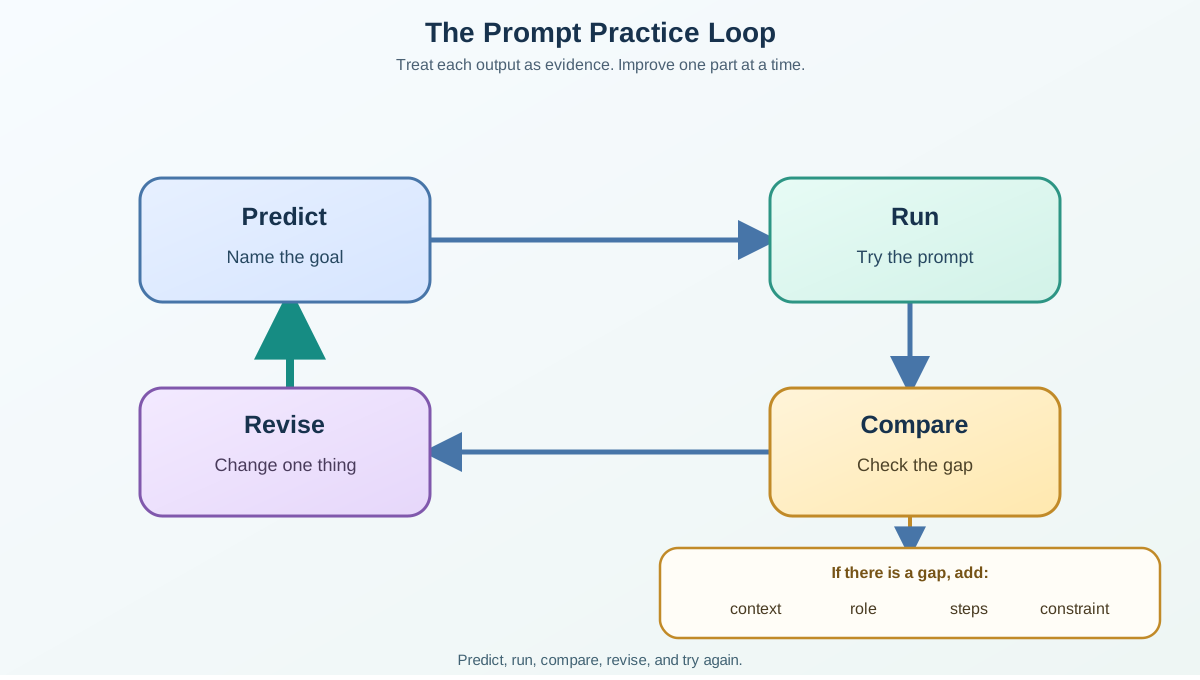
You just used the same loop four times: predict, run, compare, revise. That loop is the skill. The individual prompts matter less than the habit of treating output as evidence and revising from what you observe.
When you are not sure what a prompt needs, use this simple decision rule:
- If the output is generic, add context: audience, length, and format.
- If the output has the wrong tone or vocabulary, add a role.
- If the output skips steps or makes errors on a multi-step task, ask for intermediate values you can verify—then check them yourself.
- If the output wanders, add a constraint that limits scope.
One warning before you go: no prompt change guarantees a correct answer. A clearer prompt reduces the chance of a miss, but the model can still produce fluent, confident output that is wrong. When the result matters, verify it. That habit matters more than any single phrasing trick.
For your next practice session, take one everyday task and run it through the loop a few times. Write a prompt that asks for a weekly meal plan, a packing list for a trip, or an explanation of a work concept for a new teammate. Run it, compare the output to what you actually need, and revise.
The goal is not to write perfect prompts on the first try. It is to get comfortable with the revision cycle—because that cycle is what turns a miss into a useful result.
Knowledge check
Final check
Finish the article by checking the ideas you just learned.
References
Research updated Sep 7, 2026


