
Open-Weight vs Closed LLMs: What Control Do You Actually Need?
You do not need the best model. You need the model that matches the control you actually require.

Key topics
You do not need the best model. You need the model that matches the control you actually require.
Most beginners ask whether open or closed LLMs are better. That is the wrong question. The real question is about who holds the model, where your data goes, and who keeps the system running. Once you answer those three things, the open-versus-closed decision starts making itself.
The Question Behind the Question
When people ask me about open weight vs closed LLMs, they usually mean something simpler: "Which one should I use?" But the choice is not about picking a winner. It is about picking a relationship.
A closed LLM is a model you rent. You send your prompt to a vendor's servers through an API, and the vendor sends a response back. You never touch the model itself. You interact with it through a window the vendor controls.
An open-weight LLM is a model whose trained weights—the actual learned patterns that make the model respond—are public. You can download those weights and run them yourself, whether on your own computer or a cloud server you rent.
That difference changes everything downstream. It changes where your data lives, what you can customize, what you pay over time, and who you call when something breaks.
But before we compare the two, we need to separate two questions that beginners almost always mash together.
Two Separate Decisions: Model Access and Deployment
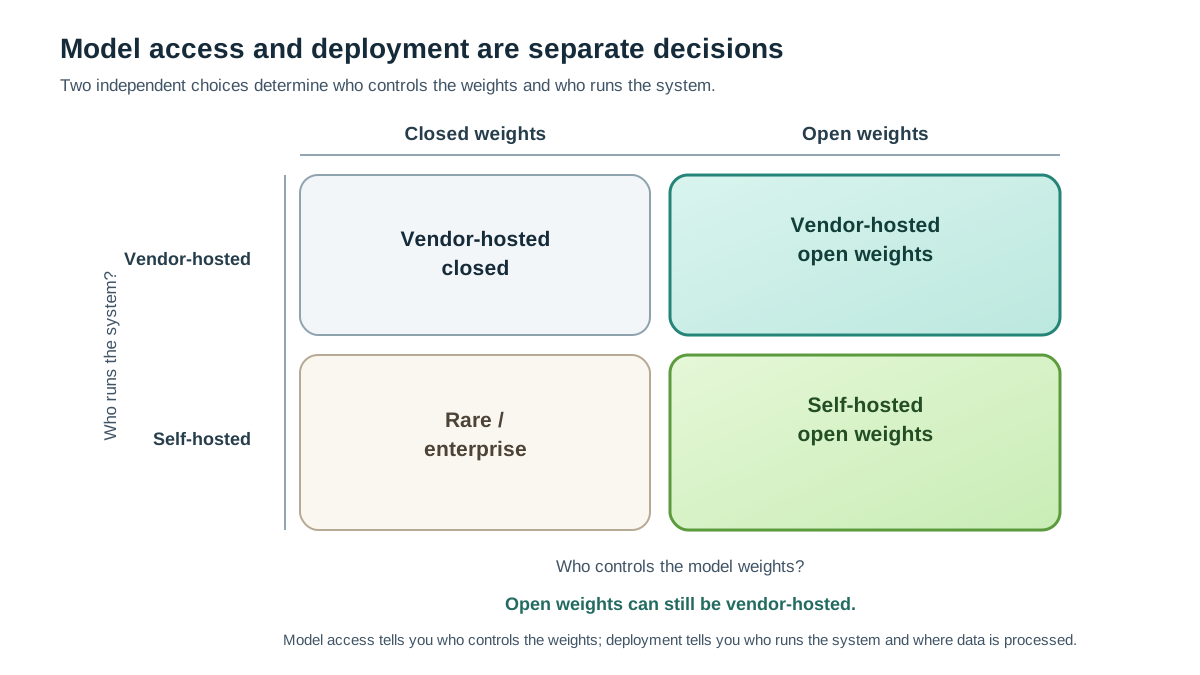
Here is the mental model that will save you from the most expensive mistake in this whole topic:
- Open vs closed answers one question: Can you access and modify the model's weights?
- Hosted vs self-hosted answers a different question: Where does the model actually run, and who operates it?
These are two separate axes, not one decision. Most people treat them as the same thing because the most common combinations line up neatly: closed models usually run on vendor servers, and open-weight models are often downloaded and run locally. But the axes can cross.
Consider three real combinations:
| Closed weights | Open weights | |
|---|---|---|
| Vendor-hosted | ChatGPT, Claude, Gemini | An open-weight model offered through a managed API |
| Self-hosted | Rare; usually enterprise agreements | Llama or Qwen running on your own hardware |
That middle cell matters. You can use an open-weight model through a hosted service without downloading anything. And you can run a closed-weight model in an environment you control under an enterprise agreement, though that is uncommon and expensive.
Why does this distinction matter for you? Because privacy, hardware, and maintenance are not automatic properties of open or closed models. They are consequences of where the model runs and who operates it. An open-weight model accessed through a hosted API does not keep your data on your own machine. A self-hosted model does.
Throughout this article, we will weigh both approaches against six criteria: control, privacy, capability, cost, hardware, and maintenance. As we go, notice which criteria belong to the open-versus-closed axis and which belong to the hosted-versus-self-hosted axis.
Knowledge check
Check your understanding
Answer this question before you continue.
Open Weight vs Open Source: A Distinction That Matters
Before comparing anything, we need to clear up a terminology trap that trips up nearly every beginner.
Most people say "open source" when they actually mean "open weight." These are not the same thing.
A fully open source LLM makes everything public: the model weights, the training code, the training data, and the license to modify and redistribute all of it. You can audit how the model was built, retrain it from scratch, and understand exactly what went into it.
An open-weight model makes only the trained weights public. You can download the model and run it, fine-tune it, and build on top of it. But the training data and the full training pipeline often stay private. You can see the result, but you cannot fully reproduce how it was made.
Here is where the popular models actually sit:
- Closed: ChatGPT, Claude, and Gemini are all closed. The vendor owns the model, hosts it, and exposes it only through an API or app.
- Open-weight: Llama, Qwen, Gemma, and DeepSeek are open-weight. You can download their weights and run them yourself, even though their training data is not fully public.
- Fully open source: A smaller set of models release the complete stack, including training data and code.
Why does this distinction matter? Because the label matters less than the license. Before you build anything on an open-weight model, read the license. Some licenses allow free commercial use. Others restrict how many users you can serve, where you can operate, or how you can use the model's output. The model may be "open," but your business may still be constrained.
Common mistake: Assuming "open" means "free to do anything with." Open-weight models still carry licenses, and those licenses vary significantly. Always check the license before building on a model.
Knowledge check
Check your understanding
Answer this question before you continue.
What Closed LLMs Give You
Closed models exist because they solve a real problem: they remove nearly all operational friction.
When you use a closed model through an API, the vendor handles everything. They run the infrastructure, scale it to handle your traffic, update the model when improvements ship, and patch security issues. You do not buy hardware. You do not maintain servers. You do not troubleshoot a mysterious slowdown at 2 a.m.
You also get access to frontier capability. The largest closed models are often the most capable, especially for complex reasoning, creative writing, and polished conversational experiences. If you need the absolute best output quality today, closed models usually lead.
For a beginner prototyping an idea, this speed is enormous. You can sign up, get an API key, and have a working prototype in an afternoon. No hardware decisions. No installation. No configuration.
But you trade control for that convenience. Your prompts travel to the vendor's servers. You cannot inspect the model or fine-tune its core behavior. You depend on the vendor's pricing, policies, and uptime. If they change their terms or raise prices, you adapt.
Note: Many closed providers offer enterprise agreements with stronger privacy terms, including promises not to train on your data. But even with those terms, your data still travels to the vendor's infrastructure. For some projects, that alone is disqualifying.
What Open-Weight LLMs Give You
Open-weight models flip the trade. You take ownership, and you take responsibility.
The clearest win is customization. Because you hold the weights, you can fine-tune the model on your own data to change its behavior. You can make it respond in your company's tone, follow your domain's conventions, or handle your specific document formats. Closed models limit you to the settings the vendor exposes. If you need the model itself to behave differently, open-weight is the only path.
You also gain independence. No per-prompt pricing that scales with usage. No sudden policy changes. No vendor deciding your use case violates their terms. Once the model is on your hardware, it keeps working on your terms.
And if you self-host an open-weight model, you gain a privacy advantage: your data stays on your infrastructure, and prompts never leave your network. That matters enormously for sensitive information—patient records, legal documents, proprietary code, or anything covered by data-residency regulations.
But here is the catch that beginners often miss. Downloading an open-weight model does not automatically give you privacy. Privacy comes from where you run it. If you use an open-weight model through a hosted API, your prompts still travel to that provider's servers. The model is open; your data is not necessarily local.
And the operational costs are real. Self-hosting an open-weight model needs capable hardware, usually a strong GPU with substantial memory. If you do not own that hardware, you rent cloud compute, which adds its own complexity. You own updates, security patches, and troubleshooting. When something breaks, there is no vendor support line—there is you, a terminal, and a search engine.
Tip: If you are new to this, do not start by buying hardware. Start with a small open-weight model that runs on modest equipment, or rent cloud compute for a few hours to test whether self-hosting fits your workflow.
Knowledge check
Check your understanding
Answer this question before you continue.
The Six Criteria That Decide for You
Let us walk through each criterion and see how it shapes the choice.
Control. This criterion belongs to the open-versus-closed axis. Closed models limit you to the settings the vendor exposes: system prompts, temperature, maybe some safety filters. Open-weight models let you change the model itself. You can fine-tune it, modify its behavior, and inspect what it is actually doing. If you need the model to behave in a specific, unusual way, open-weight is the only path.
Privacy and data residency. This criterion belongs mostly to the deployment axis. Closed models send your prompts to the vendor's servers. Even with strong privacy agreements, the data physically travels. A self-hosted open-weight model keeps sensitive data inside your walls. But an open-weight model accessed through a hosted API does not. If your project involves regulated data—healthcare, finance, legal—the decisive question is not "open or closed?" It is "can I verify where this data is processed and who can access it?"
Capability. Frontier closed models typically lead on the hardest tasks: complex reasoning, nuanced creative work, polished general assistance. But strong open-weight models are competitive for many practical tasks, especially coding, summarization, structured workflows, and domain-specific work after fine-tuning. Do not assume closed always wins. Test both against your actual task.
Cost. Closed models are cheap to start. You pay per use, with no upfront investment. But costs grow with usage, and heavy production traffic can become expensive. Open-weight models have upfront costs—hardware or cloud compute—but predictable long-term expense. Once the model runs, additional usage costs almost nothing. Note that hosted open-weight inference still carries per-use costs; the predictable-expense advantage appears when you self-host.
Hardware. This criterion belongs to the deployment axis. Closed models require none. You need only an internet connection and an API key. Self-hosted open-weight models require a capable GPU or rented cloud compute. Smaller models run on modest hardware; larger models demand serious resources.
Maintenance. This criterion also belongs to the deployment axis. Closed models mean the vendor handles updates, security, and scaling. Self-hosted open-weight models mean you own all of it. You track new versions, apply security patches, and troubleshoot failures yourself.
Knowledge check
Check your understanding
Answer this question before you continue.
Open-Weight vs Closed LLMs: A Quick Comparison Table
| Criterion | Closed LLMs | Open-Weight LLMs |
|---|---|---|
| Control | Limited to vendor settings | Full access to weights; fine-tuning possible |
| Privacy | Data travels to vendor servers | Private only if self-hosted; hosted APIs still see your data |
| Capability | Frontier models lead on hardest tasks | Competitive for many practical tasks |
| Cost | Pay per use; grows with traffic | Upfront hardware cost; predictable long-term when self-hosted |
| Hardware | None needed | Needed only if self-hosted |
| Maintenance | Vendor handles updates and scaling | You own it only if self-hosted |
Neither column wins outright. The right choice depends on which criteria matter most for your situation.
When to Choose Open, Closed, or a Hybrid
Here is the decision rule I use:
Choose closed when you want the fastest start, you need top-tier capability, you have no hardware, and your data is not highly sensitive. If you are prototyping an idea or building a general-purpose tool, start closed. The speed is worth it.
Choose open-weight when you want to fine-tune the model, you need predictable long-term cost at scale, or you need to self-host for data control. If your project handles sensitive data and you can operate the infrastructure, the control is worth the setup effort.
Choose a hybrid when you have mixed needs. This is more common than you might think. Keep sensitive work on a self-hosted open-weight model, and send general tasks to a closed API. Many teams run exactly this split: private data stays inside their network, while everyday questions go to a hosted service.
Here is a simple checklist you can apply to your own project:
- Do I need to fine-tune the model's behavior? If yes, lean open-weight.
- Does my data include sensitive or regulated information? If yes, choose a deployment you can verify keeps data in the required environment—self-hosted open-weight is one route.
- Do I have hardware or am I willing to rent it? If no, lean closed or hosted.
- Do I need the absolute best capability today? If yes, lean closed.
- Will my usage grow large enough that per-prompt costs hurt? If yes, lean open-weight with self-hosting.
- Do I want the fastest possible start? If yes, lean closed.
Common Mistakes Beginners Make
The same errors show up again and again. Here is what to watch for.
Assuming "open" means free to use commercially. Open-weight models have licenses, and those licenses vary. Some restrict commercial use, user counts, or geographic regions. Read the license before you build anything.
Assuming open-weight automatically means private. Downloading weights does not keep your data local. Privacy comes from where you run the model. An open-weight model on a hosted API sends your prompts to that provider just like a closed model does.
Underestimating the hardware and maintenance burden. Self-hosting an open-weight model is not a one-time download. You own updates, security patches, and troubleshooting. If you are not comfortable operating infrastructure, the maintenance cost can exceed the savings.
Assuming closed models always win on capability. Strong open-weight models handle many real tasks well, especially after fine-tuning on your specific data. Test both approaches against your actual workload before assuming the frontier model is necessary.
Confusing "open source" with "open weight." These are different categories with different implications. And the license matters more than either label.
Your Next Step
The decision is not permanent. You can start with a closed model to prototype quickly, then move to an open-weight model once you understand your requirements. You can run both simultaneously. Many builders do exactly that.
My advice: name the one or two criteria that matter most for your situation, and let those drive the choice. If you need to change the model itself, go open-weight. If privacy keeps you up at night, choose a deployment you can verify—which usually means self-hosting an open-weight model. If speed to your first working prototype matters more than anything, go closed. If you are unsure, start closed, learn what your project actually needs, and revisit the decision later.
And remember the deeper lesson: choosing a model and choosing where to run it are two separate decisions. Get comfortable with both axes, and you will stop guessing and start building.
When you are ready to try running an open-weight model yourself, a proper setup guide will walk you through installation and configuration. The comparison here gives you the decision framework. The setup guide gives you the hands-on path.
Knowledge check
Final check
Finish the article by checking the ideas you just learned.
References
Research updated Sep 7, 2026


