
Why Do LLMs Hallucinate? A Practical Mental Model
You ask a chatbot for a quick fact. The answer comes back in clean, confident sentences—specific dates, plausible names, a citation that looks real. It…

Key topics
You ask a chatbot for a quick fact. The answer comes back in clean, confident sentences—specific dates, plausible names, a citation that looks real. It reads like something from a careful researcher. Then you check the source, and none of it checks out. The citation doesn't exist. The date is wrong. The name belongs to someone else entirely.
This is the moment most people first ask: why do LLMs hallucinate? And the honest answer starts with a misconception. Fluent text is not the same as grounded text. A model can sound certain and be completely wrong, because confidence was never part of the equation.
The Confident Lie: What Hallucination Actually Looks Like
In plain terms, a hallucination is fluent, confident text that is factually wrong or unsupported by evidence. The model isn't stuttering or hesitating. It delivers falsehoods with the same polish as true statements.
You've probably seen the patterns:
- Fabricated citations. The model produces a scholarly-looking reference with an author, a journal, and a year. The paper doesn't exist.
- Invented statistics. A precise-sounding number appears in a confident sentence. There's no study behind it.
- Wrong dates and names. The model swaps a historical event to the wrong decade or credits the wrong person with an achievement.
These failures can look like other problems, so it helps to label what you're seeing. If a model gives you outdated information—say, last year's pricing for a product—that's not a hallucination. That's a knowledge cutoff. The model's training data simply hasn't caught up with the world. A hallucination is different: the model is generating something that isn't true now, wasn't true at training time, and has no evidence behind it.
Note: When people say "AI makes up facts," they're usually describing hallucination. The key distinction is that the model isn't retrieving a wrong fact from a database. It's producing text that sounds like a fact.
Knowledge check
Check your understanding
Answer this question before you continue.
The Core Mental Model: A Next-Word Predictor, Not a Database
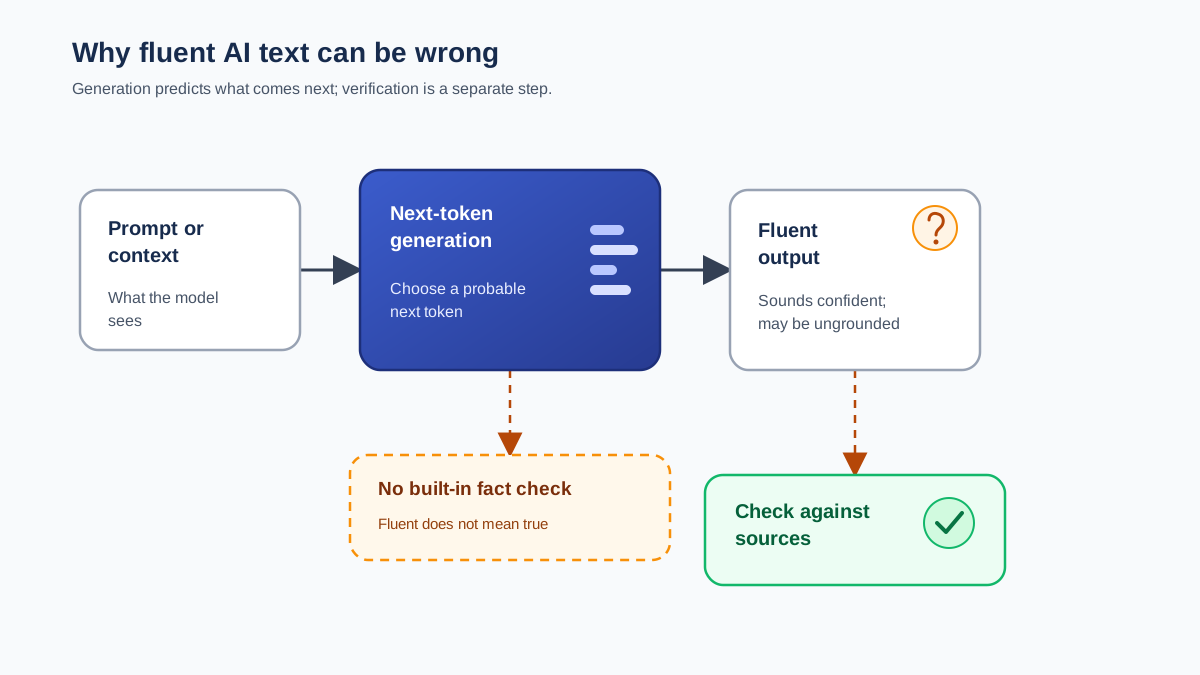
Here's the reframe that changes everything: an LLM is not a database with a search bar. It's a next-word predictor.
When you understand how LLMs work at a basic level, you know the core mechanism: given everything written so far, the model calculates which word is most likely to come next. It repeats that process until the answer is complete. Every response is a generation, not a retrieval.
This means the model has no internal fact-checker. It has no lookup table of verified truths. It has patterns—billions of them, learned from text—that tell it what plausible language looks like.
Here's the analogy I come back to: imagine a very well-read guesser. This person has absorbed an enormous amount of text, but they don't remember where any of it came from. They can't distinguish a reliable encyclopedia from a passionate conspiracy forum. When you ask them a question, they don't search their memory for the verified answer. They produce the response that sounds most like what a correct answer should sound like.
That's the mechanism behind hallucination. The model isn't choosing between truth and falsehood. It's choosing between probable and improbable text. Sometimes the most probable text happens to be true. Sometimes it doesn't. The model can't tell the difference, because generation alone was never designed to check.
Prompt → Probability-weighted next-token generation → Output
                        ↑
              No verification step in the loop
That diagram is the whole problem in one picture. There's no moment where the model pauses to ask, "Is this actually true?" The architecture doesn't include that step.
Now, one important boundary: this describes the base generation process. When you build a full application around a model, you can add steps that change the outcome—supplying source material, retrieving documents, adding tools, or checking the output afterward. Those steps don't fix the generator. They surround it with grounding and verification that the generator doesn't provide on its own.
Knowledge check
Check your understanding
Answer this question before you continue.
Why the Model Guesses Instead of Saying "I Don't Know"
You might wonder: why doesn't the model just admit uncertainty? If it doesn't know the capital of a small country, why not say so?
The uncomfortable answer is that the model's training and evaluation push it toward guessing. Think about a multiple-choice test. If you don't know the answer but you guess, you might get lucky. If you leave it blank, you're guaranteed a zero. Over a hundred questions, the student who guesses will score higher than the student who only answers when certain.
LLMs are graded the same way. When models are evaluated on accuracy alone—the percentage of questions answered correctly—guessing improves the score. Saying "I don't know" guarantees a miss. So the model learns, through the statistical patterns of its training, that producing a plausible answer is better than producing no answer.
This is an active research area, not a solved problem. Researchers have proposed changing how models are graded, penalizing confident errors more heavily and giving partial credit for appropriate uncertainty. Some standardized tests already use similar logic with negative marking. But shifting the incentive across the field is slow work, and most current evaluation systems still reward the guesser.
Common mistake: Treating the model's confident tone as a signal of accuracy. A confident wrong answer feels identical to a confident right answer. The model doesn't have a "certainty meter" you can read.
Knowledge check
Check your understanding
Answer this question before you continue.
Where Hallucinations Come From: Weak or Missing Evidence
The second major driver of hallucination is simpler: the model often doesn't have the evidence it needs. To see why, it helps to separate three different things that people lump together as "knowledge":
- Learned patterns inside the model. These come from training data and are frozen once training finishes.
- Evidence supplied at runtime. This is source material you provide in the prompt, such as a document or retrieved passages.
- Verified facts. These are claims checked against an external source or rule you trust.
Hallucinations happen when the model must answer from the first bucket alone, or when the second bucket is missing, weak, or wrong.
Stale internal knowledge. An LLM's learned patterns are frozen at training time. Once training finishes, the model can't check current facts or notice that the world changed. Ask it about a recent event, and it will do its best with patterns from its training cutoff—which means it may confidently describe something that never happened or is now outdated.
Sparse or contradictory training data. There's an old principle in computing: garbage in, garbage out. When a fact appears frequently and consistently in training data—like the capital of Peru being Lima—the model reproduces it reliably. When the data is sparse, contradictory, or low quality, the model has weaker patterns to lean on. It fills the gap with whatever sounds most plausible.
Unreliable sources in training data. Here's the part that surprises people: the model can't tell credible sources from unreliable ones. Its training data includes academic papers, news articles, personal blogs, forum arguments, and outright misinformation, all sitting side by side. If a false claim appears often enough, the model may repeat it confidently. The model doesn't know which sources to trust, because it was never taught to evaluate sources. It was taught to predict text.
Missing or wrong evidence at runtime. Even when you supply source material, things can go wrong. The retrieval step might pull the wrong document. The source itself might be outdated or biased. Or the model might ignore the supplied text and fall back on its learned patterns. Each failure needs a different fix.
| Failure | What's happening | Practical response |
|---|---|---|
| Stale internal knowledge | Training data is outdated | Retrieve current sources or check the date |
| Sparse training data | Model improvises on a niche topic | Supply authoritative source material |
| Unreliable training sources | False claim appears often in training | Verify against a trusted external source |
| Wrong retrieved context | Search pulled irrelevant documents | Improve retrieval quality |
| Generation ignores evidence | Model has the facts but doesn't use them | Constrain the prompt and verify output |
Try asking about a niche topic or a very recent development. If the model has little real signal to work with, it will improvise. That improvisation is a hallucination—not because the model is malicious, but because it's doing exactly what it was built to do: generating the most probable next words.
Practical Ways to Reduce Hallucination Risk
You can't eliminate hallucinations, but you can reduce the risk. The strategies follow a simple workflow: provide authoritative evidence, check that the right evidence was retrieved, instruct the model to abstain when evidence is missing, and verify important claims.
Ground the model with supplied evidence. Instead of asking the model to answer from its internal knowledge, give it source text to work from. Paste the relevant document into the prompt and ask the model to answer based on that text alone. This dramatically narrows the space where the model can improvise.
This pattern has a name: retrieval-augmented generation, or RAG. The idea is straightforward—instead of relying on the model's frozen training data, you retrieve relevant documents and feed them into the prompt. The model answers from the evidence you provided, not from whatever patterns it happens to remember.
Here's a minimal example. Suppose you give the model this source passage:
"The Meridian Bridge was completed in 2019. It connects the towns of Ashford and Bramblewick across the River Kest."
If you ask, "When was the Meridian Bridge completed?" the model can answer correctly: 2019. The evidence is right there.
But now ask something the passage doesn't cover: "Who designed the Meridian Bridge?" The source material doesn't say. The correct behavior is for the model to say, "The provided source doesn't mention the designer"—not to invent a plausible name. That abstention is a feature you have to request explicitly. Without it, the model may happily fill the gap with a confident guess.
Ask for citations or sources. When you prompt the model to include sources, you push it toward grounded answers. The model still might fabricate a citation, so this isn't a cure. But it gives you a starting point for verification.
Break complex questions into smaller pieces. Multi-step questions are where models stumble. Instead of asking one big question that requires connecting several facts, break it into smaller, verifiable pieces. Check each piece before moving on.
Set expectations. These strategies reduce risk. They don't eliminate it. Any system built on an LLM needs a verification layer, because the model's core behavior hasn't changed. It's still generating probable text.
Tip: The most effective pattern I use: provide the source material, ask the model to answer only from that material, and require it to point to the specific passage it used. This turns the model from a guesser into something closer to a reader.
One more warning: RAG is not a magic shield. It reduces unsupported guessing only when retrieval finds the right documents and those documents are trustworthy. If retrieval pulls irrelevant text, or the source itself is wrong, the model will happily ground its answer in bad evidence. That's why evaluation matters—you need to test whether the whole pipeline actually produces reliable answers, not just assume it does.
Knowledge check
Check your understanding
Answer this question before you continue.
When to Trust and When to Verify
Here's the practical rule I give everyone: if the answer matters and you can't verify it against a source, treat it as unverified.
That sounds cautious, but it maps cleanly onto how you should actually use these tools. For low-stakes tasks, you can relax. Brainstorming ideas, drafting an email, explaining a concept you already understand, helping you rephrase a paragraph—these don't require factual precision. The model is a useful thinking partner, and a hallucination here costs you nothing.
For high-stakes tasks, the calculus changes. Facts, citations, numbers, medical claims, legal claims, anything you'll act on or publish—these require verification. The model's confidence is not evidence. A fluent wrong answer can look identical to a fluent right answer, and you can't tell which one you got without checking.
This is the loop that closes the mental model: the model is a fluent generator, not a fact-checker. Verification is your job, not its feature.
So here's your next step: adopt one verification habit. When an answer matters, check it against a source. Look up the citation. Confirm the statistic. Find the date in a reliable reference. It takes an extra minute, and it turns a confident guess into something you can actually use.
And when you're ready to go deeper, the natural next direction is learning how to evaluate LLM outputs systematically—building test cases that reveal when a model is reliable and when it's just sounding good.
Knowledge check
Final check
Finish the article by checking the ideas you just learned.
References
Research updated Sep 7, 2026


