
What the Language-Model Training Objective Optimizes
A model can write a confident, fluent paragraph that is completely false — and its training loss curve can look excellent the whole time. That combination…

Key topics
A model can write a confident, fluent paragraph that is completely false — and its training loss curve can look excellent the whole time. That combination confuses a lot of beginners, because it breaks the assumption that "the model was trained to be correct." It wasn't. It was trained to assign probability to text that already existed.
That distinction is the whole article. Once you can read the training objective as a scoring rule over observed text, you stop expecting it to guarantee truth, usefulness, or calibrated confidence — and you start asking which later stage or system component is actually responsible for the property you care about.
What the Objective Actually Scores
Start with the mechanism, not the formula. At each position in a sequence, the model produces a vector of raw scores called logits — one score per token in its vocabulary. A softmax function turns those scores into a probability distribution that sums to one:
Here is the logit for token , and is the probability the model assigns to that token at this position, given everything before it.
Training then asks a narrow question: how much probability did you give to the token that actually appeared in the text? The loss at that position is the negative log of that probability:
This is cross-entropy loss, also called negative log-likelihood. Averaged across every position in a batch, it becomes the training loss. Minimizing it is mathematically equivalent to maximizing the log-likelihood of the observed text.
Fix the notation early, because every later claim depends on it:
- Token sequence: the text, chopped into tokens.
- Context: the tokens preceding the current position.
- Conditional probability: .
- Logits → softmax → probability: the pipeline from raw scores to a distribution.
- Cross-entropy: the penalty for how little probability the model gave the real token.
The key framing: this objective is a scoring rule over observed text. It says nothing about whether that text is true, useful, or what you actually wanted.
Knowledge check
Check your understanding
Answer this question before you continue.
Why the Labels Come for Free
Here's the structural reason this objective dominates. Every position in a text is simultaneously an input and a target. The token at position 5 is the label for the prediction made at position 4. The data labels itself.
That property is called self-supervision, and it's why pretraining can consume internet-scale text without a single human annotator. You don't need someone to mark each sentence as correct. You need the sentence.
You already know the chain-rule factorization from earlier — a sequence probability is the product of conditional next-token probabilities. The training objective is just the log of that product, maximized over the corpus. I won't re-derive it here; the point is that the thing being maximized is the likelihood of text that exists.
It's also worth knowing that "the training objective" is a family, not one universal rule. Autoregressive models predict left to right. Masked models like BERT-style architectures predict tokens from bidirectional context. Both are language modeling objectives; they optimize different conditional distributions. When someone says "the objective," ask which one.
Knowledge check
Check your understanding
Answer this question before you continue.
Teacher Forcing: The Assumption Hiding in the Loss
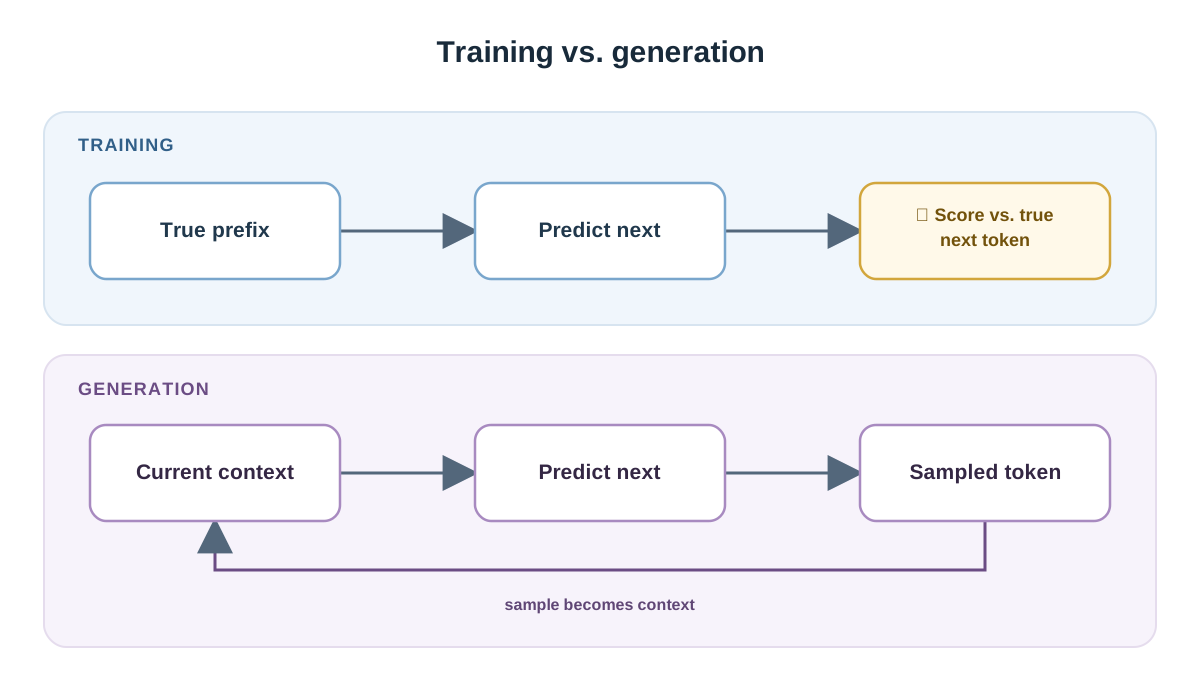
This is the single most consequential assumption in the training signal, and it's easy to miss.
During training, each prediction is conditioned on the true preceding tokens. Not tokens the model produced — the actual ones from the text. This is called teacher forcing, and it's used because it makes the loss a clean per-position signal and keeps gradients stable.
Here's the precise way to think about it. Each position is scored separately, using the true prefix that came before it. But those positions are not independent observations. The sequence likelihood is built by multiplying the conditional probabilities together — the same chain-rule factorization from earlier. Teacher forcing supplies the correct prefix for each factor; it does not sever the factors from one another. The loss you minimize is the negative log of that combined product, which is why a single bad position drags down the whole sequence's score.
Now watch what happens at generation time. The model conditions on its own outputs. It writes a token, feeds that token back in, and predicts the next one from a context it just invented.
That gap is the train/inference mismatch, sometimes called exposure bias. A small early error changes the context for every later step, and errors compound. This is why long outputs drift, why a model can start strong and end incoherent, and why the failure looks nothing like the training loss suggested.
Common mistake: Assuming decoding-time settings like temperature repair this mismatch. They don't. Temperature is applied at generation and is not part of the training objective — it reshapes the sampling distribution but does nothing about the fact that the model is now conditioning on its own tokens.
Knowledge check
Check your understanding
Answer this question before you continue.
A Worked Example: One Position, One Loss
Let's make this concrete. Suppose the vocabulary is just four tokens, and at one position the model produces these logits:
| Token | Logit |
|---|---|
| cat | 2.0 |
| dog | 1.0 |
| fish | 0.5 |
| rock | 0.0 |
Apply softmax. The exponentials are roughly 7.39, 2.72, 1.65, and 1.00, summing to about 12.76. So the probabilities are approximately:
- cat: 0.58
- dog: 0.21
- fish: 0.13
- rock: 0.08
Now suppose the actual next token in the training text was dog. The loss is .
Suppose instead the model had been confident and wrong — say it assigned 0.90 to "cat" and the true token was "rock" at 0.02. The loss would be . A wrong-but-confident prediction is punished far more than an uncertain one. That's the mechanism that pushes the model toward sharp distributions: hedging costs less than being confidently incorrect, but committing correctly costs least of all.
Translate the number back to behavior. A low average loss means the model predicts the training text well on average. It tells you nothing about whether any single generated sentence is true.
Knowledge check
Check your understanding
Answer this question before you continue.
What the Objective Does Not Optimize
Now draw the boundary. This is where the reframe pays off.
Truth is not in the objective. A fluent false statement can be the highest-probability continuation of the training text. If the corpus contains confident-sounding misinformation, predicting it well lowers the loss. That's the mechanism behind hallucination — not a bug, but the objective doing exactly what it was asked.
Usefulness is not in the objective. The loss rewards plausible text, not text that solves your task. A model can be an excellent predictor of internet prose and a poor assistant for your specific question.
Calibration is not guaranteed. Matching the statistics of the training distribution is not the same as producing well-calibrated confidence on a new question. The model learned what text tends to follow what; it did not learn to know when it doesn't know.
The objective is myopic. It scores each position given the true prefix. It does not reward reasoning about downstream consequences of a prediction. Each position is graded against the text that actually followed it, not against whether the overall output was good.
Be precise about what's known versus inferred. The objective is well-defined and measurable — that's known. Behavioral properties like truthfulness and calibration are downstream effects, not direct targets — that's inferred from the mechanism. What you should not assume is that loss is a proxy for reliability.
Why Later Training Stages Exist
If the objective only rewards plausible continuations, then "answer helpfully" and "refuse harmful requests" are not directly encoded in it. They were never in the loss function.
That's the gap later stages fill. Instruction tuning and preference-based training change the data and the signal so that preferred behaviors become the higher-probability continuation. You've already seen the stage-by-stage comparison; the point here is narrower: the objective's blind spots are the reason those stages exist at all.
There's a tradeoff worth naming. Optimizing harder for human preference can move the model away from faithfully modeling the text distribution. You gain helpfulness and lose some raw predictive fidelity. That's a deliberate exchange, not a free upgrade.
Reading a Loss Curve Without Fooling Yourself
When you see training metrics, apply one rule: lower training loss means better prediction of the training text, and that is all it means on its own.
Two traps to avoid:
- Overfitting. Loss can drop while generalization degrades, especially with repeated data. Always read loss alongside held-out evaluation.
- Perplexity confusion. Perplexity is a transformed loss — it measures predictive performance on a dataset. It does not establish factual correctness or task usefulness.
Tip: Treat loss as a diagnostic of fit. Treat task-level evaluation as the test of whether the model is useful for your application. They answer different questions.
The most common mistake I see is choosing between two checkpoints by training loss alone. That's picking the model that memorized the training text best, which is rarely the model you want.
The Decision Rule
The objective optimizes the probability of observed text under a teacher-forced context. It buys you fluent prediction — not truth, not usefulness, not calibrated confidence. Those properties come from somewhere else: instruction tuning, retrieval, evaluation, human review, or the system you build around the model.
Here's your next move. Pick a model output you actually trust. Ask what the training objective would have rewarded at each position — probably a plausible continuation of similar text, not a verified fact. Then identify which later stage or system component is genuinely responsible for the property you care about. That's the component you should be tuning, testing, and trusting.
Knowledge check
Final check
Finish the article by checking the ideas you just learned.
Want a more structured LLMOps path?
Use the LLMOps Practical Starter Bundle to connect RAG, evaluation, observability, and production patterns.
Large Language Models Starter Pack
A 12-chapter guide connecting LLM fundamentals with prompting, RAG, agents, tool calling, evaluation, security, and application engineering.
- 227-page Illustrated PDF edition
- 12 guided LLM engineering chapters
- Visual concept diagrams
- Self-assessment quizzes
- Bonus deep-dive sections
- Prompt design, structured output, context windows & RAG pipelines
- Agents, tool calling, prompt injection, evaluation & application lifecycles
Coming soon


