
LLMs vs Generative AI: How the Terms Fit Together
A headline calls an image tool "AI." A coworker calls ChatGPT "an LLM." A product page says "generative AI" for something that writes emails. Three labels,…

Key topics
A headline calls an image tool "AI." A coworker calls ChatGPT "an LLM." A product page says "generative AI" for something that writes emails. Three labels, one blurry feeling that they all mean the same thing.
They don't. And the fix is small: all LLMs are generative AI, but not all generative AI is an LLM. Once that sentence sticks, most of the confusion falls away.
This article gives you a mental model for the two terms and a rule you can apply to any AI tool you meet.
Why the Two Terms Get Swapped
Both terms arrived in everyday vocabulary at roughly the same time, mostly through chat products. You learned them together, in the same conversations, often in the same sentence. So your brain filed them as synonyms.
Marketing doesn't help. A product page might say "AI" for a text tool and "generative AI" for an image tool, with no visible difference in wording. The label is doing branding work, not classification work.
The cost of the confusion is practical, not academic. If you think every AI tool is the same kind of thing, you'll expect an image generator to answer questions, or you'll assume a chat assistant and a music tool share the same strengths and the same failure modes. They don't.
Here's the correction, stated once and clearly: generative AI is the broad category. An LLM is one specific family inside it.
What "Generative AI" Actually Covers
Generative AI is a capability label, not a single technology. It describes systems that learn patterns from existing data and then produce new output that resembles that data without being identical to it.
That's the whole definition. What matters is what comes out.
The category spans output types: text, images, audio, music, video, and code. Different output types usually rely on different underlying model families. An image generator and a chat assistant may both be called "generative AI," but they are not built the same way and do not fail the same way.
Note: "Generative" describes what the system produces, not how it was built. Keep that distinction in mind and the rest of this article gets easier.
Knowledge check
Check your understanding
Answer this question before you continue.
Where LLMs Sit Inside That Category
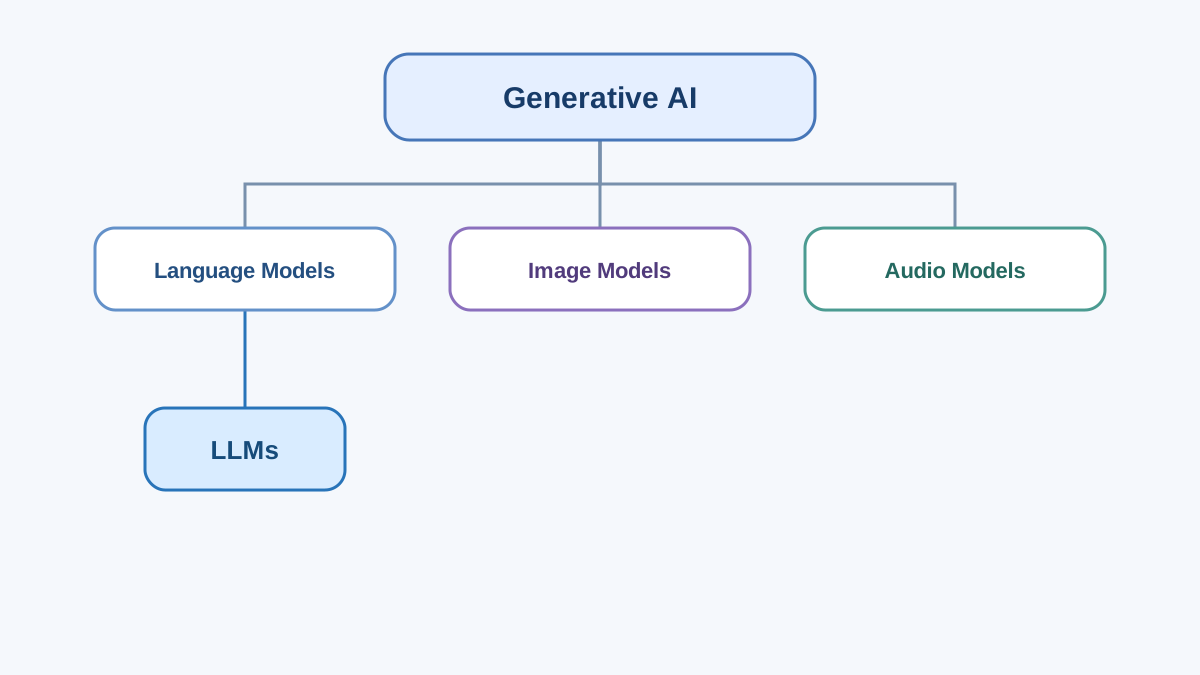
You already know the basic shape of an LLM from earlier material: a model trained on large amounts of text (and often code) whose core job is predicting and generating language. I won't re-teach that here. The useful question is where it sits.
Picture a set of nested rings. The outer ring is generative AI — everything that produces new content. Inside it sits a smaller ring: language models. Inside that, the large ones: LLMs.
The nesting is the point. An LLM is not a competing category to generative AI. It is a member of it.
One honest boundary: both words in the name are doing work. "Large" refers to scale, and "language" refers to the output. A model can be generative without being either — an image model is generative, but it isn't large in the language sense, and it isn't a language model at all.
Knowledge check
Check your understanding
Answer this question before you continue.
The One Rule That Settles Most Arguments
When you meet a new AI tool, ask two questions:
- What does it produce?
- What was it built to model?
The first question tells you whether the system is generative at all. The second tells you which family it belongs to. If it produces language by predicting text, it's an LLM. If it produces something else — pixels, waveforms, video frames — it's generative AI but not an LLM.
Here's the rule applied to tools you've probably already used:
| Tool | Produces | Typical classification |
|---|---|---|
| Chat assistant | Text | LLM and generative AI |
| Image generator | Images | Generative AI, not an LLM |
| Music or voice generator | Audio | Generative AI, not an LLM |
| Code assistant | Code and text | Usually LLM-based |
| Spam filter | A judgment | Neither |
That last row matters. A spam filter produces a decision, not new content. A recommendation engine produces a ranking. Neither is generative, so neither is an LLM.
Common mistake: Assuming that because a tool is "AI," it must be generative. Plenty of AI systems classify, rank, or predict. They don't create anything new.
There's an honest edge case too. Some products combine several model types behind one interface. A single app can be "both" at the product level while its parts remain different kinds of models. That's not a contradiction — it's just packaging.
Knowledge check
Check your understanding
Answer this question before you continue.
Side-by-Side: Generative AI vs LLM
| Question | Generative AI | LLM |
|---|---|---|
| What is it? | A broad category | A specific model family |
| Typical inputs | Text, images, audio, code | Mostly text and code |
| Typical outputs | Text, images, audio, video, code | Text and code |
| Is it a subset of the other? | No — it's the outer category | Yes — it sits inside generative AI |
The takeaway in plain words: generative AI is the workshop; an LLM is one machine inside it that happens to be very good at language.
Where the Simple Picture Breaks
Three misconceptions survive the clean explanation. Here's each one, and what to say instead.
Misconception one: "Generative AI" means one technology. It doesn't. It's a label over several model families with different strengths and different failure modes. Say instead: "Generative AI is a category, not a single model."
Misconception two: A chat model that also handles images means LLMs and image models are the same thing. Handling an input type is not the same as being built for it. A model can accept an image and still be fundamentally a language model. Say instead: "It can process images, but it's still built around language."
Misconception three: If a tool is generative AI, it must be creative or open-ended. Plenty of generative systems are narrow and repetitive by design — generating product descriptions from a template, for example. Say instead: "Generative just means it produces new output. It says nothing about how creative that output is."
Knowledge check
Check your understanding
Answer this question before you continue.
What This Changes in Practice
When you meet a new AI tool, classify it first. What does it produce? Does it work on language? Those two answers tell you what to expect — and what to stop expecting.
Then match the tool to the task. Language tasks go to LLM-based tools. Image or audio tasks go to the model families built for those outputs. Reaching for a chat assistant to generate a realistic photo is like reaching for a hammer to turn a screw. The tool isn't bad; it's the wrong machine.
Expect different failure modes by category too. A text model's confident wrong answer and an image model's distorted output are different problems with different fixes. Knowing which category you're in tells you which failure to watch for.
This article classifies terms. It doesn't benchmark tools or recommend vendors — that's a separate job with separate evidence.
The Rule to Keep
When the terms blur again — and they will — ask what the system produces and what it was built to model. That single question resolves most of the confusion you'll encounter in headlines, product pages, and conversations.
The natural next step is understanding how an LLM actually produces text: how a prompt becomes a prediction, token by token. That's where the classification stops being vocabulary and starts becoming a working model of the system.
Knowledge check
Final check
Finish the article by checking the ideas you just learned.
References
Want a more structured LLMOps path?
Use the LLMOps Practical Starter Bundle to connect RAG, evaluation, observability, and production patterns.
Large Language Models Starter Pack
A 12-chapter guide connecting LLM fundamentals with prompting, RAG, agents, tool calling, evaluation, security, and application engineering.
- 227-page Illustrated PDF edition
- 12 guided LLM engineering chapters
- Visual concept diagrams
- Self-assessment quizzes
- Bonus deep-dive sections
- Prompt design, structured output, context windows & RAG pipelines
- Agents, tool calling, prompt injection, evaluation & application lifecycles
Coming soon


