
LLMs in Education
Walk into any staff meeting about AI and you will hear two versions of the same story. One says large language models will replace teachers and turn…

Key topics
Walk into any staff meeting about AI and you will hear two versions of the same story. One says large language models will replace teachers and turn homework into a copy-paste exercise. The other says they will personalize learning for every student on Earth, at scale, starting tomorrow. Both miss what is actually happening.
The truth is more useful and more modest. LLMs are reshaping specific educational tasks—tutoring, content creation, feedback, assessment support—while leaving the core human work of teaching intact. The practical question is not whether AI belongs in the classroom. It is which jobs these models genuinely do well, and which ones are still ours.
What LLMs Actually Change in the Classroom
Earlier educational software was rigid. A computer-based tutor from twenty years ago followed a script: present a question, check the answer against a fixed set of responses, branch to the next question. It worked for drill exercises and little else.
LLMs are different because they are conversational and generative. They do not match your answer against a script. They produce new text in response to whatever you say, which means they can explain a concept five different ways, answer an unexpected follow-up question, and adapt the difficulty of their response to what you just wrote. The shift is from static content to open-ended, context-aware dialogue.
That capability is genuinely new, but it comes with a hard boundary. LLMs are excellent at language-heavy tasks: explaining, drafting, summarizing, questioning. They are not reliable for high-stakes factual accuracy. A model that can write a beautiful paragraph about photosynthesis can also state confidently that photosynthesis happens in the mitochondria. The fluency and the error come from the same mechanism.
So here is the mental model I use: LLMs are task amplifiers for educators and always-on practice partners for learners. They do not replace teaching. They compress the hours of preparation and repetition that surround teaching, and they give learners someone—or something—to practice with at 11 p.m. when no human is available.
This matters more when you understand how retrieval and agents extend what a plain chat model can do. A retrieval-grounded tutoring system, for instance, can pull from a specific textbook or curriculum before answering, which narrows the hallucination problem considerably. But that is an architecture choice, not a property of LLMs in general.
Knowledge check
Check your understanding
Answer this question before you continue.
Where LLMs Help Learners: Tutoring and Practice
The flagship use case for LLMs in education is intelligent tutoring. A student stuck on a concept can ask for a different explanation, request more examples, or demand a simpler analogy—on demand, without waiting for office hours.
The best versions of this behave like a Socratic dialogue partner. Instead of handing over an answer, the model asks questions that guide the student toward it. Instead of repeating the same textbook paragraph, it adjusts difficulty based on how the student responds. This is the kind of interaction that a single teacher cannot scale across thirty students, which is why the personalized-learning promise is not pure hype. It is just incomplete.
Researchers are pushing further. Multi-agent classroom simulations, where LLM-powered agents play distinct classroom roles alongside a real participant, have shown that simulated peer interaction can produce collaborative behavior that improves the learning experience. Think of it as a practice space where the student is the only human in a room of patient, tireless synthetic classmates.
The honest boundary is this: LLMs can explain and quiz, but they cannot reliably verify mastery. A student can sound fluent in a conversation with a tutor and still harbor a deep conceptual error that never surfaces. The model has no reliable way to detect that gap. That verification remains human work.
Knowledge check
Check your understanding
Answer this question before you continue.
Where LLMs Help Educators: Content and Feedback
The most immediately practical applications are on the teacher's side of the desk. Lesson planning, quiz generation, example problems, rubric drafting—these are language-heavy, pattern-based tasks that consume hours and follow familiar templates. An LLM can produce a first-pass draft of any of them in minutes.
The same applies to feedback. Drafting personalized comments on student work is time-consuming, and consistency across a stack of assignments is hard to maintain. LLMs can generate first-pass feedback that a teacher then reviews and adjusts. Used this way, they act less like an autopilot and more like a teaching assistant who never sleeps and never gets bored.
Multimodal models extend this further. The newest generation can generate images and audio alongside text, which means a teacher can ask for a visual learning aid or a podcast-style summary of a reading, not just a block of prose.
Here is the rule that keeps this safe: verify everything before it reaches students. Education is a domain where accuracy is non-negotiable, because a student who learns the wrong thing has to unlearn it before learning the right thing. Drafting a first-pass rubric in minutes is a genuine win. Sending that draft to students without checking it is how errors propagate.
Knowledge check
Check your understanding
Answer this question before you continue.
Accessibility, Language, and Inclusion
Some of the highest-impact uses of LLMs in education are the least flashy. Translation and multilingual explanation support diverse classrooms where students learn in a language that is not their first. Alternative explanations and reading support help students who need content presented differently. Adaptive materials can be generated for varied learning needs without requiring a specialist to hand-craft each version.
There is also a forward-looking argument. Students who learn to work with LLMs now are building skills for a job market where AI tools will be ordinary equipment. Learning to prompt well and—more importantly—to evaluate AI output critically is itself a modern form of literacy.
The equity caveat is real. These benefits depend on access to tools, devices, and reliable infrastructure, and that access is uneven across schools and households. An AI tutor is only democratizing if the student has a way to reach it.
Knowledge check
Check your understanding
Answer this question before you continue.
The Hard Problems: Accuracy, Bias, and Integrity
The limitations deserve straight talk, because beginners usually encounter them as surprises.
Hallucination is the big one. In education, the stakes are higher than in casual use, because a confident wrong answer can cement a misconception. Models trained on broad internet data also may not align with a specific curriculum, a district's standards, or age-appropriate content. A model that writes a brilliant explanation for a college student may be entirely inappropriate for a fourth grader.
Academic integrity is the other front. Students can use LLMs to generate essays and solve problem sets, and AI-detection tools are not reliable enough to police this fairly. This is not a technical problem with a clean solution. It is a question about what we are assessing and why.
Bias is the third. Models trained on internet text inherit its biases, and generated content can reflect stereotypes or omit perspectives. Human review is not a nice-to-have; it is the only safeguard that works.
These problems are why education-specific models are emerging. Some are designed to retrieve content from a curriculum chosen by the user rather than from the entire internet, which makes them curriculum-aligned and more resistant to hallucination. Others are trained specifically on educational tasks like question answering and assessment generation.
Distinguish what is known from what is open. Hallucination is real and measurable. Bias is real and measurable. But how to assess learning fairly in a world where every student has access to an LLM? That is an open question, and anyone who claims a settled answer is overselling.
How to Start Using LLMs in Education
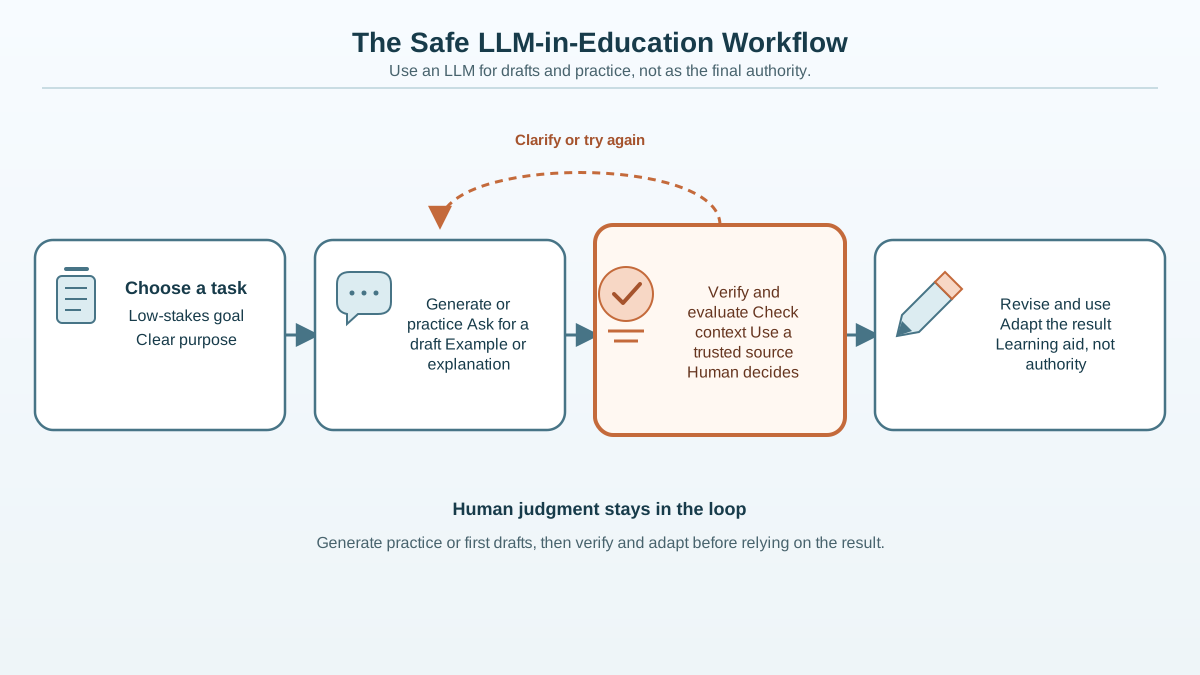
If you are an educator or a learner who wants to experiment, start small and start low-stakes.
Pick one task. Draft a lesson plan. Generate practice questions for a topic you are teaching. Ask for an explanation of a concept you are struggling to learn. Run that single experiment and compare the output against your own judgment.
Verify the output against a trusted source before relying on it. Treat every response as a draft to check, not a fact to trust.
Match the model to the task. Reasoning-heavy work like feedback and assessment benefits from a model with strong reasoning capabilities. Content creation benefits from multimodal models that can produce images and audio. The model choice matters less than the verification habit.
If you are a learner, use LLMs as a practice partner, not an answer machine. Ask for explanations and analogies before you ask for solutions. The skill that transfers is not getting the answer—it is learning to evaluate whether the answer is any good.
Common mistake: Treating LLM output as authoritative because it sounds confident. The confidence is the problem, not the feature. Every output is a draft until you check it.
The field is young, and the tools are changing quickly. The skill that will age well is not proficiency with any particular model. It is the habit of critical evaluation: asking whether the output is accurate, whether it fits the context, and whether it serves the learner in front of you.
That habit is itself the lesson worth teaching.
Knowledge check
Final check
Finish the article by checking the ideas you just learned.
References
- Paper page - Simulating Classroom Education with LLM-Empowered Agents
- The Revolution Has Arrived: What the Current State of Large Language Models in Education Implies for the Future
- The Use of Large Language Models in Education | International Journal of Artificial Intelligence in Education | Springer Nature Link
- First-ever education-specific language models open door to trustworthy generative AI for teachers and students
- How to Choose the Right Model: LLMs in Education ...
- AI in Education | Jen's Teaching and Learning Hub | Illinois
Research updated Sep 7, 2026


