
Practice Designing a Structured-Output Contract
The model returns clean JSON. Every brace closes. Every key is present. And the answer is still wrong.

Key topics
The model returns clean JSON. Every brace closes. Every key is present. And the answer is still wrong.
That is the moment most beginners learn the hard truth: valid shape is not the same thing as a valid answer. A response can pass every format check and still be useless, because the field was filled with a plausible guess, the category was technically allowed but factually wrong, or a required field got stuffed with filler just to satisfy the shape.
If you have already learned how to ask for structured output and why validation still matters, this is the next rep. Here you will design a structured-output contract for one small task, then test it against four messy inputs before you ever judge the model. The goal is to decide what a response must mean, not just how it is shaped.
Why Valid JSON Is Not a Contract
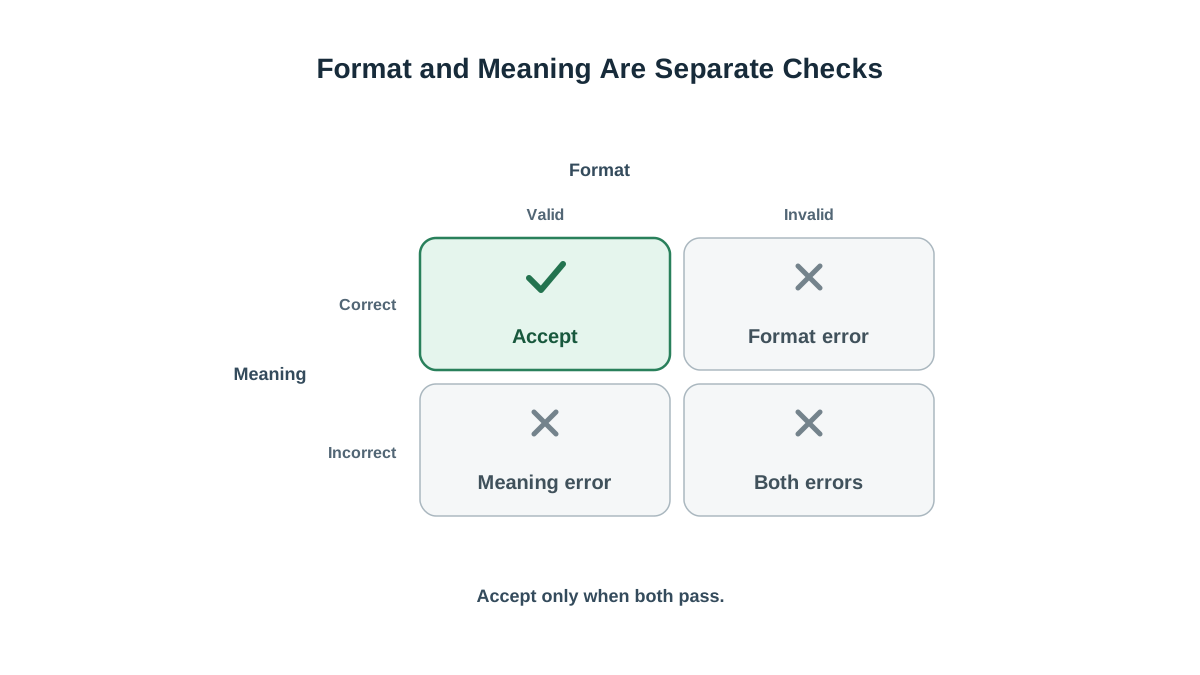
A schema describes shape. A contract describes meaning. Those are two different layers, and beginners collapse them constantly.
Format requirements cover the mechanical half: which keys exist, what types they hold, which are required, whether the JSON parses. Semantic requirements cover the judgment half: what values are allowed to mean, when a value is a guess instead of a fact, and what the response should say when the input does not fit.
The contract is the written artifact that covers both. The schema is only the format half of it.
Here is the failure in miniature. Imagine a task that classifies a support message. The model returns:
{
  "category": "billing",
  "priority": "high",
  "reason": "Customer seems upset about a charge."
}
Every field is present, every type is correct, the JSON is valid. But if the message was actually about a login failure, the category is a confident lie wrapped in perfect syntax. A validator would pass it. A human would not.
Common mistake: Treating "the JSON parsed" as "the answer is correct." Those are two separate checks, and you need both.
Knowledge check
Check your understanding
Answer this question before you continue.
Pick a Bounded Task and Name Its Decisions
Before you write a single field, pick a task with a narrow input space. Narrow means the input is short, the possible outputs are limited, and you can imagine the whole decision space in your head.
A good starter: classify a short support message into a category, a priority, and a one-line reason.
Now do the part beginners skip. List the decisions a downstream reader or program must make from the output. Each decision implies a field.
- "Which team should see this?" → needs a
category. - "Does it jump the queue?" → needs a
priority. - "Why did the model choose that?" → needs a short
reason.
That is three fields. Resist adding more. A field that drives no decision, no join, and no stored artifact is an invitation for creative filler. If nothing downstream reads it, cut it.
Finally, state the task boundary in one sentence: what is in scope and what is out. For this task: in scope is a short customer message about a product or service issue; out of scope is anything that is not a support message at all — a sales question, spam, or a message in a language the system does not handle.
Knowledge check
Check your understanding
Answer this question before you continue.
Write the Contract: Fields, Types, and Allowed Values
Draft the contract in plain language first. Then translate it into a schema-like shape. Plain language forces you to say what each field means; the schema shape forces you to say what it is.
| Field | Type | Required | Meaning |
|---|---|---|---|
category | string, closed set | yes | The single best-fit issue area |
priority | string, closed set | yes | How urgently a human should look |
reason | string, short | yes | One sentence of evidence from the message |
status | string, closed set | yes | Whether the message could be classified at all |
Now define the allowed values as closed sets wherever the decision space is closed. For category: billing, technical, account, other. For priority: low, medium, high. For status: classified, ambiguous, incomplete, out_of_scope.
Why closed sets? An open string invites drift. Ask for a category as free text and you will get billing, Billing Issue, billing-related, and payment problem — four labels for one idea, and now your downstream code has to guess which ones match.
Keep required fields minimal. A field that is sometimes unknown should either be optional or carry an explicit unknown value rather than being forced into a guess.
Order matters too. Put evidence before conclusion. If reason comes before category, the model writes its reasoning first and then commits to a label that fits. If the label comes first, the reasoning tends to justify whatever it already picked.
Note: Many structured-output implementations require every field to be declared required. When that is your constraint,
unknownbecomes an allowed value rather than an omitted key. Design for the tool you actually have.
Knowledge check
Check your understanding
Answer this question before you continue.
Decide What Happens to Messy Inputs
This is the section most beginner contracts omit, and it is where real reliability lives. You need three explicit dispositions: ambiguous, incomplete, and out-of-scope.
For each one, decide the contract's answer before you see any model output. Every disposition must still return all four required fields, so the response stays complete and testable:
- Ambiguous — the message could reasonably fit two categories. Set
statustoambiguous, pick the most likelycategory, setpriorityto your best guess, and note the competing reading inreason. - Incomplete — the message is too short to classify. Set
statustoincomplete, setcategorytoother, setprioritytolow, and usereasonto say what detail is missing. - Out-of-scope — the message is not a support issue. Set
statustoout_of_scope, setcategorytoother, setprioritytolow, and usereasonto name why it falls outside the task.
The key move is that ambiguity handling lives in the contract, not in a hopeful instruction like "ask for clarification if unsure." A vague instruction gives the model room to silently pick a side. A named status value forces it to admit the input was messy.
Out-of-scope inputs especially need a named exit. Without one, the model is forced to cram a sales question into billing or technical, because those are the only doors you left open.
Knowledge check
Check your understanding
Answer this question before you continue.
Test the Contract Against Four Examples
Now the deliberate part. Here is a small test set. Hand-fill the contract for each input yourself before you run anything. Write down what you believe the correct output is, field by field. If you cannot fill it consistently, the contract is underspecified — not the model.
Input 1 (clean): "I was charged twice for my subscription this month. Please refund the duplicate."
Input 2 (ambiguous): "I can't log in and my invoice looks wrong."
Input 3 (incomplete): "It's broken."
Input 4 (out-of-scope): "Do you offer enterprise pricing for a team of 200?"
Here is the intended contract output for each:
[
  {
    "category": "billing",
    "priority": "high",
    "reason": "Customer reports a duplicate charge and requests a refund.",
    "status": "classified"
  },
  {
    "category": "account",
    "priority": "medium",
    "reason": "Message could fit account (login) or billing (invoice); login chosen as primary.",
    "status": "ambiguous"
  },
  {
    "category": "other",
    "priority": "low",
    "reason": "No issue detail provided; cannot classify.",
    "status": "incomplete"
  },
  {
    "category": "other",
    "priority": "low",
    "reason": "Sales inquiry, not a support issue.",
    "status": "out_of_scope"
  }
]
Now run the model and compare its output against your hand-filled version, field by field. Classify each mismatch into one of four buckets:
- Format failure — missing key, wrong type, broken JSON.
- Allowed-value violation — a value outside your closed set.
- Semantic error — a valid value that is simply wrong.
- Contract gap — the model did something reasonable that your contract never anticipated.
That last bucket is the valuable one. It means your specification, not the model, needs work. Revise the contract for gaps and leave the model unchanged. One variable at a time.
Common Contract Mistakes and How to Spot Them
Run your draft against this list before you trust it.
- Too many required fields. The model invents values to satisfy the shape. If a field is often unknowable, it should not be required.
- Open strings where a closed set was available. Output drifts into near-duplicate categories.
- No disposition for ambiguity. The model silently picks a side and hides the uncertainty.
- Incomplete dispositions. A rule that says "stop" without specifying every required field leaves the response untestable.
- Confusing format compliance with correctness. A passing validator is not a passing answer.
- Writing the contract after seeing the output. Now it describes what the model did, not what you need. Write it first.
When a Contract Is Worth Writing — and When It Is Not
Write a contract when the output feeds code, a database, a downstream decision, or another person who needs consistent fields. Write one when you keep cleaning up the same mess by hand, when categories come back inconsistent, or when two people argue about what a field "should" contain.
Skip the ceremony for one-off exploratory prompts where you are still discovering what you even want to ask. A contract locks in decisions. Locking in decisions before you have made them just freezes your confusion.
The payoff is that a contract is a reusable asset. Once written, it survives model changes, prompt rewrites, and new examples. The prompt is disposable; the contract is the part that compounds.
Your Next Rep
Take the contract you just wrote and add one new allowed value to a closed set — say, a fourth category. Re-run the same four examples and watch which outputs shift. You will usually learn more from that one change than from a dozen new prompts.
Or swap the task entirely and write a second contract from scratch in under ten minutes using the same four steps: name the decisions, define the fields and allowed values, decide the messy-input dispositions, then hand-fill four examples before running the model.
Keep the contract file next to the prompt. The specification and the request should travel together, so the next person — including future you — can see what the response was always supposed to mean.
Knowledge check
Final check
Finish the article by checking the ideas you just learned.
References
Want a more structured LLMOps path?
Use the LLMOps Practical Starter Bundle to connect RAG, evaluation, observability, and production patterns.
Large Language Models Starter Pack
A 12-chapter guide connecting LLM fundamentals with prompting, RAG, agents, tool calling, evaluation, security, and application engineering.
- 227-page Illustrated PDF edition
- 12 guided LLM engineering chapters
- Visual concept diagrams
- Self-assessment quizzes
- Bonus deep-dive sections
- Prompt design, structured output, context windows & RAG pipelines
- Agents, tool calling, prompt injection, evaluation & application lifecycles
Coming soon


