
What Are Embeddings? How Meaning Becomes Searchable
You search your company's help docs for "how do I reset my password?" and get nothing useful. You know the answer is in there—you've read the page…

Key topics
You search your company's help docs for "how do I reset my password?" and get nothing useful. You know the answer is in there—you've read the page explaining how to change your login credentials. But the search box matched zero words, so the page might as well not exist.
This is the problem embeddings solve. They turn meaning into something a computer can measure, so retrieval systems can find text that means the same thing even when it doesn't say the same thing.
Why Keyword Search Misses the Point
Keyword search compares surface text. It checks whether the words in your query appear in the document. That works fine when people phrase things the way the author did. It falls apart the moment they don't.
Consider these two sentences:
- Query: "How do I reset my password?"
- Document: "To change your login credentials, visit the account settings page."
A keyword search finds zero overlap. No shared words at all. But a human reader instantly recognizes these are about the same task. The query and the document are semantically related—they just use different vocabulary.
This gap matters everywhere. Users don't know your documentation's exact phrasing. Customers describe problems in their own words. Support tickets, product manuals, and knowledge bases are full of natural language variation that exact-word matching cannot bridge.
If you've read about retrieval-augmented generation (RAG), you know the basic idea: pull relevant context from your documents and feed it into the model's prompt. But that raises an obvious question—how does the system decide what counts as relevant? Keyword matching is too brittle. What the system needs is a way to compare meaning, not just words.
That's what embeddings are for.
Knowledge check
Check your understanding
Answer this question before you continue.
Embeddings Turn Meaning Into Numbers
An embedding is a numerical representation of a piece of text. A model reads a word, sentence, or entire document and produces a list of numbers—typically hundreds of them—that captures what the text is about.
That list of numbers is called a vector. Think of it as a set of coordinates. Just as latitude and longitude pin a location to the Earth's surface, an embedding pins a piece of text to a location in a high-dimensional space. The space has many dimensions—often 384, 768, or 1,536 of them—but the principle is the same as a 2D map.
The key property: text with similar meaning lands near each other in this space. Text with unrelated meaning lands far apart.
So "how do I reset my password?" and "change your login credentials" produce vectors that sit close together, because the embedding model has learned from vast amounts of text that these phrasings are used in similar contexts. Meanwhile, "how do I reset my password?" and "the best pizza toppings ranked" produce vectors that sit far apart.
The numbers themselves are not human-readable. You can't look at [0.84, 0.42, ..., 0.02] and learn anything about passwords or pizza. The embedding model learned these coordinates during training by observing which words and phrases tend to appear in similar contexts across enormous text corpora. The result is a geometric map of meaning, built from statistical patterns rather than hand-written rules.
This is what people mean when they talk about embeddings in AI: not a clever lookup table, but a learned transformation that converts language into geometry.
Knowledge check
Check your understanding
Answer this question before you continue.
How Similarity Is Measured
Once your text lives in this space, the question "how related are these two pieces of text?" becomes "how close are these two points?"
The standard way to measure closeness is cosine similarity, which compares the angle between two vectors. Two vectors pointing in nearly the same direction are similar, even if one is longer than the other. Two vectors pointing in very different directions are unrelated. The result is a score, usually between -1 and 1, where higher means more similar.
Here's the practical detail that makes retrieval work: the same embedding model is used for both the stored documents and the incoming query. That means every piece of text—whether it was embedded last week or arrives as a fresh user question—lands in the same shared space. Comparisons stay valid because everything was mapped using the same rules.
This shared-space property is what makes semantic search possible. When a user submits a query, the system:
- Embeds the query using the same model that embedded the documents
- Computes similarity scores between the query vector and every stored document vector
- Returns the documents with the highest scores
Because documents are embedded once and stored, step 2 is just a nearest-neighbor search over precomputed vectors. That's why retrieval can be fast even over large collections—the expensive part, understanding the text, happened once at indexing time.
Note: The embedding model creates the vectors, similarity search ranks them, and a vector database is the implementation that stores and finds those vectors efficiently. Don't confuse the tool with the meaning it stores.
Knowledge check
Check your understanding
Answer this question before you continue.
Similarity Is Not Relevance
Here's the misconception I see most often from people new to embeddings: they assume a high similarity score means the retrieved text is correct.
It doesn't. Embeddings measure topical closeness, not factual accuracy.
A retrieved passage can be semantically similar to your query and completely wrong. It can be outdated, misleading, or only partially relevant. The embedding model doesn't know whether the text is true. It only knows whether the text is about the same thing as your query.
Here's a sharper version of the problem. Imagine your password query retrieves a help page about resetting passwords for a different product—one your company no longer supports. The text is topically close: it's about passwords, resets, and account access. But it's useless for answering the user's actual question. Semantic similarity said "related." The task said "wrong product."
This distinction matters enormously in RAG systems. Retrieval finds text that looks relevant. The language model then has to reason over that text, combine it with what it knows, and produce an answer. If retrieval pulls a confidently written but incorrect passage, the model may happily repeat the error.
So treat embeddings as a candidate filter, not a truth detector. A high similarity score tells you the retrieved text belongs in the conversation. It tells you nothing about whether the answer it supports is right.
Knowledge check
Check your understanding
Answer this question before you continue.
Where Embeddings Fit in a RAG Pipeline
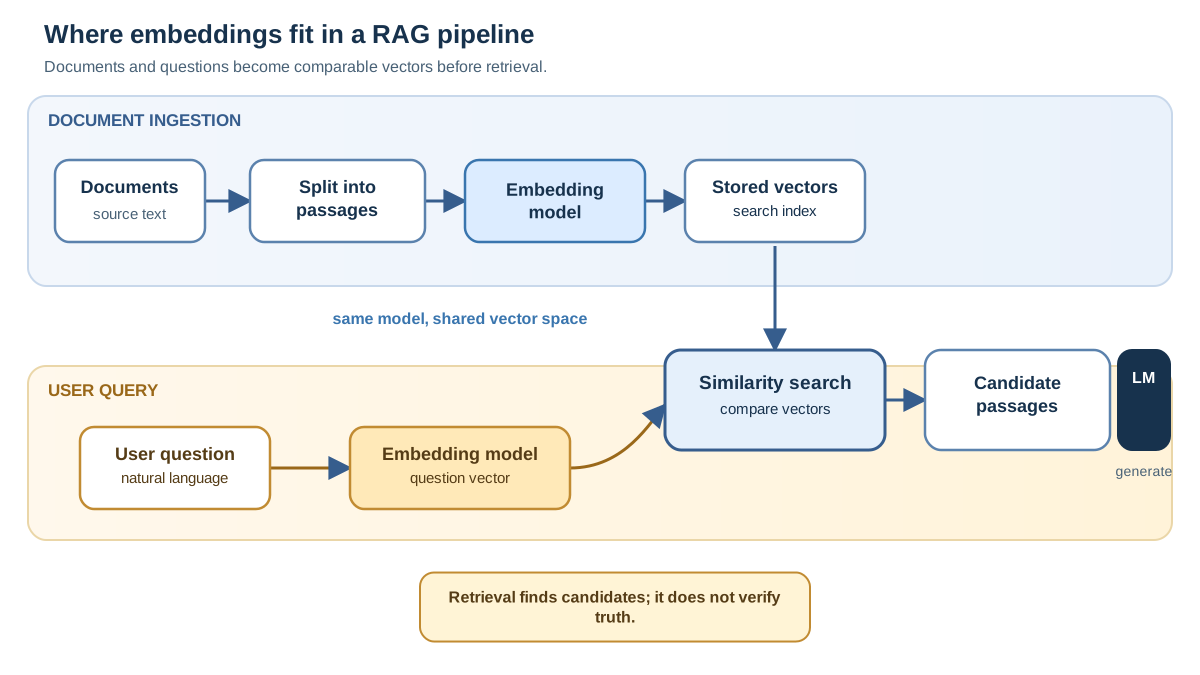
If you've seen a RAG pipeline diagram, you've probably noticed embeddings sitting in the middle of it. Here's the role they play:
During ingestion, documents are split into passages, and each passage is embedded and stored in a vector database. When a user asks a question, the query is embedded at request time. The system then finds the stored vectors closest to the query vector and returns those passages as context for the language model.
That's the whole job. Embeddings handle the retrieval stage—proposing which stored text might belong in the model's context window. They don't handle generation, and they don't verify facts.
One rule worth remembering: the embedding model used for documents and queries must be compatible. If you embed your documents with one model and your queries with another, the two sets of vectors may live in different spaces. The geometry doesn't line up, and your similarity scores become meaningless.
Common Mistakes Beginners Make
When you start working with embeddings, a few errors tend to surface repeatedly. Each one has a clear consequence and a straightforward fix.
Mixing embedding models. If your stored documents were embedded with model A and your queries run through model B, the vectors aren't comparable. The fix: pick one model and use it consistently for both sides.
Expecting embeddings to judge correctness. A semantically similar passage can be factually wrong. The fix: remember that retrieval is a filter, not a verdict. The language model still has to reason over what was retrieved.
Assuming more dimensions means better results. Higher-dimensional vectors aren't automatically better. They cost more to store and compute, and they don't guarantee improved retrieval quality. The fix: choose a model that performs well on your actual data, then test it.
Blaming the model when the input is the problem. Embedding quality depends heavily on the text being embedded. A garbled document, a passage stripped of context, or a poorly phrased query will produce a weak embedding regardless of which model you use. The fix: clean your source text and think about what you're asking the model to represent.
Treating top similarity as the final answer. Vector search proposes candidates; it doesn't declare winners. The fix: inspect the top few results, and combine vector search with metadata filters, keyword constraints, or reranking when exact terms, dates, permissions, or product versions matter.
The Takeaway
Embeddings are the mechanism that lets retrieval systems find text by meaning. They convert language into coordinates, so "how related?" becomes "how close?"—a question a computer can answer quickly across millions of stored passages.
But remember where they stop. Embeddings select plausible candidates. They don't verify relevance, and they don't verify truth. In a RAG system, they're the part that proposes what deserves a spot in the model's context window. Everything after that—reasoning, synthesis, fact-checking against the retrieved material—belongs to the language model and to the rest of your pipeline.
The next step is seeing this mechanism in action. Build a simple RAG pipeline, embed a small set of documents, and run queries that share no keywords with the source text. Watch the system find the right passages anyway. Then try a query where the closest passage is topically related but wrong for the task, and see why retrieval quality is about more than geometry. That's when embeddings stop being abstract and start being obvious.
Knowledge check
Final check
Finish the article by checking the ideas you just learned.
References
Research updated Sep 7, 2026


