
RAG vs Plain LLMs
Most people assume RAG is a different kind of model—a smarter cousin of the plain LLM. It's not. RAG doesn't change the model at all. It changes what goes…

Key topics
Most people assume RAG is a different kind of model—a smarter cousin of the plain LLM. It's not. RAG doesn't change the model at all. It changes what goes into the prompt.
Think of it this way: a plain LLM answers from memory. RAG lets it read the relevant book before answering. Same brain. Better input.
The misconception: RAG is not a different model
When people first hear "retrieval-augmented generation," they picture a competing architecture—something that replaces the LLM. That mental model causes real confusion when you start building.
Here's what actually happens: RAG wraps the same LLM with a retrieval step. The model itself never changes. It still sees a prompt and generates a response. The only difference is that RAG stuffs more relevant context into that prompt before the model reads it.
A plain LLM answers from patterns it learned during training. A RAG system retrieves external context and hands it to the model as part of the input. That context can come from a static document archive or a frequently updated knowledge base—what matters is that it was retrieved, not that it's live.
The "reading a book" analogy captures this well. Ask me a question about world history, and I'll answer from what I remember. Hand me a specific textbook and ask me to find the answer there first, and my answer changes—not because my brain got smarter, but because I'm working with better source material.
The analogy stops being exact in one place: a RAG system doesn't read the whole book. It searches for relevant passages and reads only those. That distinction matters later when we talk about retrieval quality.
Knowledge check
Check your understanding
Answer this question before you continue.
How a plain LLM answers
A plain LLM generates text from patterns learned during training. When you ask it a question, no lookup happens. No database is queried. The model relies entirely on what it learned from the data it was trained on.
That works well for general knowledge, reasoning, and creative tasks. Ask a plain LLM to explain recursion, draft an email, or summarize a concept, and it performs admirably—because those answers draw on patterns it saw thousands of times during training.
The failure mode appears when you need something the model never saw: your company's internal policies, yesterday's sales numbers, a niche technical specification, or any private document. The model doesn't know it doesn't know. It generates a plausible-sounding answer anyway. That's the hallucination problem in its purest form.
The key limitation isn't intelligence. It's that the model's knowledge is frozen at training time. No amount of clever prompting can recover information that was never in the training data.
Knowledge check
Check your understanding
Answer this question before you continue.
How RAG changes the picture
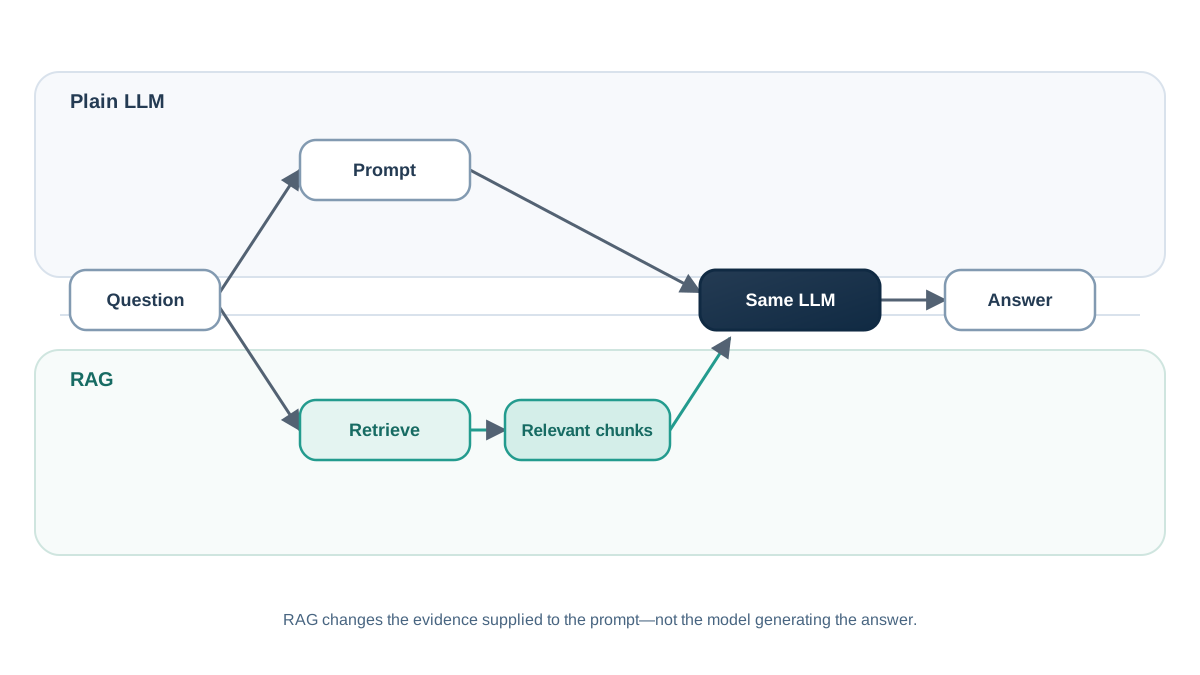
RAG inserts one step before generation: retrieval. The pipeline looks like this:
- User asks a question
- System searches an external source (documents, database, knowledge base)
- System retrieves the most relevant chunks
- Those chunks are added to the prompt as context
- The LLM generates an answer grounded in that context
The model doesn't change. The input does. Instead of asking the model to answer from memory, you're asking it to answer from evidence you provide.
This grounds the response in documents the model never memorized. If your support chatbot needs to answer questions about your product's current pricing, you don't retrain the model—you point RAG at your pricing docs. When pricing changes, you update the docs and rebuild the index. The model stays the same.
If you need a refresher on the fundamentals of how RAG works, the concept guide on retrieval-augmented generation covers the full pipeline in more depth.
Knowledge check
Check your understanding
Answer this question before you continue.
Plain LLM vs RAG: side-by-side
| Dimension | Plain LLM | RAG |
|---|---|---|
| Knowledge source | Static training data | Retrieved external context |
| Freshness | Frozen at training time | Depends on source updates and re-indexing |
| Setup effort | None—just call the model | Requires indexing and retrieval tuning |
| Token cost per query | Lower—no extra context | Higher—retrieved chunks add tokens |
| Hallucination risk | High on niche or private topics | Lower, but not eliminated |
| Best for | General knowledge, reasoning, creative tasks | Private, domain-specific, or frequently changing info |
The cost picture deserves attention. RAG sends more tokens per query because retrieved context is added to every prompt. But it often beats the alternative of sending an entire document corpus to a long-context model. Retrieval keeps the prompt lean—only the relevant chunks make it in.
RAG lowers hallucination risk, but it doesn't eliminate it. If retrieval returns irrelevant chunks, the model will confidently answer from the wrong evidence. Garbage in, grounded-sounding garbage out.
Knowledge check
Check your understanding
Answer this question before you continue.
When to use each approach
The real decision isn't just "did the model see this during training?" It's a three-part test:
- Does the answer require external evidence? If the task needs verification, citation, or access to information the model couldn't have memorized, retrieval earns consideration.
- Does that evidence change or belong to a private source? Company policies, product specs, recent research, and customer data all qualify.
- Can retrieval reliably find the right passages? If your documents are messy or your search quality is poor, RAG adds failure modes without adding value.
Apply that test to two contrasting cases.
Case one: a small, stable policy document. You have a 20-page employee handbook that changes once a year. A plain LLM with the handbook pasted into the prompt—or a long-context model reading it directly—is simpler and cheaper. No index to maintain, no retrieval failures to debug. RAG would add complexity without solving a real problem.
Case two: a large, changing internal knowledge base. Your support team has thousands of tickets, product docs, and internal wikis that update daily. No prompt can hold all of it. Here, retrieval earns its keep: it finds the relevant passages so the model only sees what matters for the current question.
Many real systems combine both. A customer support bot might use RAG to pull relevant documentation, then rely on the plain LLM's general knowledge to phrase the answer naturally. RAG isn't an either/or replacement for the model—it's an addition to the pipeline.
Common mistakes beginners make
Assuming RAG fixes every hallucination. Retrieval quality matters as much as generation quality. If your chunking strategy splits documents awkwardly or your search returns irrelevant results, the model will produce confident answers from bad evidence. RAG shifts the problem; it doesn't erase it.
Treating RAG as a model choice. RAG is an architecture decision, not a model selection. You don't choose between "RAG model" and "plain model." You choose whether to add a retrieval step around whatever model you're using.
Ignoring setup and maintenance cost. RAG requires indexing your documents, choosing a retrieval strategy, and tuning chunk sizes. That's ongoing work, not a one-time setup. When your documents change, your index needs to change too.
Overlooking that a plain LLM is often the right answer. Not every task needs retrieval. If you're building a general-purpose assistant, adding RAG means maintaining an index, paying for extra tokens, and debugging retrieval failures—for no benefit. The cheapest, simplest system that works is the one you should ship.
My rule: start with a plain LLM. Add RAG only when the three-part test points to external evidence that changes or belongs to a private source—and when retrieval can find it reliably.
Then verify the retrieval is actually helping. Collect a handful of representative questions, inspect what gets retrieved for each one, and compare answers with and without retrieval. If the evidence doesn't improve your answers enough to justify the index maintenance and extra tokens, drop it. Retrieval should earn its place in your pipeline, not occupy it by default.
Knowledge check
Final check
Finish the article by checking the ideas you just learned.
References
Research updated Sep 7, 2026


