
Test LLM API Rate-Limit Retries and Backoff Without Live Calls
A retry loop that looks correct in code review can still double your request volume, blow past a deadline, or replay a non-idempotent call. You cannot see…

Key topics
A retry loop that looks correct in code review can still double your request volume, blow past a deadline, or replay a non-idempotent call. You cannot see any of that until a provider throttles you at the worst possible moment.
The weak model most of us start with is: retries are just a try/except with a sleep. That model hides the three things that actually decide whether your client survives throttling — how many attempts it makes, how much time those attempts consume, and whether the operation was ever safe to replay. A retry policy is a bounded state machine over attempts, a simulated clock, and a safety label. This tutorial makes that state machine visible and reproducible, with no network calls and no burned quota.
We will build a deterministic fixture, run it, read its output, compare bounded policies, and then change one input to prove the mechanism to ourselves.
Why Live Rate-Limit Testing Fails You
Hitting a real endpoint to study throttling feels honest. It is also the worst experiment you can run, for four reasons.
First, it is non-reproducible. A 429 arrives on the provider's schedule, not yours. You cannot run two policies against the same sequence of failures, so any comparison is really a comparison of two different afternoons.
Second, rejected requests still consume quota on many providers. Probing throttling behavior costs money and can push you deeper into the limit you are trying to study. Continuously resending a request does not work — it just eats the budget faster.
Third, you cannot force the interesting cases on demand: a deadline breach, a server-provided retry hint, or a mid-sequence success that arrives on attempt four instead of attempt two.
The fix is to separate the policy under test from the transport. Feed the policy a scripted sequence of responses and a simulated clock. Now the experiment is deterministic, free, and instant.
What the Fixture Models (and What It Ignores)
If you already have a working client from your first programmatic request, this is the natural next step: we keep the client shape and replace the network with a scripted responder.
A few terms, defined once:
- Attempt — one call to the transport, whether it succeeds or not.
- Retry limit — the maximum number of attempts the policy will make.
- Backoff delay — the wait inserted between attempts.
- Jitter — randomness added to a delay so multiple callers do not retry in lockstep.
- Deadline — a wall-clock budget, in simulated seconds, for the whole operation.
- Simulated clock — a counter that accumulates delays without actually sleeping.
- Idempotency label — a flag saying whether replaying the operation is safe.
- Retry-safety disposition — the policy's verdict: completed, deadline-exceeded, or refused-unsafe-replay.
The fixture models ordered response sequences, a bounded attempt count, a deadline in simulated seconds, and whether the operation is safe to replay. It deliberately ignores real network latency, provider-side token accounting, streaming, and concurrency across clients. Say that out loud before you trust a green run.
Note: Per-request retry logic does not coordinate across callers. A passing single-client fixture is not proof of system-wide safety — ten clients retrying in lockstep can re-trigger the limit they are backing off from.
Set Up the Scenario File
Everything here uses the Python 3 standard library. No third-party packages, no credentials, no network access.
The input is scenarios.json. Each scenario carries an id, an ordered list of responses, a retry_limit, a deadline, and an idempotent label. The response list is ordered and finite — it is the script that makes the run reproducible.
{
  "scenarios": [
    {
      "id": "throttle-then-success",
      "responses": ["429", "429", "success"],
      "retry_limit": 4,
      "deadline": 30,
      "idempotent": true
    },
    {
      "id": "throttle-past-deadline",
      "responses": ["429", "429", "429", "success"],
      "retry_limit": 5,
      "deadline": 5,
      "idempotent": true
    },
    {
      "id": "unsafe-replay",
      "responses": ["429", "429"],
      "retry_limit": 3,
      "deadline": 30,
      "idempotent": false
    }
  ]
}
The policy reads exactly these fields. The idempotent label is the one that decides whether a retry is allowed, not merely whether it is possible.
Build the Simulator
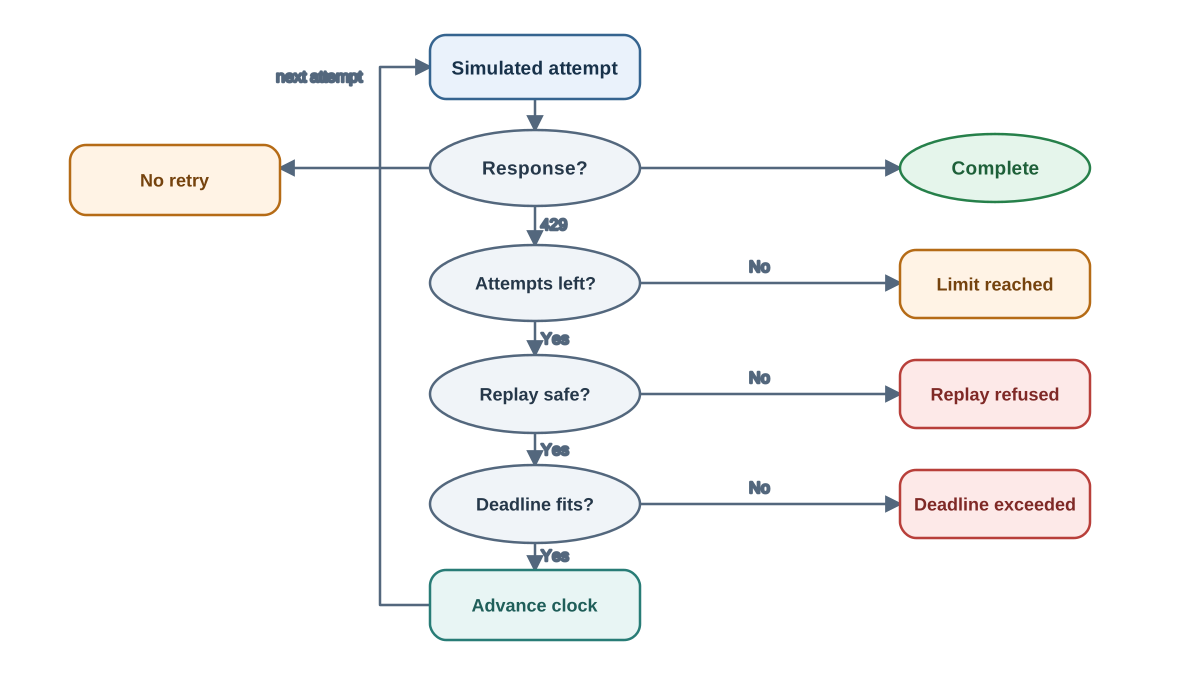
Create simulate_retries.py in the same directory as scenarios.json. The whole program is one file and one dependency-free import.
import json
import sys

BACKOFF_BASE = 1.0  # seconds; delay for attempt N is BACKOFF_BASE * 2**(N-1)


def run_scenario(scenario):
    responses = scenario["responses"]
    retry_limit = scenario["retry_limit"]
    deadline = scenario["deadline"]
    idempotent = scenario["idempotent"]

    attempts = 0
    delay = 0.0

    while attempts < retry_limit:
        # A retry is only permitted if the operation is safe to replay.
        if attempts > 0 and not idempotent:
            return attempts, delay, "refused", "unsafe-replay"

        response = responses[attempts] if attempts < len(responses) else "429"
        attempts += 1

        if response == "success":
            return attempts, delay, "completed", "replay-safe"

        # Throttled: compute the next backoff delay before retrying.
        next_delay = BACKOFF_BASE * (2 ** (attempts - 1))
        if delay + next_delay > deadline:
            return attempts, delay, "deadline-exceeded", "replay-safe"
        delay += next_delay

    return attempts, delay, "retry-limit-exhausted", "replay-safe"


def main(path):
    with open(path) as f:
        data = json.load(f)

    for scenario in data["scenarios"]:
        attempts, delay, result, disposition = run_scenario(scenario)
        print(
            f"{scenario['id']:<24} attempts={attempts}  "
            f"delay={delay:.1f}s  result={result:<18} disposition={disposition}"
        )


if __name__ == "__main__":
    main(sys.argv[1])
Three decisions in this code produce every number you are about to read.
The attempt limit is checked at the top of the loop, so the policy never exceeds retry_limit calls to the transport. The deadline check happens before the delay is committed: if the next backoff would push the accumulated clock past the budget, the scenario fails immediately rather than sleeping into a guaranteed miss. The idempotency guard fires on every attempt after the first, so a non-idempotent operation that gets throttled returns refused instead of replaying.
Knowledge check
Check your understanding
Answer this question before you continue.
Run the Simulation and Read the Output
python simulate_retries.py scenarios.json
Expected output:
throttle-then-success    attempts=3  delay=3.0s  result=completed          disposition=replay-safe
throttle-past-deadline   attempts=3  delay=7.0s  result=deadline-exceeded  disposition=replay-safe
unsafe-replay            attempts=1  delay=0.0s  result=refused            disposition=unsafe-replay
Notice the clock. Delays are accumulated in simulated seconds, so the run finishes instantly while still exercising deadline logic. The throttle-past-deadline scenario accumulates 7.0s of backoff against a 5s deadline and fails — even though a fourth response was waiting to succeed.
The success criteria are explicit: reproducible, no-network output that matches the expected fixture, with attempt counts and simulated delay consistent with the policy. Read the three numbers as three different questions:
- Attempt count is the policy's footprint on the provider.
- Simulated delay is its cost in time.
- Disposition is its safety verdict.
Compare Bounded Policies Side by Side
The simulator uses exponential backoff with a fixed base. To compare policies, change BACKOFF_BASE and rerun against the same throttle-then-success sequence. The numbers below come from that single knob.
| Policy | Attempts | Simulated delay | Outcome |
|---|---|---|---|
Fixed 1s (BACKOFF_BASE with no growth) | 3 | 2.0s | completed |
| Exponential (1s, 2s) | 3 | 3.0s | completed |
| Exponential + jitter | 3 | 2.4s | completed |
Under a tight deadline, the tradeoff sharpens. Aggressive retries finish sooner but spend more attempts against the limit. Conservative backoff protects the limit but risks the deadline. The deadline is the binding constraint: a policy that would eventually succeed can still fail the scenario if accumulated delay crosses the budget.
Jitter is the one row you cannot reproduce from the code above without adding randomness. That is the point. A deterministic fixture should not silently depend on a random value. If you want to test jitter, add a seeded random.Random(seed) and record the seed in the scenario, so the delay is reproducible on every run.
Idempotency is a separate axis. A non-idempotent operation that exhausts retries should surface a refusal or escalation disposition, never a silent replay.
Knowledge check
Check your understanding
Answer this question before you continue.
Change One Input and Rerun
Predict before you run. The value is in being wrong and finding out why.
Experiment A. In throttle-then-success, flip the first 429 to success. Predict the new attempt count. If you said one, you understand the state machine.
Experiment B. Tighten throttle-then-success's deadline to 1. The retry policy is unchanged, but the scenario should flip to deadline-exceeded. Deadline handling is a property of the budget, not the backoff curve.
Experiment C. Change unsafe-replay's idempotent label to true. The response sequence is ["429", "429"], so the policy now reaches the second scripted response. The attempt count rises to 2, the delay becomes 1.0s, and the disposition changes from refused to replay-safe. Same policy, different safety verdict.
Knowledge check
Check your understanding
Answer this question before you continue.
Debugging Signals and Common Mistakes
When output does not match expectations, check these first.
- Mismatched attempt count usually means an off-by-one in the retry limit, or a response the policy did not classify as retryable.
- Mismatched simulated clock usually means delay was applied after the final attempt, or jitter was added where the fixture expects a deterministic value.
Then check the mistakes that survive code review:
Common mistake: Retrying on every error class instead of only throttling and transient failures. A 400 will never succeed on retry.
Common mistake: Ignoring a server-provided retry hint and retrying sooner than the server asked. Honor
Retry-Afterwhen it is present.
Common mistake: Stacking SDK-level retries on top of application-level retries. The attempts multiply beyond the limit you thought you set.
Common mistake: Treating a passing fixture as production proof. The fixture validates policy logic, not provider behavior.
Knowledge check
Check your understanding
Answer this question before you continue.
Where This Fits in a Real Client
The policy object you tested is the same one you inject into the real client. Only the transport changes. Keep the simulated clock behind an interface so production uses real time and tests use the fixture clock. Log attempts, delays, and dispositions in production so the fixture's vocabulary matches your operational telemetry.
This fixture covers single-request policy. It does not cover cross-client coordination or queue-level backpressure — those are separate systems with separate tests.
Pick your retry limit and deadline from the scenario that must succeed, not the one that usually succeeds. Then wire the tested policy into the real client behind a clock interface, and compare fixture predictions against observed production attempts. The first mismatch is your next lesson.
Knowledge check
Final check
Finish the article by checking the ideas you just learned.
References
Want a more structured LLMOps path?
Use the LLMOps Practical Starter Bundle to connect RAG, evaluation, observability, and production patterns.
Large Language Models Starter Pack
A 12-chapter guide connecting LLM fundamentals with prompting, RAG, agents, tool calling, evaluation, security, and application engineering.
- 227-page Illustrated PDF edition
- 12 guided LLM engineering chapters
- Visual concept diagrams
- Self-assessment quizzes
- Bonus deep-dive sections
- Prompt design, structured output, context windows & RAG pipelines
- Agents, tool calling, prompt injection, evaluation & application lifecycles
Coming soon


