
LLMs in Business
Most people picture "AI for business" as one magic assistant that can handle anything you throw at it. That picture is wrong in a useful way. LLMs in…

Key topics
Most people picture "AI for business" as one magic assistant that can handle anything you throw at it. That picture is wrong in a useful way. LLMs in business are not a single product. They are a set of distinct job patterns—drafting, summarizing, classifying, extracting, and acting—and each pattern has its own fit, its own failure modes, and its own payoff. The real question isn't whether an LLM can do business work. It's which business job the model is actually good at, and where it quietly breaks.
What "LLMs in Business" Actually Means
When a company says it's "using AI," it usually means one of four task patterns:
| Pattern | What the model does | Typical business function |
|---|---|---|
| Generation | Drafts text from a prompt or outline | Marketing copy, email responses, proposal drafts |
| Summarization | Compresses long content into key points | Meeting notes, report digests, research briefs |
| Classification | Sorts text into categories or sentiment | Ticket routing, spam detection, feedback triage |
| Extraction | Pulls structured fields out of unstructured text | Invoice data, contract terms, form processing |
Notice what's missing from that list: agents. That's deliberate. Agents are not a fifth kind of output. They are an orchestration layer that composes these task patterns with tools, retrieval, and workflow control. When a model can act—query a database, send a message, trigger a payment—the stakes change. A wrong draft is a revision. A wrong action is an incident.
The deciding factor for any deployment is whether the task tolerates the model's known failure modes: hallucination, inconsistency, and data exposure. A marketing team can tolerate a draft that needs editing. A compliance team cannot tolerate a confident wrong answer about regulatory obligations.
Three criteria separate the safe starting points from the dangerous ones:
- How bounded is the task? Can you define the acceptable inputs and outputs clearly, or is it open-ended?
- How sensitive is the data? Would exposure cause harm, and can you control where the data goes?
- How easy is the output to verify? Can a human quickly check whether the result is right?
Keep those three tests in mind. Every use case below is really a demonstration of how they play out.
If you've worked through RAG and agents, these patterns should look familiar. Business deployment is just those same building blocks pointed at real workflows.
Knowledge check
Check your understanding
Answer this question before you continue.
The Customer-Facing Layer: Support and Sales
Customer support is the most common entry point for LLMs in business, and for good reason. The task is bounded: answer questions, route requests, follow standard operating procedures. That boundedness is exactly what makes it tractable.
But there's a critical difference between a free-form chatbot and a support agent that actually works. A useful support agent is constrained to approved workflows and policies. It doesn't improvise. It follows the same decision tree a human agent would follow, just faster and at higher volume.
Research on business-adherence benchmarks makes the hard problem clear: keeping the model inside company rules is far more difficult than generating fluent replies. A model that sounds confident while drifting outside policy is worse than one that admits it doesn't know. Fluency without guardrails is a liability, not a feature.
Common mistake: Deploying an LLM on edge cases before nailing the high-volume, well-documented questions. Start where the answers are known and the stakes are low. Expand only after the constrained version is solid.
Knowledge check
Check your understanding
Answer this question before you continue.
The Back-Office Layer: Documents, Data, and Process
The less glamorous work is where LLMs often earn their keep: reading contracts, invoices, reports, and emails, then converting unstructured text into structured, usable output.
Extraction and classification are often easier to validate than generation because the model's output can be checked against known fields. If the model pulls a contract's renewal date, a human can verify it. If it misclassifies an invoice category, the error is visible and correctable. The output is a draft that gets reviewed, not a final answer that gets trusted.
But "easier to validate" is not the same as "safe." The risk depends on what happens after validation. Extracting a renewal date for a human to review is low-risk. Extracting that same date and automatically triggering a payment is not—because now a wrong extraction becomes a wrong transaction. The task pattern didn't change. The consequence of error did.
LLMs can also assist with process analysis—decomposing workflows and flagging steps that don't add value. But this is assistive analysis, not autonomous decision-making. The model points at where waste might be; a human decides what to change.
Warning: The real constraint is data handling. Sending proprietary documents to an external model raises exposure questions that must be answered before you discuss value. If you can't control where the data goes, the capability discussion is premature.
Knowledge check
Check your understanding
Answer this question before you continue.
The Frontier: Autonomous Agents in Operations
The emerging frontier is LLM agents that operate over longer horizons—negotiating with suppliers, managing inventory, handling returns and cash flow. Recent benchmarks simulate agents running e-commerce stores over a full year, and the results are genuinely interesting.
Here's the finding that matters: no single model dominates across all dimensions. One model may maximize profit while ranking poorly on fraud avoidance or operational efficiency. Capability in one area does not guarantee reliability in another.
That unevenness is the honest picture of agentic business operation. It's promising, but it's not uniform. A model that excels at negotiating prices down may be the same model that misses fraudulent returns. You're not choosing a general business brain. You're choosing a specialist with known strengths and blind spots.
Note: This is the frontier, not the default. Most businesses should not start here. Agents compound every failure mode of the simpler patterns—hallucination becomes a wrong action, inconsistency becomes unpredictable behavior, and data exposure becomes a security incident.
Knowledge check
Check your understanding
Answer this question before you continue.
How to Choose Where to Start
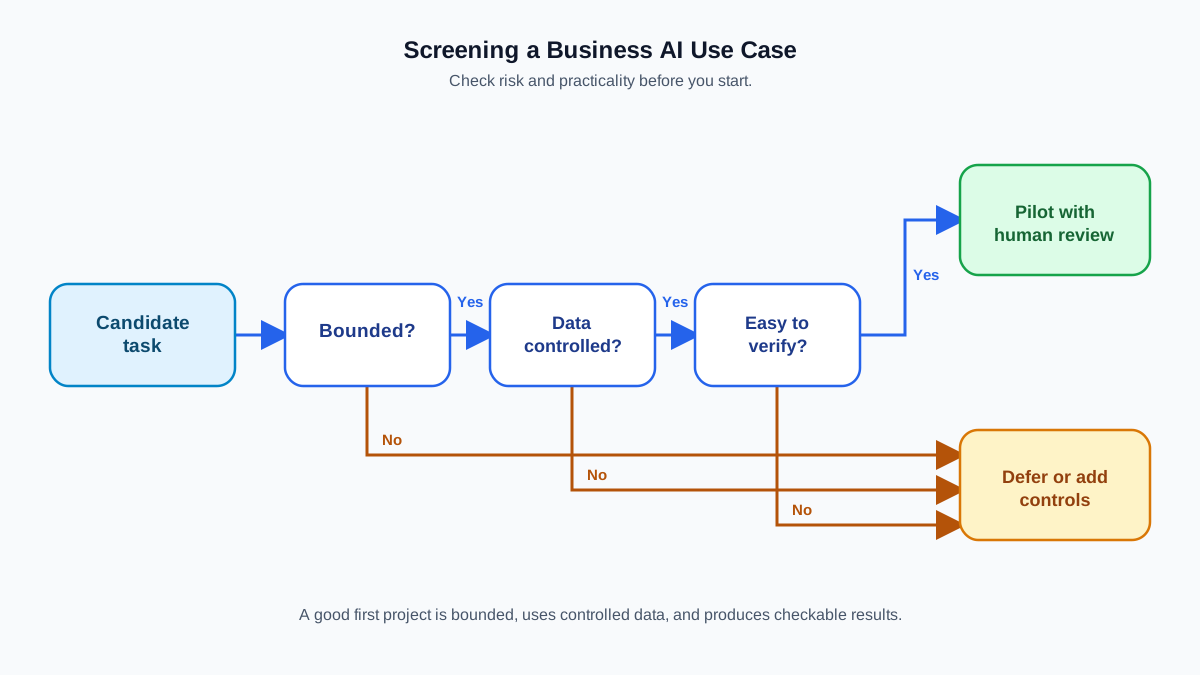
Run every candidate use case through the three criteria from earlier: boundedness, data sensitivity, and verifiability.
Low-risk starting points: internal summarization, document extraction, drafting assistance with human review. These are bounded, verifiable, and typically involve data you can control.
High-risk starting points to defer: autonomous decisions, anything touching regulated or confidential data without clear controls, anything where a confident wrong answer is costly.
And here's the when-not-to-use guidance that saves companies real money: do not deploy an LLM where a deterministic rule, lookup, or simple script already solves the problem reliably. If a regex catches the pattern, use the regex. If a database lookup answers the question, use the lookup. LLMs are for judgment-adjacent work, not for replacing logic that already works.
My rule: pick the task where a wrong answer is cheap to catch and easy to fix. That's where you learn the most with the least risk.
A Practical Learning Path for Business AI
The fastest way to understand LLMs in business is not to read more overviews. It's to pick one bounded task and build the narrow version of it.
Here's the progression I recommend:
- Start with document extraction or summarization on your own data. Pull key fields from a contract. Summarize a batch of customer emails. See where the model succeeds and where it fumbles.
- Add retrieval (RAG) when you need the model to answer from a specific knowledge base rather than general knowledge. This is the step where you learn how to ground the model in your actual business context.
- Consider an agent only after the simpler patterns are solid. By then you'll understand the failure modes well enough to know what an agent would actually need to succeed.
The RAG and agents practice exercises on this site are the natural next hands-on step. They'll take you from understanding these patterns to building them.
Before you close this article, do one thing: name a specific business problem you could prototype this week. Not a vague aspiration—a concrete task with real documents or real data. That prototype will teach you more about LLMs in business than any amount of reading.
Knowledge check
Final check
Finish the article by checking the ideas you just learned.
References
Research updated Sep 7, 2026


