
LLM Failure Triage: Is the Problem the Prompt, Model, Data, or Workflow?
You have rewritten the prompt seven times. Each version is clearer, more detailed, more emphatic. The model still returns the same wrong answer. Somewhere…

Key topics
You have rewritten the prompt seven times. Each version is clearer, more detailed, more emphatic. The model still returns the same wrong answer. Somewhere between your frustration and the output, you lost track of what is actually failing.
This is the trap that catches nearly every early builder: treating every bad output as a prompt problem. But an LLM application is not a single model call. It is a chain—prompt, model, data, retrieval, tools, and workflow—and any link can break. When you debug an LLM application by rewriting the prompt without inspecting the other layers, you are guessing with extra steps.
The fix is triage before you edit. Treat the failure as evidence about which layer is misbehaving, confirm that layer with a decisive check, and apply the smallest fix that survives re-testing.
Why Prompt Rewriting Becomes a Loop
The loop feels productive. You see a bad answer, you tighten the instructions, you run it again. When the output improves, you assume the prompt was the problem. When it does not, you tighten further. Either way, you never checked whether the prompt was the failing layer in the first place.
Here is what actually happens in a typical LLM application:
- A user query arrives.
- Retrieval selects candidate documents from a knowledge base.
- The prompt assembles those documents with instructions into a context.
- The model generates a response.
- A tool call or workflow step may act on that response.
A failure at step 2 looks identical to a failure at step 4 from the outside: the user gets a wrong answer. But the fix is completely different. If the right evidence never reached the model, no amount of prompt engineering will help. If a tool returned malformed data, the prompt is innocent. If the model simply lacks the capability, your carefully worded instructions are polishing a ceiling.
The deeper issue is a weak mental model. When you treat every output as the direct result of your prompt, you collapse the whole system into one variable. You lose the ability to ask the question that actually matters: which layer produced this failure?
Triage breaks that loop. You reproduce the case, capture evidence, inspect each layer, and only then decide where to intervene.
Name the Layers Before You Blame One
Before you can isolate a failure, you need a map of the system. The layers form a pipeline, and each one has a distinct job:
- Data is what exists in your knowledge base or source system.
- Retrieval selects which pieces of that data deserve attention.
- Context is what actually gets assembled for the model to read.
- Prompt defines the task, format, and constraints on top of that context.
- Model does the reasoning.
- Tools and workflow execute actions and move state between steps.
The boundary matters because the same wrong answer can come from several places. A confident but incorrect fact might mean retrieval missed the right document, the context contained an outdated version, the prompt asked the model to ignore the evidence, or the model simply cannot handle the reasoning. The symptom tells you where to look. It does not tell you where the fault is.
| Layer | What it does | Failure signature |
|---|---|---|
| Data | Stores the source material | Facts missing, stale, or contradictory at the source |
| Retrieval | Selects documents for the context | Relevant evidence never reached the model |
| Context | Assembles what the model actually sees | Needed fact absent, buried, or conflicting in the assembled input |
| Prompt | Defines task, format, and constraints | Output ignores format, misses constraints, or misinterprets the task |
| Model | Performs the reasoning | Confidently wrong on tasks beyond its capability |
| Tools and workflow | Executes actions and passes state | Schema mismatches, bad tool output, dropped state, wrong step order |
The point of naming layers is not taxonomy. It is giving each failure a testable hypothesis. When the output arrives in the wrong JSON format, you suspect the prompt or the tool schema. When a multi-step agent loses track of what it was doing, you suspect the workflow. A format error and a dropped state are not the same class of bug. They point to different layers, and they demand different fixes.
Knowledge check
Check your understanding
Answer this question before you continue.
Reproduce the Case Before You Change Anything
A single bad output is an anecdote. Before you change anything, you need to know whether the failure reproduces, varies, or was a one-off.
This is where LLM debugging diverges from traditional software. In conventional code, the same input reliably produces the same output. LLMs are non-deterministic: identical inputs can produce different responses across runs. That means reproduction is not one run—it is several runs, with each one logged.
Capture the full evidence for every run:
- The exact prompt sent to the model
- The model name and version
- The temperature and other sampling parameters
- The retrieved context, if any
- Tool inputs and outputs
- The final answer
If you cannot reproduce the failure, you cannot verify a fix. This is where observability and tracing earn their keep. A trace that records each step of the run lets you replay the failure instead of chasing a ghost.
The common mistake here is fixing a one-off variance as if it were a systematic bug. Run the case several times—three to five is a practical heuristic, not a universal rule. If the failure appears once and vanishes, you may be chasing noise. If it appears consistently, you have a real target.
Knowledge check
Check your understanding
Answer this question before you continue.
Inspect the Evidence Layer by Layer
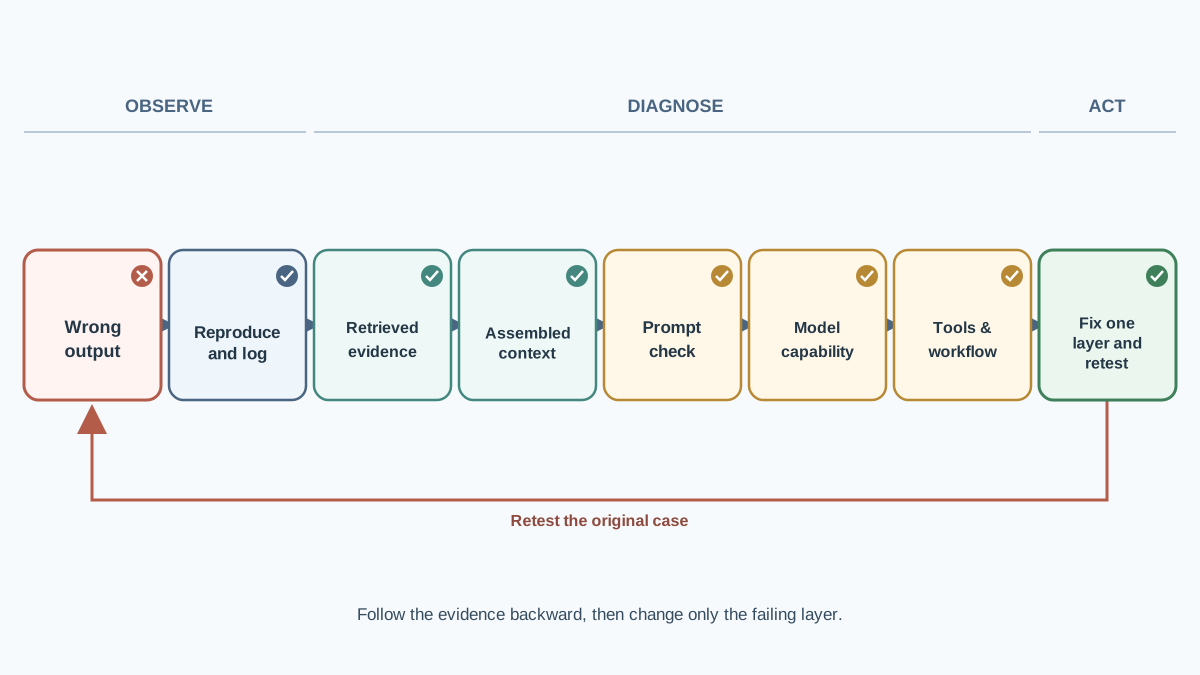
Once you have a reproduced failure and a logged run, work through the layers. The organizing principle is evidence-first: inspect what the model actually saw before you blame the model, and trace backward to how that input was assembled.
Check retrieval first. In a RAG system—one that retrieves documents before generation—did the right evidence even reach the model? Inspect the retrieved documents independently from the generated answer. If the relevant fact is missing from the context, retrieval is your problem—not the prompt, not the model.
Check the context and data. Was the needed fact present, current, and unambiguous in what the model saw? Sometimes retrieval returns the right document, but the document is outdated, contradicts another source, or buries the answer in irrelevant text. The model can only work with what you gave it. If the source itself is wrong, no retrieval tweak will save you.
Check the prompt. Is the task ambiguous? Is the output format underspecified? Does a later instruction contradict an earlier one? Prompt problems are real, but they are one suspect among several—not the default culprit.
Check the model. Is this a capability limit? A version regression? A temperature setting that produces too much variance for your use case? If the model cannot reason about the task, no prompt will fix it.
Check tools and workflow. Did a tool return bad data? Did a schema mismatch break a function call? Did an orchestration step—the code that sequences steps and passes state—drop information between calls? In agentic systems, failures often cascade from an early step into a confusing final output.
Each check produces a hypothesis, not a verdict. The decisive move is confirmation: inspect the exact retrieved passages, or remove retrieval and test with a known-good context, or compare a stronger model on the same input. That is how you separate a suspicion from proof.
Knowledge check
Check your understanding
Answer this question before you continue.
A Worked Case: The Wrong Policy Citation
Suppose your support assistant answers questions from a policy manual. A user asks about the refund window, and the assistant confidently cites a 14-day policy. Your manual says 30 days. Where is the fault?
The symptom—a confident wrong fact—points at context or retrieval, but it does not decide between them. Run the triage.
First, reproduce the case. The wrong answer appears consistently across five runs, so this is not noise.
Next, inspect the retrieved passages. The retrieval step returned a document titled "Refund Policy," but the passage inside it covers return conditions for damaged items, not the refund window. The relevant section exists in the manual but never made it into the context. Retrieval is the failing layer.
The smallest effective fix is not a sharper prompt. It is a retrieval improvement: better chunking so the refund-window section stands alone, or a query rewrite that targets the specific question. After the fix, re-run the original case and a few neighboring policy questions to confirm you did not break adjacent behavior.
Now imagine the same symptom with different evidence. The retrieved passages contain the correct 30-day policy, but the assistant still says 14 days. That points to the prompt or the model. If the system prompt says "prioritize the most recent policy update" and an older 14-day policy also appears in context, you have an instruction conflict. If the context is clean and the instructions are unambiguous, the model may simply be the wrong tool for this reasoning task.
Same visible failure. Different confirmed layer. Different fix.
Knowledge check
Check your understanding
Answer this question before you continue.
Pick the Smallest Effective Fix
Once you have confirmed the failing layer, resist the urge to fix everything at once. Change one variable and re-test.
Match the fix to the layer:
- Prompt ambiguity gets a prompt fix.
- Missing context gets a retrieval or data fix.
- A tool schema error gets a code fix.
- A model capability limit gets a different model or a different approach.
The classic mistake is fixing a retrieval gap by adding more prompt instructions. You are treating the symptom, not the cause. The model cannot reason from evidence it never received, no matter how eloquently you ask it to.
After the fix, re-run the original failing case. Then run a few neighboring cases to confirm you did not break adjacent behavior. This is where a small fixed case set pays off. If you have a handful of representative inputs with known-good outputs, you can verify that your fix improved the target case without regressing the others.
A Triage Order You Can Reuse
Here is the full sequence, compressed into something you can apply to the next failure:
- Reproduce. Run the case several times. Confirm the failure is systematic, not noise.
- Capture evidence. Log the prompt, model version, parameters, retrieved context, tool calls, and output.
- Check retrieval. Did the right evidence reach the model?
- Check context and data. Was the needed fact present, current, and unambiguous?
- Check the prompt. Was the task or format underspecified?
- Check the model. Is this a capability limit or parameter issue?
- Check tools and workflow. Did a call fail or state get dropped?
- Fix the smallest layer. Change one variable. Re-test the failing case and its neighbors.
The order is a heuristic, not a law. Inspecting retrieved documents costs seconds. Switching models or redesigning a workflow costs hours. Work from the cheapest evidence toward the most expensive intervention—but if the model input and output are inconsistent with each other, check tools and workflow before you blame the model. A dropped tool result upstream can explain why the final context looks wrong.
Know when to stop. If the failure is a genuine model capability limit, no prompt edit will fix it. Change your approach—use a stronger model, decompose the task, or accept the boundary. The triage order tells you when you have hit that wall, which saves you from burning an afternoon on prompt variations that cannot work.
The next time a bad output tempts you into another prompt rewrite, stop. Take one recent confusing failure and run it through this order. Identify which layer actually failed before you make any edit. Each failure is evidence about your system—read it before you react to it.
Knowledge check
Final check
Finish the article by checking the ideas you just learned.
References
Research updated Sep 7, 2026


