
LLM Accuracy vs Reliability: Why One Good Answer Proves Little
You run a few prompts. The answers are sharp, detailed, exactly what you wanted. Three for three. The system is ready, you conclude. Time to ship it.

Key topics
You run a few prompts. The answers are sharp, detailed, exactly what you wanted. Three for three. The system is ready, you conclude. Time to ship it.
That conclusion is the most expensive mistake beginners make with LLM applications. A handful of impressive outputs tells you what the model can do. It tells you almost nothing about what it will reliably do when real users arrive with messy phrasing, missing context, and edge cases you never imagined. The gap between those two things is where dependable applications are built—and where demo-grade tools quietly fall apart.
The Demo Trap: Three Good Answers Is Not Evidence
The scene is familiar. You're building something—a support chatbot, a summarization tool, an extraction pipeline. You test it with a few well-chosen prompts. The model handles them gracefully. You show the results to a colleague, get the nod, and start planning the launch.
Here's the weak mental model underneath that confidence: treating single correct outputs as proof of dependable behavior.
A model can be right sometimes and still be unreliable in ways that matter. It can nail your three test prompts and then contradict itself when a user rephrases the same question. It can handle clean, complete inputs and fail on the slightly broken ones real users actually type. It can give you the right answer on the first run and a different answer on the second.
The central question isn't whether the model is capable of good answers. It's whether the system you've built around it delivers good answers consistently—across rephrasings, edge cases, missing data, and repeated runs. That distinction between what a model can do and what it reliably does is the difference between a demo and a product.
Knowledge check
Check your understanding
Answer this question before you continue.
Accuracy vs Reliability: Two Different Questions
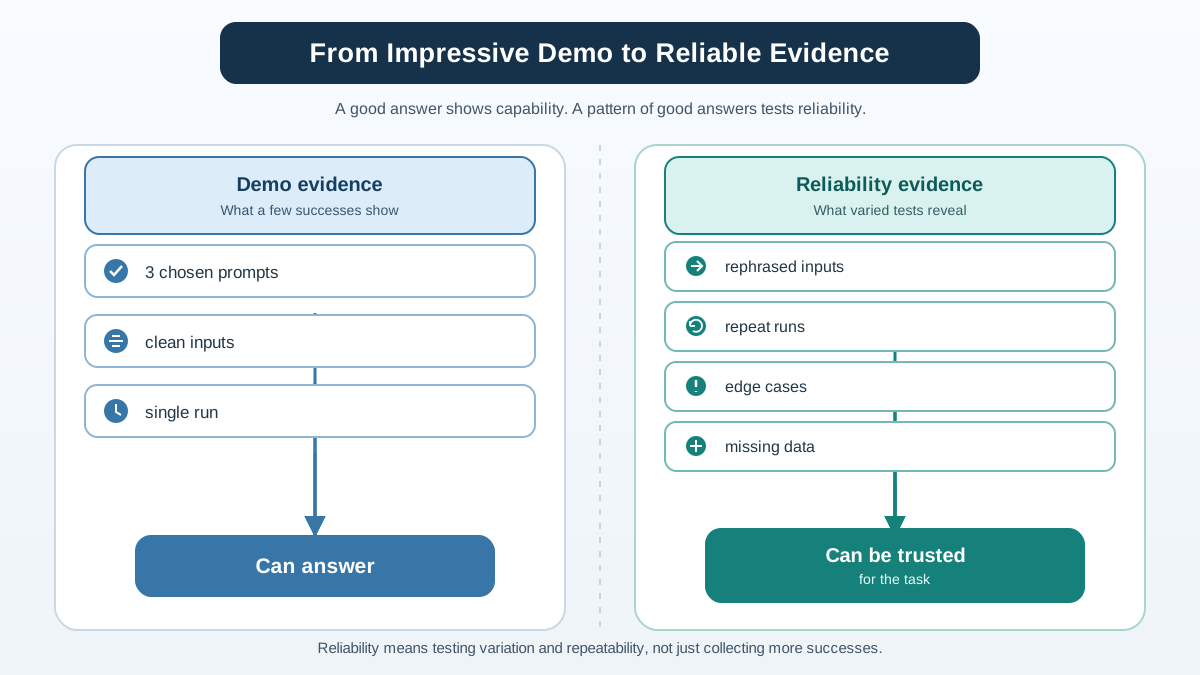
Part of the confusion comes from everyday language. When we say something is "reliable," we usually mean it's both correct and consistent. The car starts every morning and gets us where we're going. But in LLM evaluation, these are separate questions that need separate answers.
Accuracy asks: how often is the model correct against a known standard? If you have 100 questions with verified answers and the model gets 85 right, that's 85% accuracy. It's a measurement against ground truth.
Reliability, in its narrow measurement sense, asks: how consistent and repeatable is the model's behavior? Does the same question produce the same answer across rephrasings? Does it give stable results across repeated runs?
The key insight is that these can diverge sharply. A system can be accurate on a test set yet unreliable in production, because the test set didn't cover the messy variety of real inputs. And a system can be reliable yet inaccurate—consistently wrong in the same way.
Consider a weather forecaster who predicts sunshine every single day. In a desert, that forecaster is highly reliable: same prediction, every day, no surprises. The forecaster is also frequently wrong when a storm rolls in. Reliability without accuracy is just confident repetition of error.
The reverse matters more for LLM applications. A model that gives the right answer on your test cases but produces different, contradictory answers when users rephrase their questions is accurate on your tests and unreliable where it counts. You can't trust the system because you can't predict which run will be the good one.
Knowledge check
Check your understanding
Answer this question before you continue.
The Three Ways Reliability Breaks
Reliability failures tend to show up in three recognizable patterns. Once you know what to look for, you'll start seeing them everywhere.
Rephrasing sensitivity. The same question, asked with slightly different wording, produces different or contradictory answers. Ask a support bot "How do I reset my password?" and then "I forgot my password, what now?" If the first returns clear steps and the second returns a policy explanation that never mentions the reset flow, the system is prompt-sensitive in a way that will frustrate real users. They won't know they need to phrase things in the one specific way the model handles well.
Edge cases and missing data. Ordinary inputs work fine. Rare, unexpected, or incomplete ones don't. A summarization tool that handles clean articles gracefully might produce confident nonsense when given a page that's mostly boilerplate or missing its main content. An extraction pipeline that pulls dates and amounts from standard invoices might silently guess when a field is blank. The system wasn't tested on the broken edge, so it fails without warning.
Run-to-run variance. Generation is stochastic. The same input can return different answers across repeated calls. Sometimes the differences are trivial—slightly different wording, same meaning. Sometimes they're not. Ask a model to classify a support ticket as "refund" or "technical issue" five times, and you might get four refunds and one technical issue. For a human reviewer, that's an annoyance. For an automated pipeline making decisions without review, it's a reliability failure with real consequences.
These aren't exotic problems. They're the ordinary texture of working with stochastic language models. The question is whether your evaluation process accounts for them.
Knowledge check
Check your understanding
Answer this question before you continue.
Why Confidence Is Not a Shortcut
When models are uncertain, they often sound certain. A model can state an answer with high confidence and be wrong. It can also be confident and inconsistent—giving different answers on different runs, each delivered with the same assured tone.
This is where the concept of calibration enters. Calibration asks whether a model's stated confidence matches its actual rate of being correct. A perfectly calibrated model that says it's 90% confident should be right about nine times out of ten.
But here's the catch: even a perfectly calibrated model can be unreliable. If a model gives different evaluations of the same input on different runs—each with accurate confidence scores—you still don't know which run to trust. The inconsistency itself destroys trust, regardless of how well the confidence scores reflect reality.
Confidence tells you how sure the model is. It doesn't tell you whether the model will be sure the same way twice. For that, you need consistency.
Knowledge check
Check your understanding
Answer this question before you continue.
A Comparison Table: Accuracy, Consistency, Robustness, Reliability
These four terms get thrown around interchangeably, but they measure different things. Here's a compact reference:
| Term | What it measures | The question it answers |
|---|---|---|
| Accuracy | How often outputs are correct against ground truth | Is the answer right? |
| Consistency | Whether similar inputs produce similar outputs | Does the model agree with itself? |
| Robustness | Whether behavior holds under edge cases, rephrasings, and degraded inputs | Does the system survive unusual conditions? |
| Reliability | Whether the system meets its required behavior across the conditions that matter for your task | Can I trust this system with real work? |
Notice what reliability is not: it's not an average of the other three columns. A system can score well on accuracy, consistency, and robustness individually and still fail your reliability bar if those properties don't hold for the specific inputs, users, and failure modes your application actually faces. Reliability is a product-level judgment against a stated task contract, not a score you can compute by combining the other metrics.
The decision rule that follows: judge an application by reliability across varied and repeated inputs, not by accuracy on a handful of chosen examples. A model that's 95% accurate on your curated test set but falls apart when users rephrase questions is not a 95% reliable system. It's an accurate system with a robustness problem—which makes it unreliable where it matters.
How to Test for Reliability Yourself
You don't need a full evaluation harness to start checking reliability. A few minutes of deliberate testing will reveal more than hours of admiring good outputs.
Rephrase the same question three or four ways. Ask "What's your refund policy?" then "Can I get my money back?" then "How do returns work?" Compare the answers against the task your application promises. Do they agree on the core facts? Do they contradict each other? Watch for the difference between harmless paraphrase and a changed decision or unsupported claim. If one version says "refunds within 30 days" and another says "refunds within 14 days," that's not stylistic variation—it's a contradiction that will cost you.
Run the same input multiple times. Send the identical prompt through several times and compare results. Watch for run-to-run variance. If the model gives different answers to the same question, you've found a reliability gap. Again, compare at the task level: different wording with the same meaning is fine; different classifications, extracted fields, or actions are not.
Throw in one edge case and one input with missing data. Give the system something unusual—a very long input, a strangely formatted one, a question with ambiguous context. Then give it something incomplete. See whether it handles the gap gracefully or fills it with confident invention.
This lightweight manual testing won't replace a proper evaluation set, but it will tell you quickly whether your system has a reliability problem worth addressing. When you're ready to go deeper, assembling a representative set of test cases with expected criteria is the natural next step—it turns these ad hoc checks into a repeatable process you can run after every change.
When to Care Most About Reliability
Not every application needs the same reliability bar. The mistake is assuming yours doesn't need one at all.
High-stakes uses demand high reliability. Customer-facing answers, medical or financial guidance, automated decisions—these have real costs when a single run goes wrong. A chatbot that gives contradictory refund policies to different customers isn't just inconsistent; it's creating liability. An automated system that misclassifies a support ticket because of run-to-run variance isn't quirky; it's broken.
Low-stakes or creative uses can tolerate inconsistency. Brainstorming, drafting, exploration—these benefit from variety. If a model gives you three different angles on a marketing message across three runs, that's a feature, not a bug. The user reviews and selects; inconsistency becomes optionality.
The decision rule has two parts. First, consider consequence and reversibility: reliability requirements rise when errors are costly, hard to detect, irreversible, or applied automatically. Second, consider human review: the more the output is consumed without a person checking it, the more reliability matters. A tool that drafts ideas for a human to refine can afford inconsistency. A tool that answers customers directly cannot. And a tool that produces a legally or financially consequential recommendation needs strong correctness and robustness even when a human reviews it—because the reviewer may not catch a confidently wrong answer.
The common mistake is treating a demo-grade tool as production-grade because the underlying model is capable. The model's capability is not your system's reliability. Your system includes the prompts, the context, the error handling, and the review process. All of it needs testing.
Stop judging LLM applications from a few impressive outputs. Start testing them across rephrasings, edge cases, and repeated runs. The model's capability is the raw material. Reliability is what you build with it—and what your users will actually experience.
Knowledge check
Final check
Finish the article by checking the ideas you just learned.
References
Research updated Sep 7, 2026


