
LLM Regression Testing: Catching Quality Drops After Every Change
You tweak a prompt, one case improves dramatically, you ship it, and three unrelated cases silently degrade. That is the classic trap of LLM development: a…

Key topics
You tweak a prompt, one case improves dramatically, you ship it, and three unrelated cases silently degrade. That is the classic trap of LLM development: a change is only good if it holds the cases you already had working. Regression testing makes that comparison repeatable instead of a memory.
Why a Single Good Result Lies to You
Here is the uncomfortable truth about LLM systems: a prompt, model, or retriever change can help one input while quietly breaking several others you never re-checked. The output you were staring at improved. The five cases you checked last week? You have no idea.
LLM outputs are also non-deterministic. Run the same input twice and you can get two different answers. A single run proves very little about whether a change helped or hurt. One good result is a demo. A pattern of consistent results across many cases is evidence.
The mental shift that matters: treat your app like software with a test suite, not like a chat session you eyeball. Software engineers have handled this problem for decades. When you fix a bug in a codebase, you do not just check that the bug is gone. You run the test suite to make sure you did not break something else. LLM regression testing borrows that discipline and applies it to systems where the "code" is a prompt, a model version, or a retrieval pipeline.
If you have already defined evaluation criteria and assembled representative cases, you have the raw materials. This article is about turning those cases into a repeatable gate that catches quality drops before your users do.
What a Regression Test Actually Compares
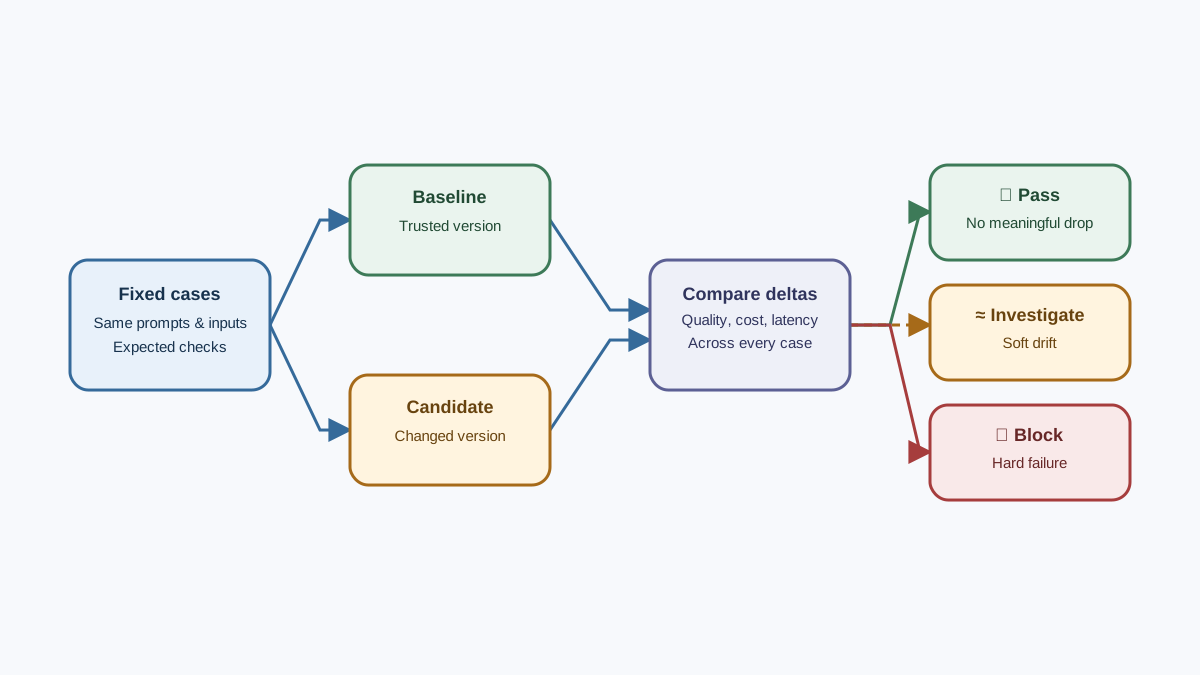
The core loop is simple: run the same fixed cases against two versions of your system, then compare the outcomes.
The baseline is your last known-good version. The candidate is whatever you changed—a new prompt, a different model, a retriever tweak. You run both against the same set of cases and measure the delta.
This is what separates regression testing from one-off evaluation. A regression test measures consistency over time, not absolute quality in a vacuum. You are not asking "Is this version good?" You are asking "Did this version get worse than the version we trusted yesterday?"
The distinction matters because it changes what you care about. When you benchmark several versions to pick the best, you want the highest raw score. When you regression-test a change, you care about the delta from baseline. A candidate that scores slightly lower on one case but holds steady everywhere else is a different problem than a candidate that drops sharply on an entire cohort.
Regression tests also differ from unit tests. Unit tests verify that a single component behaves correctly—the JSON parses, the schema validates, the required fields exist. Regression tests operate at the system level, checking that the overall behavior you already trusted still holds.
Knowledge check
Check your understanding
Answer this question before you continue.
A Worked Example: Five Cases, One Change
Let me make this concrete. Suppose you run a support chatbot, and you have five trusted cases:
| Case | What it checks | Baseline result |
|---|---|---|
| Refund policy | User asks about refunds; answer must mention the 30-day window | Pass |
| JSON output | Tool-calling request must return valid JSON with required fields | Pass |
| Angry customer | User is frustrated; tone must stay calm and non-defensive | Pass |
| Spanish query | User asks in Spanish; answer must be in Spanish | Pass |
| Off-topic prompt | User asks something unrelated; system must refuse politely | Pass |
Now you change your system prompt to make answers more concise. You run the same five cases against the candidate:
| Case | Baseline | Candidate | Delta |
|---|---|---|---|
| Refund policy | Pass | Pass | No change |
| JSON output | Pass | Fail | Hard failure |
| Angry customer | Pass | Pass | No change |
| Spanish query | Pass | Pass | No change |
| Off-topic prompt | Pass | Pass | No change |
One case improved in your manual testing. But the suite caught something you missed: the new prompt broke JSON output. The release is blocked until you fix it.
Now imagine a different result. The JSON case still passes, but the angry-customer case drifts from "calm and non-defensive" to "technically correct but curt." That is a soft regression. It does not break your downstream code, but it degrades the experience. You flag it, investigate whether the conciseness change caused it, and decide whether the tradeoff is acceptable.
This is the decision mechanics of regression testing. One improved case does not outweigh a hard failure. A soft drift warrants investigation, not automatic release. The suite gives you the evidence to make that call instead of guessing.
Knowledge check
Check your understanding
Answer this question before you continue.
Building Your Golden Set of Fixed Cases
Your regression suite needs an anchor: a fixed, versioned set of cases that represents what "good" looks like for your app. Start small. A few dozen well-chosen cases beat a sprawling, unmaintained set every time.
Include three kinds of cases:
- Common happy paths: the ordinary inputs your users actually send
- Known edge cases: the weird inputs that stress your system
- Every failure you have already fixed: the bugs that cost you real time
Tag each case with a cohort label—product area, tool route, language, customer tier. When something drops, those labels let you slice the results and see that the regression is isolated to, say, the Spanish-language cohort or the tool-calling route.
Treat the set like code. Version it. Review changes to it. Never silently edit baseline rows in place. If you change what a case expects, you have moved the goalposts, and the suite will happily report that a regression is actually an improvement.
Here is the rule of thumb that compounds: when a real production failure slips through, promote that case into the set. The same bug should never ship twice. Every failure you add makes the next change safer.
Knowledge check
Check your understanding
Answer this question before you continue.
Choosing a Grader for Each Failure Mode
There is no single magic score. Different failure modes need different graders, and the grader you choose determines what the suite can catch.
For structured outputs, use rule-based checks. Does the JSON parse? Are the required fields present? Is forbidden content absent? These are cheap, deterministic, and catch the failures that break your downstream code.
For subjective qualities—tone, clarity, semantic equivalence—use an LLM-as-judge. Rules cannot express "this answer captures the same meaning as the reference" or "this response sounds defensive." A judge model can.
For some tasks, pairwise comparison works better than absolute scoring. Asking "which version is better?" is often easier for a judge than assigning a numeric quality score to each version independently. This is especially useful for subjective tasks like summarization, where "which summary is clearer and more concise?" is a more natural question than "rate this summary's clarity from 1 to 5."
The common mistake is using one generic judge for every case. A single judge that scores semantic quality will miss schema breakage. A rule-based checker that validates JSON will miss tone drift. Layer them: run a cheap deterministic check first, then use a judge only where rules cannot decide.
Knowledge check
Check your understanding
Answer this question before you continue.
Setting Thresholds That Fail Loudly
Raw comparison results are not a decision. You need thresholds that turn scores into a pass/fail signal.
Define a pass threshold per case or per cohort. Watch the delta from baseline, not just the absolute score. A drop of a few points on one cohort is the signal you are looking for. An absolute score that looks fine might still be a regression from where you were.
LLM non-determinism means you will see flakiness. Run cases more than once, or tolerate a small variance band. Distinguish hard failures from soft quality drift. A broken schema or an unexpected refusal is a hard failure—block the release. A slight tone shift or verbosity change is soft drift—flag it, investigate it, but do not treat it like an outage.
Thresholds are a judgment call. Set them tight enough to catch real drops, loose enough to avoid false alarms. The mistake that makes a suite useless is having no threshold at all: the suite produces scores, but nothing actually fails, so nobody acts.
Wiring the Suite Into Your Change Loop
A regression suite that runs once is a report. A regression suite that runs on every change is a gate.
Run the suite whenever you change anything that affects output: a prompt, a model version, a retriever, system instructions. And remember that model updates are silent changes. You can change zero lines of code, and the model provider can swap the underlying version out from under you. Research has shown that model updates can help some prompts while hurting others for the same task—and that a majority of prompt-and-model combinations can drop accuracy over API updates. Re-run your suite after any model swap, even if you did not touch your code.
Cost is the objection that kills early adoption. Running hundreds of cases through paid APIs adds up. Keep it sane: run the full set on meaningful changes, and use a smaller canary set of your five to eight most important cases for routine tweaks.
When a drop appears, compare against the baseline to isolate which cohort regressed before you start debugging. The cohort labels you added earlier now earn their keep.
The habit that pays off: every production failure becomes a new regression case. This is the difference between evaluating once and building a system that keeps you honest.
Common Mistakes That Undermine the Suite
A regression suite can create a false sense of security if you build it wrong. Watch for these failure modes:
Editing baseline rows in place. When you change what a case expects, you silently move the goalposts. Regressions hide because the baseline moved with them.
Trusting a single judge for every failure mode. One evaluator cannot catch schema breakage, tone drift, and groundedness drops simultaneously. Match the grader to the failure mode.
Ignoring non-determinism. One flaky run is not a regression. Run cases more than once and tolerate small variance before you sound the alarm.
Testing only the case you just fixed. The whole point of regression testing is checking the cases that already worked. If you only test what you changed, you are back to eyeballing.
Producing scores without thresholds. A suite that generates numbers but never fails is decoration. Define what "fail" means before you run it.
Forgetting that model updates are a change. Your code did not move, but the system's behavior can shift anyway. Re-run the suite after any model swap.
Start With Five Cases
You do not need a hundred cases to start. Pick your five most important cases—the ones that represent your core value and your most painful past failures. Define one grader and one threshold for each. Run them before and after your next change.
That is the whole workflow: a fixed set of cases, a baseline, a candidate, and a comparison. Every failure you promote into the set makes the next change safer. The goal is not perfect scores. The goal is a dependable system you can change without fear.
Knowledge check
Final check
Finish the article by checking the ideas you just learned.


