
LLM-as-a-Judge Evaluation: When Model Graders Help and Mislead
An LLM judge will grade your outputs instantly, cheaply, and at scale. It will also quietly reward verbose answers, favor responses that sound like itself,…

Key topics
An LLM judge will grade your outputs instantly, cheaply, and at scale. It will also quietly reward verbose answers, favor responses that sound like itself, and miss real errors with complete confidence. The hard part is not calling the judge API. The hard part is knowing whether its verdict means anything.
Here is the builder's rule: an LLM judge is a measurement instrument, not an oracle. You calibrate instruments before you trust their readings.
Why You Need a Grader at All
You already have an evaluation set with criteria and failure labels. You have cases that represent real user requests, edge conditions, and known failure modes. Now you face the question this article is about: who or what grades those cases?
Manual human review works when you have a few dozen outputs. Past that, it becomes a bottleneck. You cannot read every response your system produces, and you certainly cannot re-read them after every prompt tweak or model change.
Deterministic checks—exact match, regex, schema validation—handle the checks that have a single right answer. But most of what matters in production has no single right answer. Is this summary faithful to the source? Is this tone on-brand? Is this answer actually helpful, or just confident? These qualities require something that understands language.
That is the gap LLM-as-a-judge evaluation fills. It is an automated grader for the semantic qualities that rules cannot capture.
Knowledge check
Check your understanding
Answer this question before you continue.
What an LLM Judge Actually Does
The mechanism is simpler than the name suggests. A judge model receives three things: the original input, the output you want graded, and a rubric that defines what "good" looks like. It returns a score, a verdict, or a preference between two outputs.
Three modes are common:
- Pointwise scoring: the judge rates one output against your criteria, often on a numeric scale.
- Pairwise comparison: the judge sees two outputs for the same input and picks the better one.
- Classification: the judge assigns the output to a category, such as "faithful" or "hallucinated."
Most implementations also ask the judge to explain its reasoning alongside the score. That rationale is not decoration. It is your main window into whether the judge understood the task, and it becomes the most useful tool you have when scores go wrong.
Here is the leverage that makes the approach attractive: because criteria are expressed in natural language, the same judge model can grade entirely different tasks by changing the prompt. No retraining, no new pipeline. You want faithfulness today and brand tone tomorrow? Swap the rubric.
That flexibility is real. It is also the source of most of the trouble ahead.
Knowledge check
Check your understanding
Answer this question before you continue.
Where Model Graders Help
LLM judges earn their keep in a specific territory: open-ended outputs where a human would apply judgment. Summarization quality, tone compliance, helpfulness, faithfulness to a source—these are tasks where a rubric in natural language maps naturally onto what you care about.
The strongest fit is regression testing across prompt or model changes. You run the same fixed cases through two versions of your system, grade both with the same judge, and compare relative scores. You are not asking for absolute truth. You are asking whether version B dropped relative to version A on the cases you already know matter.
Production monitoring on sampled traces is a similar story. The goal is catching degradation trends, not perfect per-item accuracy. A judge that flags "this week's faithfulness scores are drifting down" is doing its job even if individual scores are imperfect.
My rule of thumb: judges earn their keep when the alternative is either no measurement at all or a human bottleneck that stops you from iterating. If you can measure with code, do that. If you cannot measure at all, a calibrated judge beats blind guessing.
Knowledge check
Check your understanding
Answer this question before you continue.
The Failure Modes That Fool You
Here is where the seduction breaks. LLM judges have documented biases, and they will mislead you in predictable ways if you do not design against them.
Verbosity bias. Judges tend to reward longer, more elaborate answers over concise correct ones. This is a genuine problem when conciseness is part of your quality bar. Your judge may be silently training you to ship wordier outputs.
Self-preference and style bias. A judge tends to favor outputs that resemble its own phrasing, length, and style. If your judge model writes in a particular register, answers that match that register score higher regardless of quality.
Scale granularity. Judges are reliable at coarse decisions—binary correct/incorrect, or a simple 1–5 scale. As the scale gets finer, scores become arbitrary. A 1–10 rubric often produces noise dressed as precision.
Gaming and fragility. Persuasive but empty outputs can trick judges into high scores. Research has shown that even nonsense responses can earn high rankings when styled convincingly. Your judge can be fooled by the same rhetorical polish that fools human readers, minus the substance check.
Misleading agreement. High agreement on overall rankings can hide substantial disagreement on individual judgments. A judge can look calibrated while being wrong on exactly the cases you care about—the edge cases, the failure modes, the subtle errors.
The common thread: a judge can be confidently wrong. The score arrives with the authority of a number, but the number is only as sound as the rubric that produced it.
Designing a Rubric That Reduces Bias
Good rubric design is your primary defense against these failure modes. The rubric is where you encode what quality means, and vague rubrics produce biased judgments.
Define each criterion as observable behavior, not a vibe. "Good answer" tells the judge nothing. "Factually accurate and grounded in the provided context" tells it what to check. The more you can describe what you would point at in a bad answer, the better the judge can identify one.
Keep the scoring scale coarse. Prefer a small number of distinct levels with concrete anchors. Instead of "score from 1 to 10," try: "Score 1 if the answer contains a factual error. Score 2 if it is accurate but misses a required element. Score 3 if it is accurate, complete, and well-grounded." Each level describes what it looks like, so the judge is classifying rather than guessing at degrees.
Separate criteria into independent dimensions. Correctness, faithfulness, and tone are different failures. If you fold them into one overall score, a strong tone can mask a factual error. Grade each dimension separately, and you can see which one is actually degrading.
Break fuzzy criteria into explicit steps. When a criterion is interpreted inconsistently, do not expect the judge to infer your intent. Spell out the evaluation steps: "First, check whether every factual claim appears in the source. Second, check whether the answer introduces claims not present in the source. Third, assign the faithfulness score based on the results of steps one and two."
Give the judge what it needs—and tell it what to ignore. Include source material for faithfulness checks, ground truth when you have it, and the original user request. Also state what should not influence the score, such as answer length or stylistic flair.
Common mistake: Writing a rubric that describes your ideal output instead of describing the behaviors that distinguish good from bad. The judge does not need inspiration. It needs a checklist.
Knowledge check
Check your understanding
Answer this question before you continue.
Calibrating Your Judge Against Human Labels
No rubric survives contact with reality unexamined. Before you trust any automated score, you need to know whether the judge agrees with how a human would label the same cases.
The core practice is straightforward. Take a small set of human-annotated cases from your evaluation set—the one you already built with criteria and failure labels. Run the judge on those same cases. Compare its verdicts against the human labels.
Measure agreement on individual judgments, not just overall ranking agreement. Ranking agreement can hide systematic disagreement. You want to know: on this specific case, did the judge call it the way you would? If it disagreed, was the disagreement random or patterned?
Expect moderate-to-strong but imperfect agreement. Even human evaluators disagree with each other. The goal is a judge "good enough" for your decision, not a perfect one. If your judge matches human labels on the cases that matter most—your known failure modes, your edge cases—that is the signal you need.
When agreement is poor, iterate. Tighten the rubric. Add examples of what each score level looks like. Split a fuzzy criterion into explicit steps. If the rubric is already sharp and the judge still disagrees, consider a stronger judge model.
Treat calibration as ongoing, not one-time. As your product, prompts, or criteria change, re-check that the judge still agrees with your standards. A judge calibrated on last quarter's outputs may not grade this quarter's correctly.
When Not to Use an LLM Judge
The decision boundary matters as much as the technique itself.
If the check is deterministic, use code. Exact match, schema validation, format rules—these do not need a judge. A judge adds cost and noise to something a rule can answer exactly.
If the task has a verifiable correct answer, prefer a direct check. Reference-based comparison or a correctness check beats a judge's semantic guess. Judges are for open-ended quality, not for known answers.
If the stakes are high, a judge is a screening layer at best. Legal, medical, and safety-critical outputs need human review. A judge can flag suspicious cases for human attention, but it should never be the final authority.
If you cannot assemble even a small set of human labels to calibrate against, slow down. Without calibration, you have no idea what the judge's scores mean. You are trusting an instrument you have never tested.
A Practical Calibration Workflow
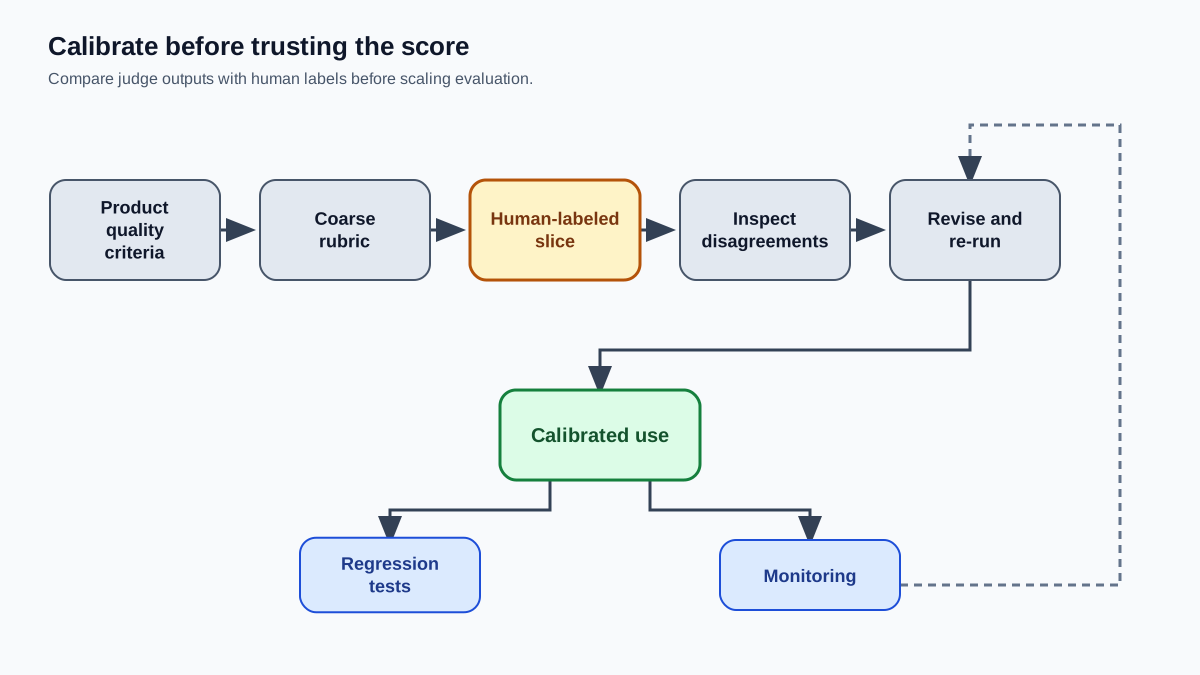
Here is the sequence I would run, start to finish:
Step 1: Pick the criteria that map to real product quality. Not what is easy to grade—what actually determines whether your users get value. If conciseness matters to your users, grade conciseness even though the judge will be biased against it.
Step 2: Write a coarse rubric with observable anchors. Define each level by behavior. Include the context the judge needs and state what it should ignore.
Step 3: Run the judge on a small human-labeled slice of your evaluation set. Compute per-item agreement, not just overall correlation.
Step 4: Inspect the disagreements. Read the judge's reasoning on the cases where it diverged from the human label. Name the pattern. Is it verbosity bias? Is it a criterion the judge keeps misinterpreting? Is it a case type your rubric does not cover?
Step 5: Fix the rubric or judge, re-run, and only then trust the scores. The fix might be sharper anchors, explicit evaluation steps, or a different model. Re-run until the disagreements are ones you can live with.
Then use the calibrated judge for regression testing and monitoring—and re-check it when your system changes.
An LLM judge is a measurement instrument, and instruments need calibration before their readings mean anything. The score is not the truth. It is a reading produced by a rubric you wrote and a model you chose. When you treat it that way, it becomes one of the most useful tools in your evaluation stack.
Your next move: take a small slice of your existing evaluation set, hand-label it if you have not already, run a judge against it, and inspect the disagreements. That inspection will teach you more about your judge—and your rubric—than any guide can. Once you have a calibrated judge, you are ready to wire it into regression testing and catch quality drops after every change.
Knowledge check
Final check
Finish the article by checking the ideas you just learned.
References
Research updated Sep 7, 2026


