
Human-in-the-Loop LLM Systems: Where Review Belongs
The most common mistake I see when teams first put an LLM into a real workflow is also the most understandable one: they bolt a human approval step onto…

Key topics
The most common mistake I see when teams first put an LLM into a real workflow is also the most understandable one: they bolt a human approval step onto everything. Every output gets reviewed. Every action waits for a click. The result is a system that feels safe but isn't—because reviewers stop reading, approvals become rubber stamps, and the one error that matters slips through in a stream of noise.
More human review is not the same as better human oversight. Review is a targeted control, not a blanket layer. The question is not whether to add humans, but where the human actually changes the outcome.
Why "Add a Human Reviewer" Is Not a Safety Strategy
The instinct makes sense. An LLM can produce confident, fluent, completely wrong output. If you cannot trust the model, you add a checkpoint. The problem is that a checkpoint you apply to everything becomes a checkpoint you apply to nothing.
Reviewer fatigue is real and predictable. When 98 percent of outputs pass without issue, the human brain learns to stop looking. The reviewer skims, clicks approve, and moves on. The gate is still there. It just stopped doing anything.
This is not a character flaw in reviewers. It is what happens to any person placed in front of a high-volume, low-signal approval queue. The system trains them to rubber-stamp.
There is also a quieter cost: false confidence. A workflow with a decorative approval gate feels safer than one without it, which means the team pays less attention to the actual failure modes. The gate becomes a security blanket that hides the fact that nobody is really watching.
The reframe is simple: human review is a control you place at a decision boundary, not a layer you add to the whole pipeline. And the way to find those boundaries is to ask four questions about each step in your workflow.
The Four Questions That Decide Where Review Belongs
Before you design any human-in-the-loop LLM system, run every workflow step through these four questions. But do not treat them as four equal triggers. They play different roles.
Impact and reversibility set the consequence boundary. These two questions define how bad a mistake can be. Impact asks: what is the cost if the output is wrong? A wrong email draft costs a few minutes of embarrassment. A wrong SQL delete costs a customer database. A wrong payment instruction costs real money. Reversibility asks: can the action be undone cheaply? Drafting an email is reversible—you read it before you send it, and even after sending, the damage is limited. Deleting records is not reversible. Sending a payment is not reversible. Approving a plan that an agent will execute across multiple systems is effectively not reversible, because by the time you notice the error, the agent has already acted.
Uncertainty and verification determine whether the system can safely assess the step on its own. Uncertainty asks: how likely is the model to be wrong here? Some tasks are genuinely hard for an LLM—ambiguous instructions, novel situations, tasks requiring up-to-date knowledge. Others are routine. Verification asks: can an automated check confirm correctness? Some outputs can be verified by rules. A JSON response either parses or it does not. A number either falls in range or it does not. But many LLM outputs require judgment: Is this summary accurate? Is this tone appropriate for a regulatory submission? Is this source trustworthy for a medical claim?
Here is the priority rule: impact and reversibility decide whether a mistake is acceptable. Uncertainty and verification decide whether the system can be trusted to catch it without a human. A high-impact, irreversible action earns a human gate even when the model is almost always right. A low-impact, reversible action does not need one even when the model is frequently wrong—because the cost of letting the error through is trivial.
Consider two steps in the same workflow.
Drafting a routine email reply: low impact, fully reversible, and the recipient will tell you if it is wrong. The model may occasionally produce an awkward phrase, but no human gate is needed. Let it fail cheaply and fix it later.
Executing a SQL delete against production: catastrophic impact, zero reversibility, and no automated check can confirm the deletion was a good idea. The model might be 99 percent reliable at generating the correct query. That does not matter. This step earns a human gate because the consequence boundary is unforgiving.
Now flip the uncertainty case. A model summarizing a messy, ambiguous support ticket may be wrong half the time—but the summary is a draft that a human will read anyway. High uncertainty, low impact, fully reversible. No gate required. The existing workflow already contains the human.
The four questions are not a scoring matrix. They are a filter with a built-in priority order.
Knowledge check
Check your understanding
Answer this question before you continue.
Where Human Review Actually Belongs in a Workflow
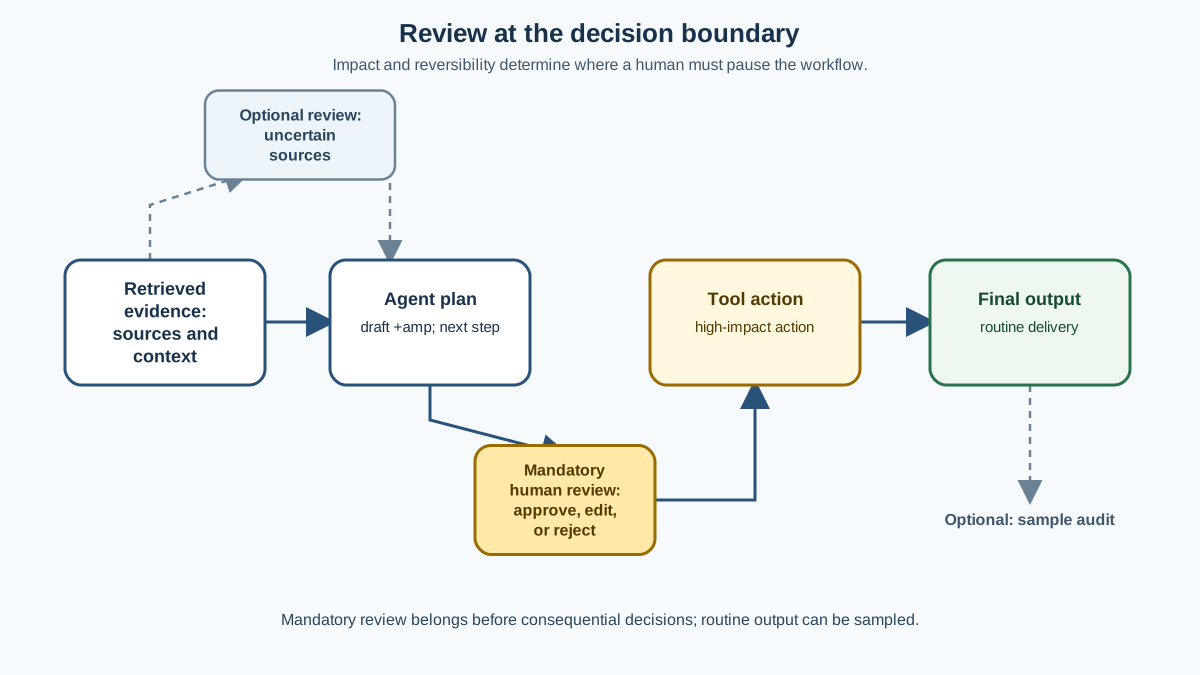
Once you have the filter, you can look at a workflow and see the natural review points. Most LLM workflows have four places where a human gate can sit, and each one protects against a different failure.
Review before action. The model wants to call a tool—execute a query, send a message, modify a file. The human approves or rejects the specific call before it executes. This is the right gate for irreversible operations. The reviewer sees the tool name and the arguments, not just a vague description of intent.
Review after generation. The model produces a final output—an email, a report, a code change—and the human checks it before it reaches the user or a downstream system. This gate works when the output is the product and the risk is in the content itself.
Review of the plan. Before an agent starts executing a multi-step task, it presents its plan. The human approves, edits, or rejects the plan before any action begins. This is one of the most powerful gates available, because it catches bad strategy before it becomes bad execution. A plan review can also be cheaper than reviewing every step: one decision instead of ten.
Review of retrieved evidence. In a RAG system, the model's answer is only as good as the sources it was given. A human can verify that the retrieved documents are relevant and trustworthy before the model generates an answer from them. This gate matters most in domains where source quality varies and bad sources produce confidently wrong answers.
Where does review usually not belong? On routine, low-impact, reversible outputs where automated checks or sampling suffice. If you have a validation rule that can catch the error, use the rule. If the error is cheap to fix, let it happen and fix it. If the output is one of a thousand similar outputs, review a sample instead of every item.
The same workflow can mix gates. An agent might draft responses autonomously, route anything containing a payment instruction to a human gate, and require plan approval only when the task involves external systems. Autonomy is not all-or-nothing.
Knowledge check
Check your understanding
Answer this question before you continue.
Where Review Happens vs. How Much Oversight You Apply
Before you choose an oversight model, separate two design questions that beginners often collapse into one. Where review happens is about placement: which specific step pauses for a human. How much oversight you apply is about frequency: whether every case pauses or only a sample does. These are independent dimensions, and you can combine them freely.
A mandatory pre-action gate on high-impact tool calls is one combination. A sampled post-run review of routine outputs is another. Both are legitimate human-in-the-loop designs; they just sit at different points on the frequency spectrum.
The spectrum has three main positions.
Human-in-the-loop means the system cannot proceed without human approval. The human is a required step in the process, not an observer. This is the right model for high-impact, irreversible, or hard-to-verify actions. It is slow and expensive, but it is the only model that guarantees a human sees the decision before it happens.
Human-on-the-loop means the system runs autonomously, but a human monitors and can intervene. The human watches dashboards, reviews samples, and steps in when something looks wrong. This model works for moderate-risk, high-volume work where reviewing every action would be impractical but full autonomy would be reckless.
Human-out-of-the-loop means fully autonomous operation. No human watches individual decisions. This is only appropriate for well-bounded, low-risk, reversible tasks where the cost of error is negligible.
| Oversight model | When to use it | What it costs | What it protects against |
|---|---|---|---|
| Human-in-the-loop | High impact, irreversible, hard to verify | Latency, reviewer workload | Wrong actions executing |
| Human-on-the-loop | Moderate risk, high volume | Monitoring infrastructure, sampling effort | Drift, systemic failures |
| Human-out-of-the-loop | Low risk, reversible, well-bounded | Minimal | Nothing—accept the risk |
Here is the practical path most teams should follow: start with human-in-the-loop during early pilots, even for steps you expect to automate later. Mandatory review on every output gives you two things—a baseline for how often the model is actually wrong, and a dataset of corrections you can learn from. As evidence accumulates that a step is reliable, relax it to human-on-the-loop with sampling audits. Let the data tell you when the human can step back.
Knowledge check
Check your understanding
Answer this question before you continue.
Designing a Review Gate That Reviewers Actually Use
A review gate is only as good as the context you give the reviewer. If you show a human a final answer and ask "approve or reject?" with no other information, you have built a rubber stamp. The reviewer cannot judge what they cannot see.
Give reviewers the full trace, not just the final output. What prompt did the model receive? What tools did it call, and with what arguments? What documents did it retrieve? The answer alone is often unverifiable; the path to the answer is where the errors live.
Provide a decision summary that states what is being approved. The reviewer should not have to reconstruct the context from raw logs. They should see: "The agent wants to execute this SQL delete against the production database. It retrieved these three documents. It plans to delete records older than 30 days." That is a decision a human can actually make.
Support granular decisions. Approve, reject, and edit are not the same action. Sometimes the plan is 90 percent right and needs one correction. If your only options are yes and no, the reviewer either approves a flawed plan or rejects a mostly good one and forces the whole workflow to restart.
Define what good looks like. A rubric with written criteria and examples produces far more consistent review than an instruction to "check quality." Reviewers should be able to point to the specific criterion a rejection is based on.
And remember the human failure modes. Reviewers default to approval when confidence scores are high, when the interface hides the reasoning, or when they have approved fifty similar outputs in a row. Sampling audits—where a second reviewer checks a random subset of approved outputs—keep the first reviewer honest. Rotating reviewers across different systems prevents the familiarity that breeds complacency.
Knowledge check
Check your understanding
Answer this question before you continue.
Common Mistakes When Adding Human Review
The failure modes are consistent enough that you can check your design against them.
Reviewing every output. This burns reviewer attention on low-risk work and buries the important failures in noise. Apply the four-question filter and review only what earns it.
Placing the gate after the action. If the irreversible thing has already happened, the review is theater. The gate must sit before the action it is protecting.
Giving reviewers no context. Forcing a human to approve blind, or to spend ten minutes reconstructing what the model did, guarantees either rubber-stamping or a bottleneck. The trace and the decision summary are not optional.
Treating human review as a substitute for evaluation. Review catches errors in production. Evaluation tells you how often errors happen and why. You need both. A review gate without an evaluation loop is a fire alarm with no fire department.
Forgetting that the reviewer is part of the system. If reviewers rubber-stamp, the gate is decorative. Design the interface, the incentives, and the audit process with that reality in mind.
A Simple Way to Start
You do not need to redesign your whole workflow today. Start with a map.
List every step in your LLM workflow where the model produces an output or takes an action. Score each step against the four questions. Then put a human gate on the single step that scores highest on impact or irreversibility and lowest on verifiability. Just one gate, placed where it changes the outcome.
Instrument that gate from day one. Log every approval, rejection, and edit. But do not mistake a high approval rate for proof that the gate works. A reviewer who approves everything may be looking at a genuinely safe step—or they may be rubber-stamping because they lack context or have simply stopped reading. The approval rate alone cannot tell you which.
Measure what the gate actually catches. Review a sample of approved cases to confirm they were sound. Track rejections and edits by severity, not just by count. A gate that catches one catastrophic error a month is earning its place even if it approves 99 percent of everything else. A gate that never catches anything consequential may be decorative—or may be protecting a step that is already safe. The evidence tells you which.
Use that early review data to decide which gates you can relax to human-on-the-loop or sampling, and which ones need to stay mandatory.
The goal is not more human review. It is review that sits exactly where it changes the outcome. Place it where impact is large, the action is hard to reverse, and no automated check can verify the result. Then let the evidence tell you when the human can step back.
Knowledge check
Final check
Finish the article by checking the ideas you just learned.
References
Research updated Sep 7, 2026


